
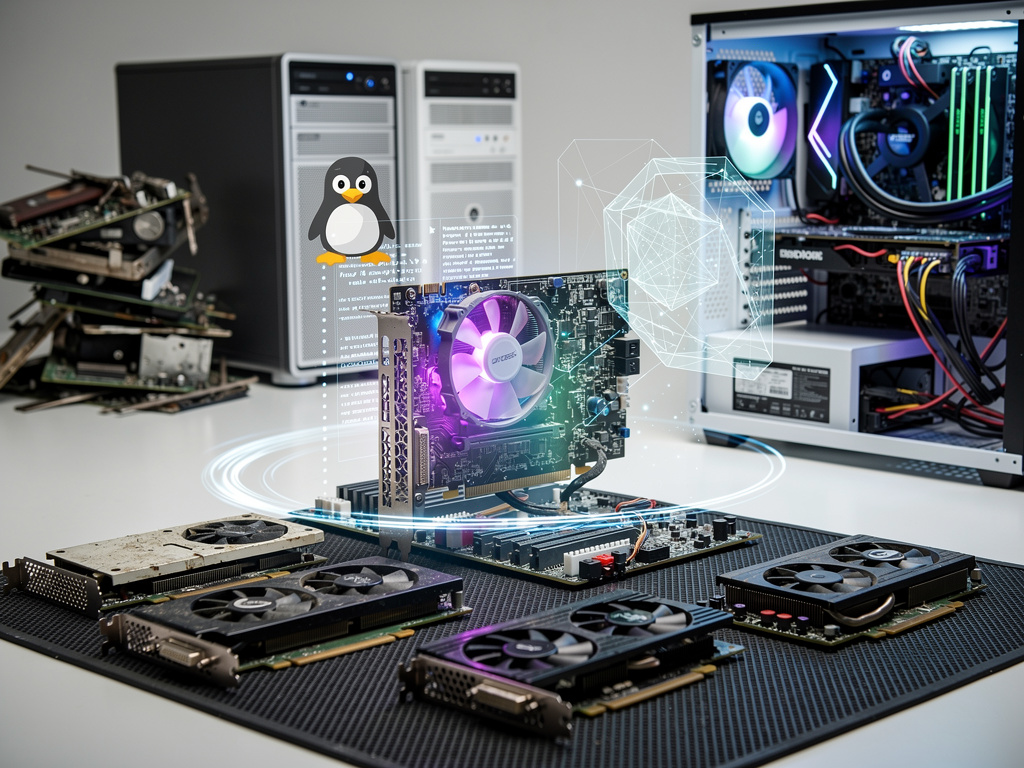
The open-source community has found new ways to extend the lifespan of older AMD Radeon graphics cards that manufacturers have long since abandoned. Through a combination of artificial intelligence tools and dedicated Linux kernel developers, these legacy GPUs now receive driver updates, performance improvements, and feature additions years after official support ended. This effort demonstrates how collaborative programming and modern technology can keep hardware functional and relevant.
AMD stopped providing proprietary driver updates for many Radeon cards from the RDNA1 and earlier generations several years ago. Once a card reaches end-of-life status, users typically face declining performance in new games and applications, security vulnerabilities, and incompatibility with newer software. Rather than accepting this obsolescence, Linux enthusiasts and AI-assisted programmers have stepped in to maintain these devices through the open-source AMDGPU driver stack.
The AMDGPU driver serves as the foundation for all modern AMD graphics support in the Linux kernel. Unlike the older Radeon driver that handled pre-GCN cards, AMDGPU supports a wide range of architectures from GCN onward. When AMD shifts its engineering focus to newer products, the open-source community assumes responsibility for bug fixes and feature development. This handoff has become more effective with the introduction of large language models and other AI coding assistants that help developers work more efficiently.
Linux kernel contributor Alex Deucher has played a central role in maintaining older Radeon hardware. His work appears regularly in kernel mailing lists where he submits patches for chips dating back to the Radeon HD 7000 series. These contributions often address power management issues, display output problems, and hardware decoding capabilities that would otherwise remain broken. The consistency of these updates shows a deliberate strategy to prevent hardware from becoming electronic waste.
AI tools have accelerated this maintenance work considerably. Developers now use systems like GitHub Copilot, Tabnine, and custom-trained models to generate boilerplate code, suggest optimizations, and identify potential bugs in complex driver code. The repetitive nature of graphics driver development makes it particularly suitable for AI assistance. Tasks such as register definition updates, timing calculations, and memory mapping routines can be partially automated, allowing human developers to focus on architecture-specific problems that require deeper understanding.
One notable example involves the resurrection of compute capabilities on older Vega and Polaris cards. These GPUs were originally designed with strong compute performance for machine learning and scientific workloads. After AMD moved on to newer architectures, support for certain compute features began to degrade in the open-source drivers. Community developers, assisted by AI code completion tools, restored OpenCL functionality and improved ROCm compatibility for these aging cards. Users can now run modern AI inference workloads on hardware that would otherwise sit unused.
The process typically starts with reverse engineering. When AMD does not release documentation for older chips, developers examine binary drivers from Windows, study hardware behavior through experimentation, and share findings through wikis and mailing lists. This information then gets translated into kernel code. AI models help bridge the gap between sparse documentation and working implementations by suggesting logical register configurations based on patterns from newer chips.
Performance improvements have been substantial in some cases. Recent kernel updates have brought measurable gains in Vulkan and OpenGL frame rates for RDNA1 cards like the RX 5000 series. These gains come from better command submission, improved memory management, and more efficient shader compilation. For users with RX 5700 XT or similar cards, the difference between an unmaintained driver and current mainline kernel support can mean the difference between playable and unplayable frame rates in newer titles.
Energy efficiency has also seen major gains. Older cards often suffered from poor power management when running on Linux, leading to excessive fan noise and high electricity consumption. Through careful analysis and iterative testing, developers have implemented better clock gating, voltage scaling, and idle state management. Some Polaris cards now consume up to 30 percent less power during desktop use compared to earlier driver versions.
The display engine receives particular attention because monitor compatibility issues frustrate users more than almost any other problem. HDMI 2.0 support, variable refresh rate implementation, and multi-monitor configurations often break after manufacturers stop updating firmware. The community has methodically fixed these problems across multiple generations. Recent work has improved color management on older cards, bringing them closer to the visual quality expected from modern displays.
Gaming represents a major motivation for this work. Many Linux users maintain older AMD cards specifically for Steam Play and Proton compatibility. As new games add more demanding graphics features, the open-source drivers must evolve to support them. The community has successfully backported certain RDNA2 and RDNA3 features to older architectures where the hardware allows it. While a Radeon RX 580 cannot magically match an RX 7800 XT, it can still run many current titles at respectable settings thanks to these improvements.
Hardware monitoring capabilities have expanded significantly. Tools like MangoHud, CoreCtrl, and lm-sensors now provide detailed information about temperatures, fan speeds, power draw, and clock frequencies on cards that previously offered limited feedback. This data helps users optimize their systems and diagnose problems. The addition of GPU statistics to the Linux perf subsystem allows even more advanced analysis for developers and power users.
Security updates form another critical aspect of this maintenance. As new vulnerabilities are discovered in graphics processors, the open-source community works quickly to implement mitigations. These patches often require careful implementation to avoid breaking compatibility with older hardware. The transparency of open-source development means users can verify that their legacy cards receive the same security attention as current models.
The social dynamics behind this effort reveal an interesting mix of motivations. Some contributors enjoy the technical challenge of making old silicon perform beyond its original specifications. Others focus on environmental concerns, arguing that extending hardware life reduces electronic waste and the need for new manufacturing. A significant portion of developers simply want to use their existing hardware without being forced into unnecessary upgrades.
Educational value also drives participation. Working on graphics drivers teaches low-level programming, hardware architecture, and operating system design. Many students and junior developers cut their teeth on AMDGPU contributions before moving to other projects. The presence of AI tools has made this learning process more accessible by reducing the barrier of complex syntax and providing instant feedback on code correctness.
Companies have begun to take notice of these community efforts. Some hardware vendors now contribute resources to open-source graphics development, recognizing that strong Linux support improves their overall platform compatibility. System integrators who build Linux workstations often specify AMD cards precisely because of the quality of open-source drivers maintained by the community.
The integration of AI into this workflow continues to evolve. Beyond simple code completion, researchers are exploring how machine learning can optimize driver parameters automatically. Some experimental projects use neural networks to predict optimal clock speeds and voltage curves based on workload characteristics. While these techniques remain in early stages, they suggest future possibilities where AI actively tunes drivers for individual cards and use cases.
Documentation quality has improved alongside the code itself. The AMDGPU wiki and kernel documentation now contain extensive information about supported features across different generations. This knowledge base helps new contributors understand the complex interactions between different driver components. Clear documentation also benefits end users who want to understand why certain features work on one card but not another.
Testing infrastructure plays a vital role in maintaining quality. The community maintains extensive automated testing systems that run thousands of test cases across different hardware configurations. These tests catch regressions before they reach mainline kernels. AI tools help analyze test failures by suggesting likely causes and potential fixes based on historical data.
User adoption of these improved drivers has grown steadily. Many Linux distributions now ship recent kernels by default, making the benefits available to ordinary users without manual compilation. Gaming-focused distributions like Nobara and Bazzite include additional patches and tools that further enhance the experience on older AMD hardware.
The contrast with other platforms is striking. Windows users with older Radeon cards often find themselves stuck with increasingly outdated drivers that receive only critical security updates. The Linux approach of community stewardship offers a different model where hardware can remain viable for much longer periods. This difference affects purchasing decisions, with some users deliberately choosing AMD cards knowing that the open-source community will support them long-term.
Challenges remain in this maintenance work. The increasing complexity of modern graphics APIs makes it harder to add new features to older hardware. Memory limitations on older cards restrict certain advanced techniques. Despite these constraints, developers continue finding creative solutions that squeeze additional performance from aging silicon.
The economic impact of this work extends beyond individual users. Companies that deploy large numbers of older GPUs in render farms or scientific computing clusters benefit from continued driver improvements. Rather than replacing entire fleets of cards, they can extend their investment through software updates. This approach aligns with growing emphasis on sustainable computing practices.
Looking forward, the combination of human expertise and AI assistance seems likely to strengthen. As language models become more capable at understanding hardware specifications and driver architecture, they will take on more complex tasks. Human developers will increasingly focus on novel problems and strategic decisions while AI handles routine implementation details.
This model of hardware maintenance offers valuable lessons for the technology industry. When manufacturers abandon products, communities can sometimes fill the gap through open collaboration and modern tools. The story of older AMD Radeon cards demonstrates that with sufficient expertise and the right technology, yesterday’s hardware can continue serving users effectively today. The Linux kernel community has shown that obsolescence is not inevitable when dedicated people choose to keep devices alive.


 WebProNews is an iEntry Publication