
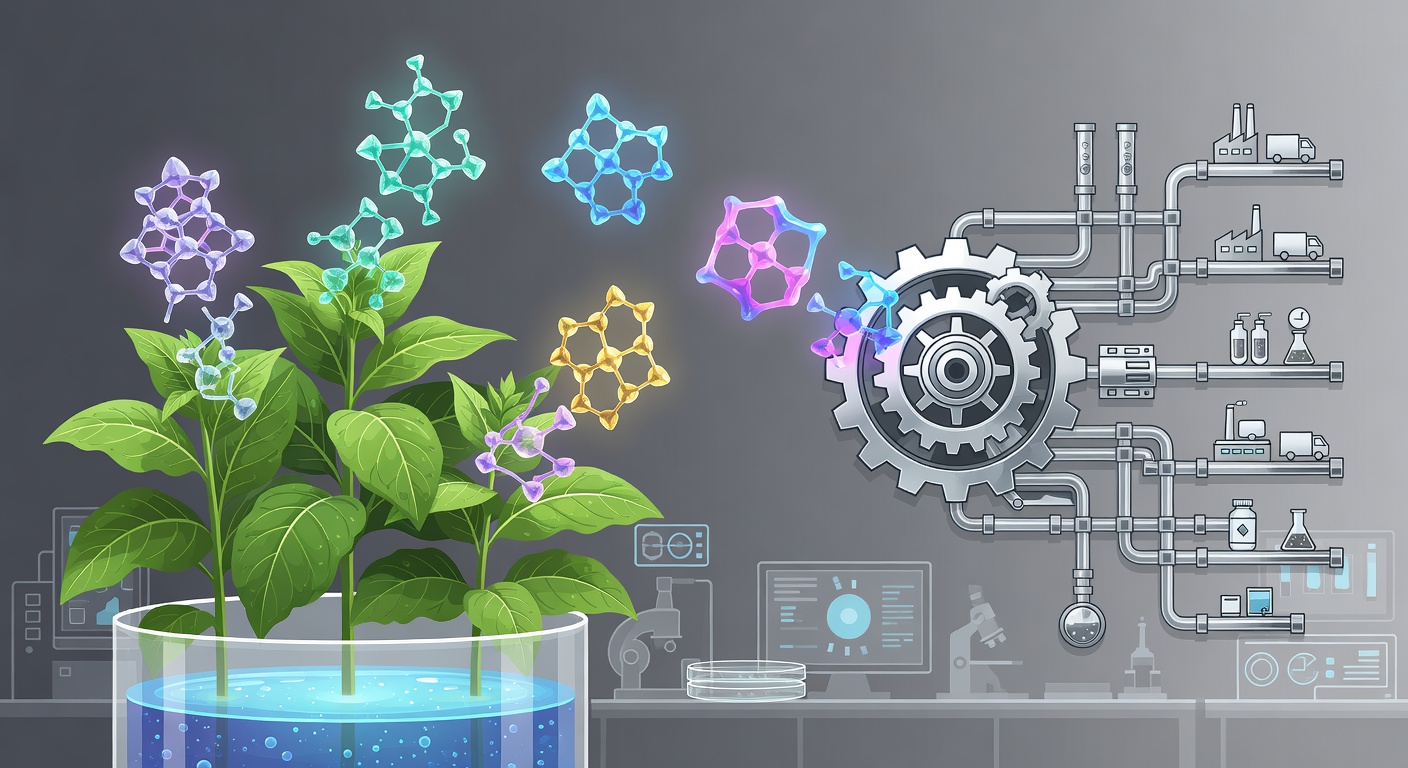
A team of scientists has engineered a single tobacco plant to simultaneously produce five different psychedelic compounds — psilocybin, psilocin, baeocystin, norbaeocystin, and aeruginascin — in quantities that could upend how these substances are manufactured for clinical use. The achievement, published in the journal Nature Chemical Biology, represents the most complex reconstruction of a psychedelic biosynthetic pathway in a plant host to date.
It’s the kind of result that makes pharmaceutical executives recalculate their supply chain assumptions.
The research team, led by scientists at the Technical University of Denmark, didn’t just insert a few mushroom genes into Nicotiana benthamiana — the workhorse cousin of commercial tobacco. They reconstructed the entire biosynthetic machinery of Psilocybe mushrooms, optimizing gene expression so the plant’s cellular infrastructure could handle the metabolic load. The result was a living factory capable of churning out a cocktail of tryptamine-derived psychedelics from its own leaf tissue, as first reported by Slashdot.
Why does this matter? Because the current methods for producing pharmaceutical-grade psilocybin are expensive, slow, and difficult to scale. Chemical synthesis requires hazardous reagents and generates waste. Growing Psilocybe mushrooms is notoriously inconsistent — yields vary wildly depending on strain, substrate, and environmental conditions. Fermentation using engineered yeast or bacteria has shown promise but struggles with the final enzymatic steps that convert precursor molecules into the desired end products.
Plants solve several of these problems at once.
From Mushroom to Tobacco: How the Pathway Was Rebuilt
The biosynthesis of psilocybin in magic mushrooms follows a relatively well-characterized pathway. It starts with the amino acid tryptophan, which is sequentially modified by four key enzymes — PsiD, PsiK, PsiM, and PsiH — to produce the suite of compounds found naturally in Psilocybe species. The Danish team transferred genes encoding these enzymes into N. benthamiana using a transient expression system based on Agrobacterium-mediated infiltration, a standard technique in plant biotechnology.
But standard technique doesn’t mean simple execution. The researchers had to balance the expression levels of each enzyme so that metabolic intermediates didn’t accumulate at bottleneck steps. Too much PsiD activity without sufficient PsiK, for instance, would flood the system with 4-hydroxytryptamine and stall the pathway. The team used different promoter strengths and tested multiple gene combinations to find configurations that pushed flux through the entire pathway efficiently.
The presence of aeruginascin — a trimethylated analog of psilocybin found in only a few mushroom species — was particularly notable. This compound has attracted attention in psychedelic research circles because of the so-called “entourage effect” hypothesis, which suggests that the therapeutic impact of psilocybin may be modulated by co-occurring compounds in the mushroom matrix. Producing aeruginascin alongside psilocybin in a single plant host opens the door to studying these interactions more systematically.
The yields reported in the paper, while not yet at commercial scale, are competitive with early-stage fermentation platforms. The researchers reported milligram-per-gram quantities of total psychedelic alkaloids in dried leaf tissue. That’s significant. Psilocybe cubensis mushrooms typically contain 0.5–1.0% psilocybin by dry weight in good conditions. The engineered tobacco plants are approaching the lower end of that range, with considerable room for optimization.
And optimization is where this gets interesting for industry.
Plant-based production systems offer advantages that microbial fermentation can’t easily match. Plants don’t require sterile bioreactors. They scale with sunlight and soil — or, more precisely in this case, with controlled-environment agriculture. A greenhouse full of engineered tobacco could theoretically produce psychedelics at a fraction of the cost per gram compared to current GMP-certified synthesis routes, which can run $5,000 to $10,000 per gram for pharmaceutical-grade psilocybin.
The timing is not coincidental. The psychedelic medicine sector has entered a critical phase. Compass Pathways, the Peter Thiel–backed biotech company, has been pursuing FDA approval for its synthetic psilocybin formulation COMP360 for treatment-resistant depression. Usona Institute has its own psilocybin program in Phase 2 trials. Australia’s Therapeutic Goods Administration approved psilocybin for treatment-resistant depression in 2023, making it the first country to do so at a national level. The demand for reliable, affordable, high-purity psilocybin supply is growing faster than the industry’s ability to meet it.
Regulatory Tangles and the Question of Scheduling
Here’s where the complexity multiplies. Psilocybin remains a Schedule I substance under the United Nations Convention on Psychotropic Substances and under U.S. federal law. Producing it — by any method — requires DEA licensing in the United States. The fact that it’s being produced in a plant rather than a flask doesn’t change the legal classification, but it does raise novel regulatory questions.
Consider the precedent of opium poppies. Papaver somniferum is legal to grow as an ornamental in the United States but illegal to cultivate for the purpose of extracting opiates. The distinction rests on intent. An engineered tobacco plant that produces psilocybin has no plausible ornamental purpose. Every plant is, by design, a drug factory. Regulators will need to develop frameworks for oversight that account for this reality — and those frameworks don’t yet exist.
There’s also the question of containment. Transient expression systems like the one used in this study don’t permanently alter the plant’s genome. The engineered traits aren’t heritable. But stable transformation — integrating the psychedelic pathway genes into the plant’s chromosomes so they’re passed to seeds — is the logical next step for anyone pursuing commercial production. That raises biosecurity concerns. A seed that grows into a psilocybin-producing plant is, in regulatory terms, a controlled substance precursor in botanical form.
The Drug Enforcement Administration has not publicly commented on the research. Neither has the FDA. But industry insiders expect that plant-based psychedelic production will eventually fall under the same Current Good Manufacturing Practice (cGMP) requirements as any other pharmaceutical manufacturing process, with additional agricultural biosafety layers.
Some companies are already positioning themselves. Octarine Bio, a Copenhagen-based startup with ties to the Technical University of Denmark research community, has been developing yeast-based psilocybin production. The new plant-based results could complement or compete with such platforms. Meanwhile, companies like Filament Health in Canada have pursued natural extraction from cultivated Psilocybe mushrooms as their core strategy, arguing that natural-source psilocybin offers a differentiated product profile.
The Danish team’s work cuts across all of these approaches. It offers natural-source compound profiles — including the entourage compounds — with the scalability and consistency advantages of a bioengineered system.
So what happens next?
The researchers have indicated that further optimization is underway, including efforts to boost yields through metabolic engineering of the host plant’s tryptophan supply. Tryptophan is the starting material for the entire pathway, and tobacco plants don’t naturally produce it in the quantities needed to maximize psychedelic output. Engineering upstream pathways — or simply feeding exogenous tryptophan to the plants — could substantially increase titers.
There’s also work to be done on extraction and purification. Producing psychedelics in leaf tissue is one thing. Getting them out in pharmaceutical-grade purity is another. The good news is that alkaloid extraction from plant biomass is a well-established industrial process — it’s how the pharmaceutical industry has sourced compounds from plants for over a century, from morphine to vincristine to paclitaxel.
The Bigger Picture for Synthetic Biology and Medicine
This research sits at the intersection of two powerful trends: the mainstreaming of psychedelic medicine and the maturation of plant synthetic biology as a production platform. The same techniques being applied here could, in principle, be used to produce other complex natural products — from anti-cancer alkaloids to novel antibiotics — in plant hosts.
N. benthamiana has already been used to produce vaccines, monoclonal antibodies, and various small molecules. The tobacco relative is essentially the E. coli of the plant world — fast-growing, easy to transform, and well-characterized. Adding psychedelic alkaloids to its repertoire is a logical extension of decades of work in plant molecular farming.
But the psychedelic application carries unique social and political weight. Public opinion on psilocybin has shifted dramatically in recent years. Oregon legalized supervised psilocybin use in 2020. Colorado followed in 2022. Multiple U.S. cities have decriminalized possession. The FDA granted Breakthrough Therapy designation to psilocybin for depression in 2018 and 2019. Against this backdrop, a technology that could make psilocybin cheaper and more accessible has implications that extend well beyond the laboratory.
Critics will point out that cheaper production doesn’t automatically translate to broader access. Regulatory approval, clinical infrastructure, trained therapists, insurance coverage — these are the real bottlenecks for psychedelic medicine reaching patients. A $50 dose of psilocybin doesn’t help much if the supervised therapy session costs $2,000.
Fair point. But supply-side innovation has a way of reshaping markets over time. And if plant-based production can deliver not just psilocybin but a defined, reproducible blend of psychedelic compounds — mimicking or improving on the natural mushroom profile — it could enable a new class of combination therapies that pure synthetic approaches can’t easily replicate.
The pharmaceutical industry has spent decades trying to reduce natural products to single active ingredients. The psychedelic field is moving in the opposite direction, toward an appreciation of chemical complexity. This engineered tobacco plant, quietly photosynthesizing in a Danish greenhouse, may be the most efficient vehicle yet for exploring what that complexity can do.
The research was published in Nature Chemical Biology and covered by Slashdot.


 WebProNews is an iEntry Publication