
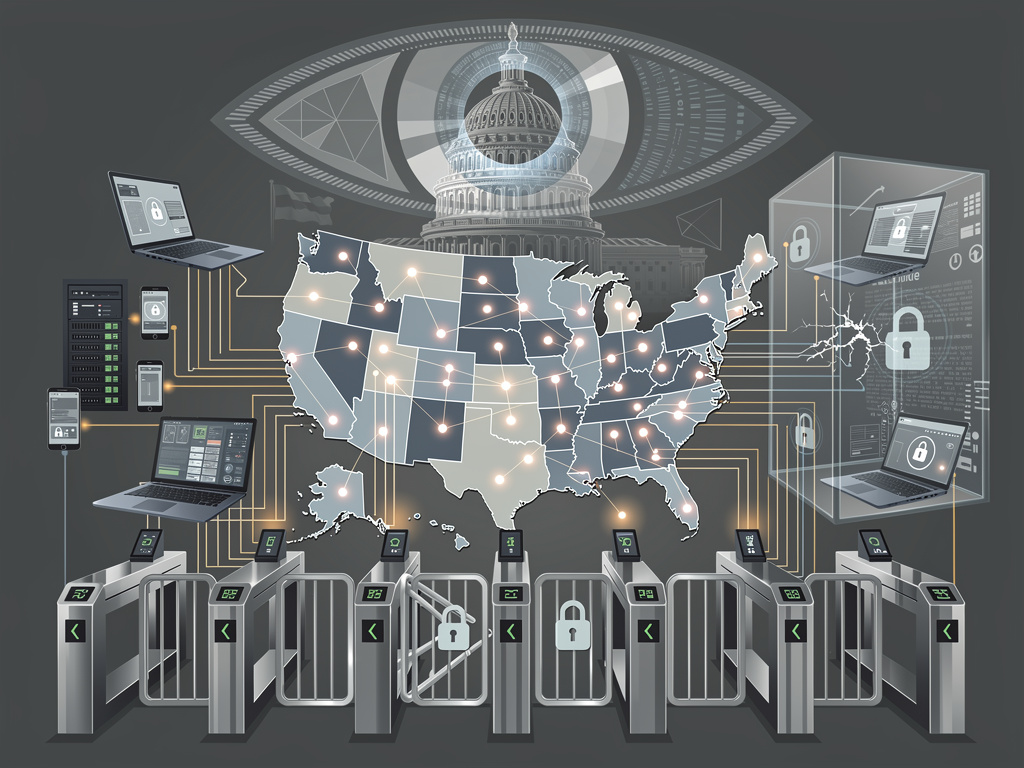
The warnings came sharp and clear. A single legislative bargain in Washington could lock in federal rules that end online anonymity for millions of Americans. The Foundation for Individual Rights and Expression put it bluntly in its recent alert: “We’re one bad D.C. deal away from the era of online government censorship.” (fire.org)
That deal hovers around familiar names. The Senate version of the Kids Online Safety Act. The NO FAKES Act. And mandates for age verification across platforms. Each carries First Amendment risks. Together they threaten to hand government new power over what Americans see and say online. And they arrive at a moment when half the country already lives under state age-check rules.
Half the U.S. Twenty-five states now require verification for sites with substantial adult content. Nine more saw laws activate in 2025 alone. The numbers come from the Electronic Frontier Foundation’s year-end review. (eff.org) Privacy advocates there argue these measures do more harm than good. They burden lawful speech. They erode anonymity. They create fresh privacy and security headaches for every user.
California’s AB 1043, signed into law by Governor Gavin Newsom in October 2025, takes the concept further. It orders operating system providers to build an interface at account setup that captures birth date or age data. Developers then receive a digital signal placing the user in an age bracket. The deadline sits at January 2027. Similar language appears in Illinois SB 3977, which targets operating systems and could sweep in open-source developers who lack resources to comply. Previous coverage in WebProNews traced how these bills risk turning Linux distributions and independent software into collateral damage. (webpronews.com)
But the story runs deeper than state experiments. Big Tech helped write the original script. WebProNews reported that technology giants shaped the liability protections and technical frameworks politicians now copy. The playbook lets platforms shift responsibility while constructing the very surveillance infrastructure they once resisted. (webpronews.com) System76, a Linux hardware maker, called out the pattern in stark terms. Age verification bills, they argued, amount to a liability dodge for large firms that doubles as government surveillance for everyone else. (webpronews.com)
Recent developments sharpen the stakes. CNBC documented in March how new laws pull millions of adults into mandatory gates that rely on AI, government IDs, or biometric scans. The result? Backlash from users and fresh warnings that a free internet hangs in the balance. (cnbc.com) Virginia’s social media restrictions faced a temporary federal block last February after a First Amendment challenge. Texas saw its app-store age verification law enjoined in December 2025. Judges cited speech concerns. Yet lawmakers press ahead. The Supreme Court’s earlier ruling in Free Speech Coalition v. Paxton upheld certain verification for adult sites, giving states fresh confidence.
And. The push extends beyond porn. California’s law, and its proposed follow-on AB 1856, eyes signals that reach web browsers and everyday applications. Operating systems could soon broadcast age categories to dating apps, games, forums, even open-source tools. PCMag explored the prospect in May. Your computer might soon require an age check it refuses to forget. (pcmag.com)
Critics see mission creep. What begins as protection for minors widens into control over lawful adult expression. The Foundation for Individual Rights and Expression noted that age verification demands personal data disclosure. That ends the ability to browse or post without identification. Chilling effects follow. People self-censor when every comment carries a traceable name. The Kids Online Safety Act would push platforms to restrict content that might harm minors even if it remains legal for adults. Government would effectively dictate design choices. The NO FAKES Act opens new avenues for lawsuits over AI-generated images, including satire and parody long shielded by precedent.
But the technical reality compounds the legal one. Many verification vendors store biometric templates or ID scans. Breaches happen. Sumsub disclosed a 2024 incident discovered months later. The Free Speech Coalition maintains a live tracker showing twenty-five states with active or pending harmful-to-minors rules. (action.freespeechcoalition.com) Colorado floated exemptions for open-source software, a sign that lawmakers recognize collateral damage yet still advance the framework. (webpronews.com)
Public reaction on X reflects raw frustration. Users decry the shift from child safety to mass surveillance. One thread linked the UK’s Online Safety Act expansions to political censorship. Another warned that age gates form the foundation for social credit systems. Signal, the encrypted messaging app, issued a strong statement against proposals that combine age verification with client-side scanning. The company called such ideas dystopian. They endanger everyone, not just children.
So what happens next? Federal talks continue. A bargain that trades AI regulation relief for speech restrictions could arrive quietly. If it does, the patchwork of state laws becomes national policy. Developers, from Silicon Valley coders to lone Linux maintainers, would face uniform compliance costs. Smaller players without compliance teams simply disappear or move offshore. The internet fragments. Access narrows. Anonymity fades.
History offers caution. Past attempts to gate speech for minors, from the Communications Decency Act to later filtering mandates, often stumbled in court. Yet persistence pays. Each new bill learns from the last. Each adds technical mandates that feel incremental until the cumulative weight settles. EFF’s comments on California’s SB 976 rulemaking highlighted discriminatory impacts and overreach. Courts have blocked pieces before. They may again.
Still the momentum builds. Child safety carries emotional force. No lawmaker wants to vote against protecting kids. The harder conversation, the one about tradeoffs, stays quieter. Privacy traded for safety. Anonymity traded for accountability. Open development traded for centralized control. The WebProNews series laid out how these choices favor incumbents who already collect vast user data while burdening everyone else. (webpronews.com)
The question FIRE posed cuts through the noise. Will power over online speech remain with individuals or transfer to government? The answer may come sooner than expected. One deal. One compromise. One set of mandates sold as protection. The infrastructure for routine identity checks would then sit in place, ready for expansion to news sites, forums, or any corner of the web deemed risky. That future looks less like safety and more like papers, please at every digital border.
Industry insiders already feel the pressure. Linux distributions weigh forks that strip compliance code. App developers debate geoblocking entire states. Privacy tools see usage spikes when laws activate. The pattern repeats internationally. The UK’s age rules triggered VPN surges over one thousand percent. Discord’s verification announcement sparked user revolt. These reactions reveal the tension. People want children shielded. They do not want their own lives funneled through permanent identity layers.
Recent Harvard Law Review analysis examined intermediate scrutiny standards for these laws. Courts wrestle with content-neutral claims versus obvious speech burdens. Outcomes remain mixed. Yet the volume of legislation keeps rising. Sixteen states regulate minors’ social media access in some form. More eye app stores. The coalition of child-safety advocates grows. Tech giants spar over responsibility. Apple and Google resist mandates that turn them into age gatekeepers. Meta pushes different approaches. The disputes mask a shared problem. Once the verification habit takes root, reversing it grows difficult.
California’s 2027 deadline looms. Illinois follows close behind. Other states watch and copy. The federal conversation, if it concludes with the feared package, would accelerate everything. Open-source communities, already strained, could face existential compliance questions. One WebProNews piece asked whether Illinois SB 3977 would swallow independent software whole. The concern is real. A small developer cannot afford enterprise-grade age assurance systems. Many will simply stop serving affected jurisdictions. The internet shrinks in practice if not in theory.
Advocates urge alternatives. Better parental tools. Education. Targeted enforcement against actual illegal content. These draw less attention. They lack the sweeping clarity of a single age signal broadcast by every operating system. Yet they avoid the surveillance trap. The EFF warned that age verification undermines rights for adults and minors alike. Its documentation shows harms across age groups. (eff.org)
The coming months will test whether lawmakers hear that caution. Or whether the allure of visible action overrides documented risks. The infrastructure now under construction will not stay limited to pornography or social media. It scales. It normalizes. It invites further mandates. One bad deal could cement the shift from open web to gated, identified, monitored network. The era it ushers in would look very different from the internet many built their careers around. And once built, such systems rarely disappear.


 WebProNews is an iEntry Publication