
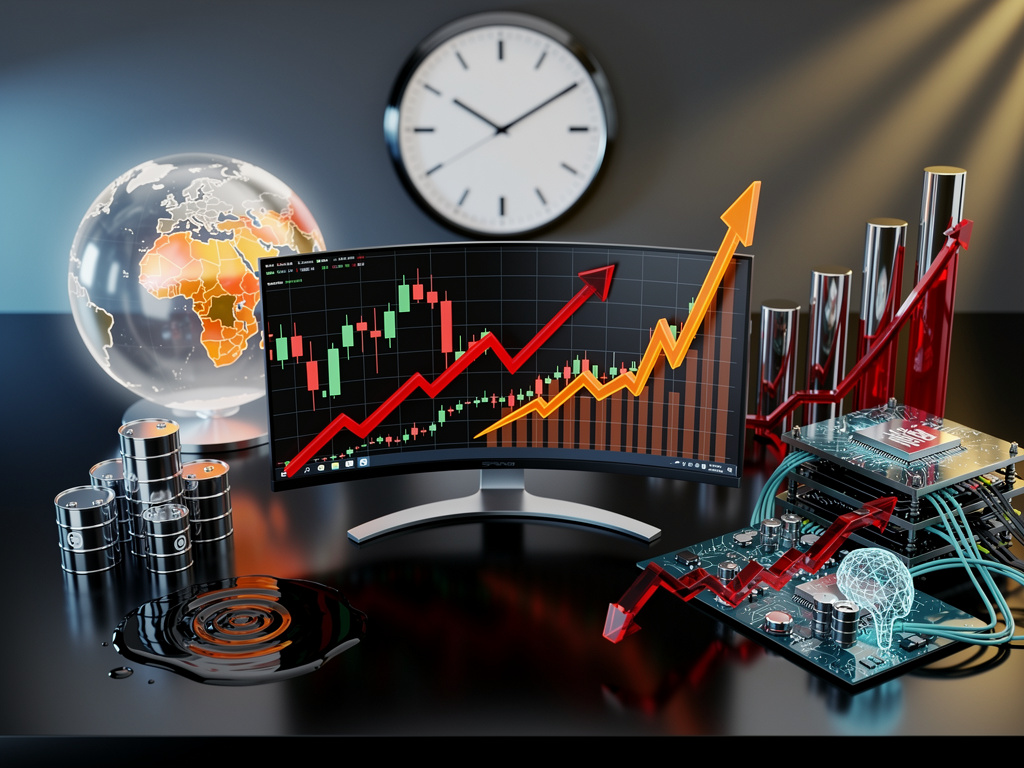
S&P 500 futures dropped hard. Treasury yields climbed to levels not seen in months. Oil prices surged on doubts about Middle East stability. The combination delivered a sharp reminder to investors: markets don’t run on momentum alone.
Friday’s selloff cut more than 1% from each major U.S. index. The Dow Jones Industrial Average fell 537 points, or 1.07%, to close at 49,526. The S&P 500 lost 93 points, or 1.24%, ending at 7,408. Nasdaq shares slid 410 points, or 1.54%, to 26,225. Yet the S&P 500 still posted its seventh weekly gain in a row. That marks the longest such streak since late 2023.
But the tone shifted fast. Spiking crude sent bond yields higher across the curve. The 10-year Treasury note yield rose to its highest level since May 2025. Global bonds followed suit. Japanese 10-year yields hit a 29-year peak. UK gilts reached an 18-year high. Investors suddenly found safer returns in fixed income than in high-flying tech names.
Energy Prices Ignite Inflation Concerns
Rising oil acted as the spark. Combative statements from President Donald Trump and Iran’s Foreign Minister Abbas Araqchi cast doubt on any quick resolution to tensions. The Strait of Hormuz stayed closed. Hopes for normalized shipping faded. Crude jumped more than 4% in a single session.
That move fed directly into inflation worries. Recent CPI and PPI readings already showed pressure. Longer oil prices stay elevated, the greater the risk that those readings become sticky. One strategist captured the shift. “There’s a realization that the market had gotten way ahead of itself,” said Kenny Polcari, chief market strategist at Slatestone Wealth in Jupiter, Florida. “It wasn’t paying enough attention to what the bond market and economic data is telling it. It was caught up in this momentum AI trade.” (Reuters)
The numbers back him up. Odds of a 25-basis-point Fed rate hike by December jumped to nearly 40% from 13.6% a week earlier, according to CME Group’s FedWatch tool. And this happened on Jerome Powell’s final day as Fed chair. He leaves after guiding the central bank through pandemic chaos, inflation spikes, and multiple rate cycles. His successor, Kevin Warsh, steps in at a delicate moment. A prolonged conflict in the Middle East could force the new chair to consider rate increases rather than cuts.
Trump’s summit with Chinese President Xi Jinping added little comfort. The meeting produced few concrete outcomes on trade or the Iran situation. “It certainly was encouraging to see both countries engaging again at the highest level,” noted Matthew Keator, managing partner at the Keator Group in Lenox, Massachusetts. “This week’s meeting seemed like more of a reset in relations between the two countries and less short-term, quantifiable results.” He added that the day’s weakness underlined fears the recent inflation data won’t fade quickly. The new Fed leadership will likely stay neutral until clearer signals emerge. (Reuters)
Semiconductor stocks absorbed the worst damage. The Philadelphia SE Semiconductor Index dropped 4%. Nvidia shares fell 4.4%. AMD lost 5.7%. Intel declined 6.2%. These names had powered the AI-driven advance. Their sudden reversal showed how quickly sentiment can flip when macro forces intrude.
Not every name suffered. Energy stocks rose 2.3% as the only S&P 500 sector in the green. Microsoft climbed 3.1% after Bill Ackman’s Pershing Square disclosed a new stake. Dexcom jumped 6.6% on news of board changes tied to activist investor Elliott Investment Management. Ford, however, gave back ground. It fell 7.5% after a recent 21% surge tied to its energy storage plans.
Market internals told a clear story. Decliners swamped advancers by nearly 4-to-1 on the NYSE. Nasdaq saw more than three times as many losers as winners. Volume ran above average at 19.3 billion shares. New lows outnumbered new highs on both exchanges.
This pullback arrives after months of AI-fueled gains that pushed indexes to repeated records. The S&P 500 had recovered fully from earlier tariff-related losses. But the bond market’s message grew louder. Higher yields for longer change the math for growth stocks that rely on cheap capital and future earnings power.
So traders now watch two fronts. First, whether oil prices stabilize or keep climbing as Middle East diplomacy stalls. Second, how the incoming Fed leadership signals its response. Warsh inherits a board where Powell will remain as a member until 2028. That overlap may shape early communication.
Analysts caution against reading too much into one session. Yet the speed of the reversal stands out. Futures had pointed to a weak open. The actual decline matched those signals and then some. It wasn’t a crash. But it exposed vulnerabilities that momentum had hidden.
Broader global markets reflected the same pressure. European shares closed lower on similar inflation concerns. Asian bonds sold off too. The move looks less like isolated U.S. noise and more like a coordinated repricing of risk.
Investors who rode the AI wave now face questions about duration. How long can oil stay elevated without forcing policy changes? How patient will markets remain if yields keep rising? Those answers will shape trading in the weeks ahead. For now, the easy gains of recent months have met a serious test.


 WebProNews is an iEntry Publication