
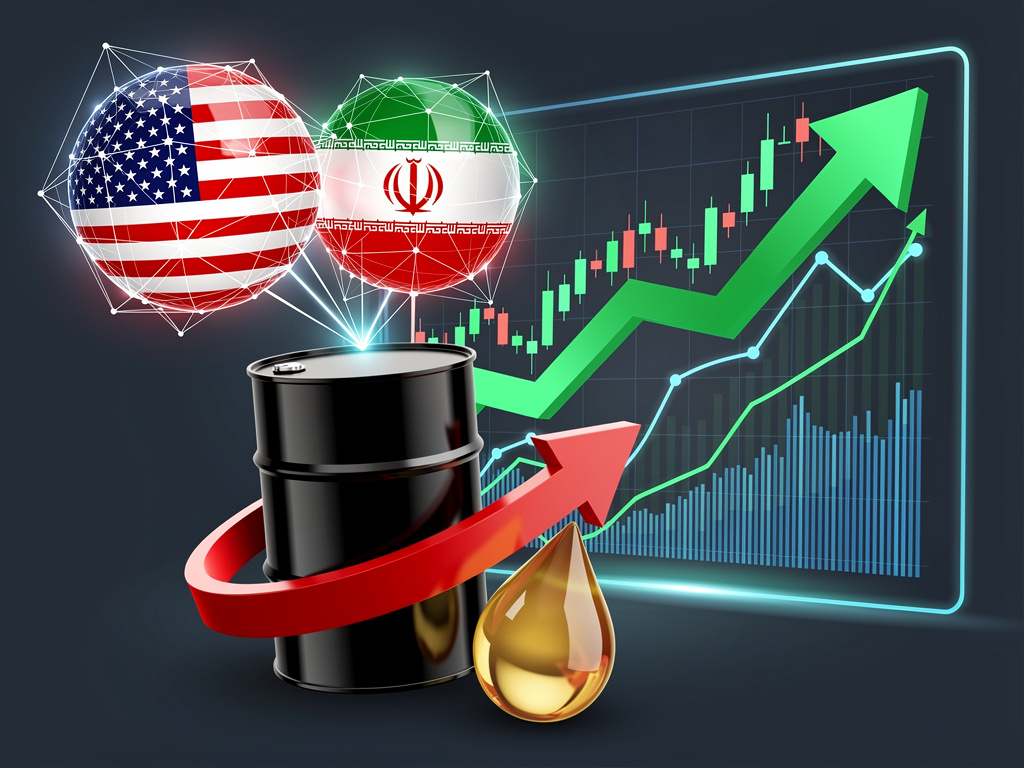
Oil futures dropped sharply on Monday morning as traders digested an unexpected diplomatic signal: Iran and the United States appear to be talking again. Not just talking — making what both sides described as productive progress toward a deal that could reshape energy markets, Middle Eastern geopolitics, and the calculus behind every barrel of crude sitting in storage from Cushing, Oklahoma, to Fujairah.
West Texas Intermediate crude fell more than 2% in early trading, slipping below $67 a barrel. Brent crude, the international benchmark, dropped by a similar margin. The catalyst was a weekend of headlines suggesting that the Trump administration and Iranian officials had conducted what Business Insider described as “productive talks” — language that sent energy traders scrambling to reassess their positions.
The timing matters. A lot.
For months, the oil market had been pricing in a certain level of geopolitical risk premium tied to tensions between Washington and Tehran. Sanctions on Iranian crude exports, the ever-present threat of military escalation in the Persian Gulf, and the broader standoff over Iran’s nuclear program had all contributed to a floor under oil prices that many analysts considered durable. That floor just cracked.
Stock futures, meanwhile, ticked higher. The S&P 500 futures gained modestly in overnight trading, and Nasdaq futures rose as well, reflecting a market that interpreted the diplomatic progress as broadly positive for risk assets. Lower oil prices tend to ease inflationary pressures, which in turn gives the Federal Reserve more room to maneuver on interest rates — a chain of logic that equity investors were quick to embrace.
But the details of these talks remain frustratingly thin. Neither the White House nor Iranian officials have disclosed the specific terms under discussion, the timeline for any potential agreement, or the preconditions that each side has put on the table. What’s known is that intermediaries — reportedly including Omani diplomats, who have historically served as back-channel facilitators between Washington and Tehran — helped arrange the discussions. President Trump, in a post on Truth Social, called the talks “very productive” and suggested that a deal could be reached “soon,” though he offered no specifics.
That vagueness is itself a kind of signal. In past diplomatic engagements with Iran, both the Obama and Trump administrations used carefully calibrated public statements to manage expectations and market reactions. The choice to characterize these talks as productive without providing substance suggests that both sides see value in keeping momentum alive — and in letting markets do some of the work by pricing in the possibility of sanctions relief before any formal agreement is reached.
Iran’s oil production capacity has been a wildcard in global energy markets for years. Under maximum pressure sanctions, Iranian crude exports officially fell to a trickle, though in practice significant volumes continued to flow — primarily to China — through a network of intermediaries, ship-to-ship transfers, and creative invoicing. Industry estimates suggest Iran has been exporting somewhere between 1.2 million and 1.8 million barrels per day, much of it at steep discounts to Brent. If a deal were to formally lift or significantly ease sanctions, those barrels could enter the market at full price and in greater volume, adding meaningful supply at a time when OPEC+ is already grappling with how to manage its own production increases.
That’s the bear case for oil, and it’s the one the market chose to trade on Monday.
The bull case is more nuanced. Any deal with Iran would almost certainly face intense scrutiny from Congress, where bipartisan skepticism of Iranian diplomacy runs deep. Even if the administration reaches a preliminary agreement, implementation could take months, and the history of U.S.-Iran negotiations is littered with last-minute collapses. The 2015 Joint Comprehensive Plan of Action — the original Iran nuclear deal — took years to negotiate, and Trump himself withdrew the United States from it in 2018. Rebuilding that kind of framework won’t happen overnight.
There’s also the OPEC+ dimension. Saudi Arabia and its allies within the producer group have been carefully managing output to support prices, and the prospect of Iranian barrels flooding back into the market complicates that strategy. Riyadh has historically viewed Iranian production gains as a competitive threat, and any deal that boosts Tehran’s export capacity could trigger a reassessment of Saudi production policy. If the kingdom decides to defend market share rather than prices — as it did briefly in 2020 — the resulting supply glut could push crude significantly lower.
Energy analysts spent Monday morning recalibrating their models. Goldman Sachs, which has maintained a relatively constructive outlook on oil prices for 2026, had previously flagged geopolitical risk as a key support factor. A sustained diplomatic thaw between Washington and Tehran would undermine that thesis. Morgan Stanley’s commodity desk, meanwhile, has been more bearish on crude, and the Iran news reinforced their view that supply-side risks are tilted to the downside.
For U.S. consumers, lower oil prices translate fairly directly into lower gasoline prices — a politically potent outcome for the Trump administration heading into a midterm election cycle. The national average for a gallon of regular gasoline has been hovering around $3.20, according to AAA, and a sustained decline in crude could push that figure below $3.00 by summer. That would be a tangible win for an administration that has made energy costs a central economic talking point.
Not everyone is convinced the optimism is warranted. Iran hawks in Washington — including several influential Republican senators — have already signaled opposition to any deal that doesn’t fully dismantle Iran’s nuclear enrichment capabilities and address its ballistic missile program. Senator Tom Cotton of Arkansas posted on X that any agreement with Iran that falls short of those benchmarks would be “worse than Obama’s deal,” a framing designed to put pressure on the administration from the right. The political dynamics within the Republican caucus could constrain Trump’s negotiating flexibility, even if the economic incentives for a deal are clear.
And then there’s China. Beijing has been the primary buyer of sanctioned Iranian crude, and any normalization of Iran’s oil trade would disrupt that arrangement. Chinese refiners have benefited from deep discounts on Iranian barrels, and a return to market-rate pricing could shift their purchasing patterns — potentially increasing demand for competing grades from Russia, Iraq, or West Africa. The second-order effects of an Iran deal ripple far beyond the Persian Gulf.
Monday’s price action, dramatic as it was, may ultimately prove premature. Markets have a tendency to front-run diplomatic developments, pricing in outcomes that haven’t materialized and then reversing sharply when reality falls short. The 2015 Iran deal negotiations produced multiple false starts and near-collapses before a final agreement was reached, and each one generated volatility in oil markets. This time could follow a similar pattern — a series of hopeful headlines followed by setbacks, with crude prices whipsawing in response.
But something does feel different about this moment. The Trump administration, which built its first-term Iran policy around maximum pressure and confrontation, appears to be genuinely exploring a diplomatic off-ramp. Whether that reflects a strategic calculation about energy prices, a desire to notch a foreign policy achievement, or simply the pragmatic recognition that sanctions have failed to change Iranian behavior is unclear. Probably all three.
What is clear is that the oil market is paying attention. Every barrel of Iranian crude that could potentially re-enter the global supply picture represents a marginal pressure point on prices, and traders are recalculating those probabilities in real time. The next few weeks will be telling. If talks progress to a formal framework — even a preliminary one — expect another leg down in crude. If they stall, as so many previous efforts have, the geopolitical risk premium will reassert itself quickly.
For now, the market has made its bet. Oil is down. Stocks are up. And somewhere between Washington and Tehran, diplomats are trying to close a deal that could move billions of dollars across global energy markets. The stakes, as they say, are considerable.


 WebProNews is an iEntry Publication