
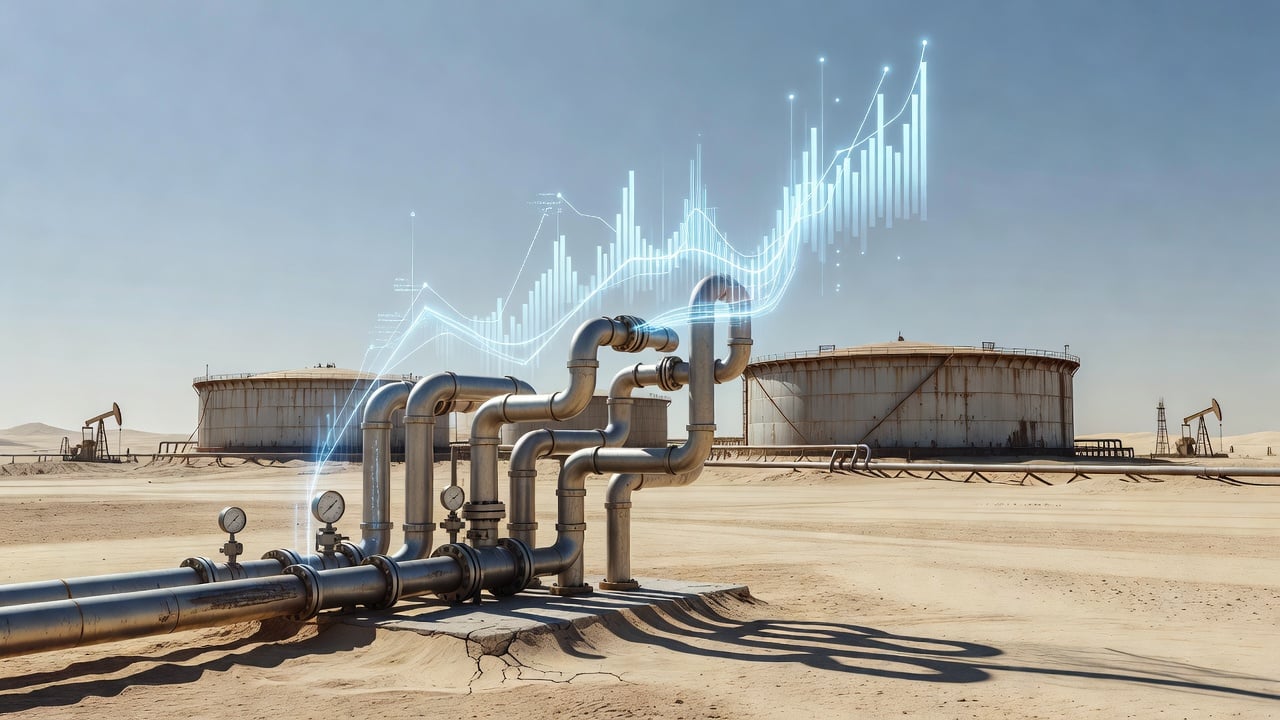
Oil prices rose sharply on Thursday as investors reacted to fresh signals from the United States regarding potential new sanctions on Iran and ongoing supply concerns from the Middle East. Brent crude futures gained more than two percent during trading, while West Texas Intermediate also posted solid gains, reflecting renewed worries about tighter global supplies amid geopolitical tensions.
The movement comes after reports that the Trump administration is considering reimposing strict measures on Iranian oil exports, a development that could remove hundreds of thousands of barrels per day from the market. Market participants have grown increasingly attentive to any policy shifts from Washington that might affect energy flows from the Persian Gulf. According to a report from Yahoo Finance, the price climb followed these renewed discussions, highlighting how sensitive crude markets remain to diplomatic and sanctions-related news.
This latest uptick builds on a pattern seen throughout the year where oil prices swing based on headlines from key producing regions. Iran currently exports roughly 1.5 million barrels per day, much of it heading to China despite existing restrictions. Any successful effort to curb those shipments would tighten an already delicate balance between global supply and demand. Analysts suggest that full enforcement of maximum pressure sanctions could cut Iranian exports by as much as 500,000 barrels daily, a volume significant enough to move prices in a market where spare capacity remains limited.
Beyond sanctions, the broader Organization of the Petroleum Exporting Countries and its allies continue to manage output carefully. The group, often referred to as OPEC+, has maintained voluntary production cuts that have helped support prices even as demand growth from major economies shows signs of slowing. Recent data from the International Energy Agency indicates that world oil demand is still expanding, though at a more moderate pace than earlier forecasts suggested. Factors such as slower industrial activity in Europe and mixed signals from Chinese manufacturing have tempered expectations, yet overall consumption continues to rise, particularly in aviation and petrochemical sectors.
Geopolitical risks extend beyond Iran. Ongoing conflicts in the Middle East, including developments in Yemen and tensions between Israel and various regional actors, add another layer of uncertainty. Shipping through the Strait of Hormuz, which carries nearly one-fifth of global oil supply, remains vulnerable to disruption. Even the threat of interference in these vital sea lanes tends to push prices higher as traders build in risk premiums.
On the supply side, U.S. production has remained near record levels, providing something of a buffer. American shale operators have shown discipline in recent quarters, resisting the urge to drill aggressively despite higher prices. This measured approach has helped prevent a flood of new barrels from reaching the market too quickly. Nonetheless, any sustained rise above $80 per barrel for Brent could eventually encourage more drilling activity in the Permian Basin and other key shale plays, potentially capping further gains.
Inventory levels in the United States offer additional context for the recent price action. Weekly data from the Energy Information Administration showed a modest draw in commercial crude stocks, though gasoline inventories rose as refinery runs increased ahead of the summer driving season. The combination of lower crude stockpiles and healthy product demand has supported refining margins, which in turn helps pull crude higher.
Market structure also plays a role. The forward curve for both Brent and WTI has remained in backwardation for much of the past year, meaning near-term prices trade above longer-dated contracts. This configuration signals tight physical markets and encourages participants to keep barrels in storage to a minimum. As long as backwardation persists, it provides underlying support even when headline risks temporarily fade.
Financial markets have amplified these physical dynamics. Speculative money flowing into commodity funds and exchange-traded products has increased exposure to energy in recent weeks. Money managers have lifted net long positions in crude futures, according to data from the Commodity Futures Trading Commission. This positioning leaves the market vulnerable to sharp moves in either direction should sentiment shift abruptly, yet for now it contributes to upward momentum when positive news emerges.
Looking further ahead, several variables will likely determine whether the current rally can be sustained. The pace of economic growth in Asia remains central. China, as the world’s largest crude importer, has shown resilience in its energy demand despite property sector challenges. If Beijing rolls out additional stimulus measures that boost industrial output and consumer spending, oil consumption could exceed current projections. India too continues to register strong demand growth as its economy expands and its middle class grows.
On the policy front, the Federal Reserve’s approach to interest rates will influence the strength of the U.S. dollar, which has an inverse relationship with commodity prices. A softer dollar makes oil more affordable for buyers using other currencies, potentially supporting consumption. Conversely, if inflation data forces the Fed to keep rates higher for longer, it could weigh on economic activity and, by extension, oil demand.
Environmental and transition factors also shape long-term outlooks. While oil demand is not expected to disappear anytime soon, investments in renewable energy and electric vehicles continue to accelerate in many regions. European countries in particular have set ambitious targets for phasing down fossil fuel consumption. These trends have prompted some analysts to forecast a peak in global oil demand within the next decade, though considerable disagreement exists about both the timing and the level at which that peak might occur.
For producers, this uncertainty creates difficult strategic choices. National oil companies in the Middle East are balancing the need to maintain market share today with the necessity of preparing for a lower-carbon future. Many have launched ambitious diversification programs, investing in petrochemicals, renewables, and even tourism. Saudi Arabia’s Vision 2030 represents one of the most comprehensive efforts in this regard, seeking to reduce the kingdom’s reliance on crude exports over time.
Refiners face their own set of pressures. Simple distillation facilities that produce mostly fuel oil struggle in a world increasingly focused on lower-sulfur marine fuels and cleaner transport options. More complex plants capable of turning heavy crudes into high-value products such as gasoline, diesel, and petrochemical feedstocks enjoy better economics. This disparity has driven significant investment in upgrading capacity, particularly in Asia and the Middle East.
Trading houses and commodity merchants have also adapted to the new environment. Companies like Vitol, Trafigura, and Glencore have expanded their physical trading networks while simultaneously developing sophisticated risk management capabilities. Their ability to move cargoes quickly between regions helps balance the global market, smoothing out regional imbalances caused by sanctions, maintenance, or weather-related disruptions.
The recent price increase serves as a reminder that oil markets retain their traditional volatility. While structural changes are underway, near-term prices continue to be driven by familiar factors: geopolitical developments, production decisions by major producers, inventory fluctuations, and macroeconomic signals. The renewed focus on U.S. policy toward Iran has simply provided the latest catalyst.
Participants will watch upcoming OPEC+ meetings closely. The group has signaled willingness to adjust output as conditions warrant, though internal dynamics sometimes complicate decision-making. Compliance with existing quotas has generally improved, lending credibility to the organization’s efforts to stabilize prices. Any indication that further cuts could be forthcoming would likely add upward pressure, while signals of gradual increases might temper the current enthusiasm.
Economic data releases in the coming weeks will also hold considerable sway. Figures on industrial production, consumer spending, and inflation from major economies could alter growth expectations and, consequently, oil demand forecasts. In particular, the next round of Chinese activity indicators will be scrutinized for signs that the world’s second-largest economy is gaining momentum.
Storage operators and logistics providers form another important part of the picture. The availability of floating storage, onshore tanks, and transportation capacity influences how quickly supply can respond to price signals. When rates for very large crude carriers rise, it often reflects both strong demand for moving oil and, at times, the use of tankers as temporary floating storage. Current freight rates suggest healthy underlying activity without the extreme tightness witnessed during previous supply crunches.
For consumers at the pump, higher crude prices eventually translate into elevated gasoline and diesel costs. In the United States, national average gasoline prices have already begun to climb from spring lows. While still below levels seen in 2022, the direction of travel has prompted concern among households and businesses alike. Refiners will need to balance strong summer demand with the risk that excessive price increases could eventually dampen consumption.
Aviation fuel represents another area of focus. As air travel recovers fully from pandemic-era restrictions, jet fuel demand has shown consistent growth. Airlines have largely passed higher energy costs through to ticket prices, though competitive pressures limit how much they can raise fares. Any sustained increase in oil prices could eventually affect travel demand if economic conditions weaken simultaneously.
Looking beyond the immediate horizon, technological developments in exploration and production continue to shape supply potential. Advances in seismic imaging, drilling techniques, and completion methods have lowered breakeven costs for many operators, allowing commercial production from resources that once seemed uneconomic. These improvements have been particularly evident in shale basins but have also benefited conventional offshore developments.
At the same time, the energy transition has spurred innovation in areas such as carbon capture, hydrogen production, and advanced biofuels. While these technologies are unlikely to displace oil entirely in the near term, they could gradually erode its market share in certain sectors. Oil companies have responded by increasing their own investments in lower-carbon initiatives, seeking to position themselves for a range of possible future scenarios.
The recent climb in prices following news of potential new U.S. measures against Iranian oil exports illustrates how traditional geopolitical factors still dominate short-term market behavior. Despite years of discussion about energy transitions and diversification, the world remains heavily dependent on oil for transportation, manufacturing, and countless everyday products. This dependence ensures that developments capable of restricting supply will continue to command attention from traders, policymakers, and consumers alike.
As the situation evolves, market participants will weigh the likelihood that announced sanctions will be fully enforced against the ability of other producers to offset any lost barrels. History suggests that determined exporters often find ways to move their product, whether through ship-to-ship transfers, relaxed documentation, or other creative arrangements. The effectiveness of sanctions therefore depends not only on the stringency of enforcement but also on the willingness of buyers to comply.
For now, the mere prospect of tighter Iranian supplies has been sufficient to lift prices and refocus attention on supply security. Whether the gains hold will depend on subsequent developments in diplomacy, production trends, economic data, and the broader sentiment surrounding global growth. In energy markets, certainty remains elusive, and prices reflect that reality on a daily basis. The coming weeks and months will provide further clues about whether this latest upward move represents the start of a more sustained recovery or simply another episode in oil’s long history of volatility.


 WebProNews is an iEntry Publication