
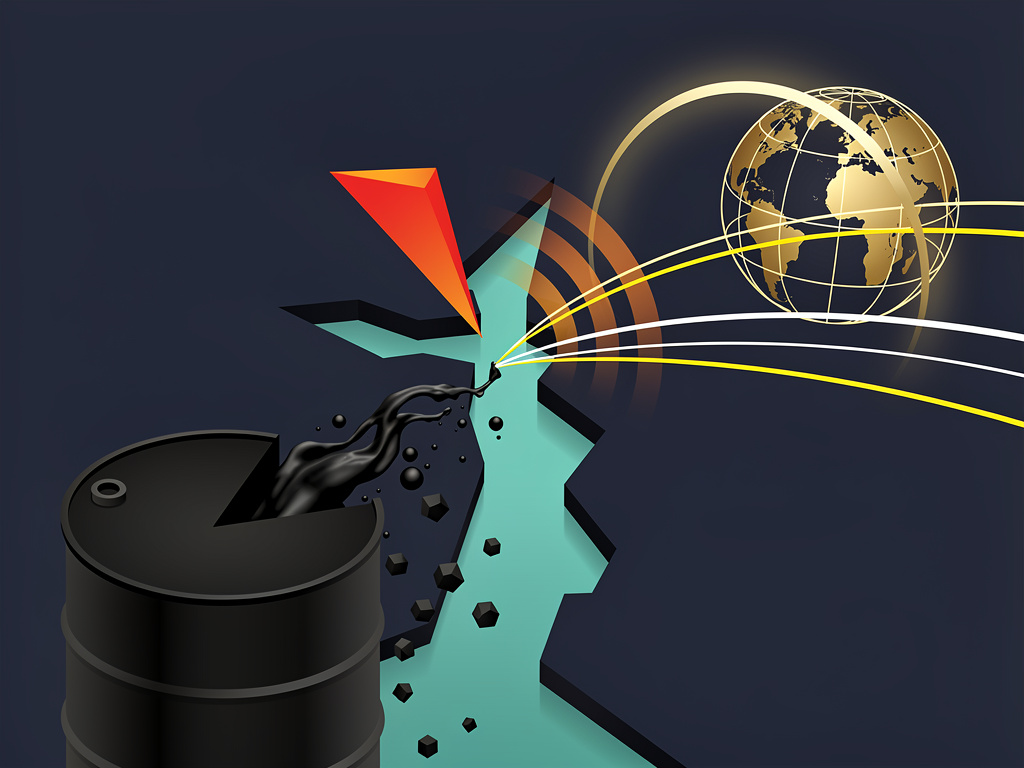
Oil prices surged this week as the United States signaled it is prepared to use military force against Iran’s nuclear program, injecting a war premium into crude markets that had spent months drifting on oversupply concerns and tepid demand forecasts. Brent crude jumped above $73 a barrel. West Texas Intermediate followed, climbing past $70. The moves were sharp, sudden, and driven almost entirely by geopolitics rather than fundamentals.
The catalyst was unmistakable. President Donald Trump, in remarks that rattled trading floors from London to Singapore, declared that the U.S. would resort to bombing if Iran refused to abandon its nuclear ambitions through diplomatic channels. According to Business Insider, Brent crude rose 2.4% to $73.28 per barrel while WTI gained 2.6% to reach $70.19 — marking the most significant single-session geopolitical rally in months.
This isn’t idle saber-rattling, and the market knows it. The Strait of Hormuz, a narrow chokepoint between Iran and Oman, handles roughly 20% of the world’s daily oil supply. Any military engagement with Iran — whether a targeted strike on nuclear facilities or a broader campaign — carries the risk of disrupting that flow. And disruption at Hormuz doesn’t just affect Iranian barrels. It threatens exports from Saudi Arabia, Iraq, Kuwait, Qatar, and the United Arab Emirates.
Traders are pricing that risk now.
The timing compounds the anxiety. Oil markets entered 2026 under pressure from multiple directions: OPEC+ had been gradually unwinding production cuts, U.S. shale output remained resilient, and Chinese demand growth — once the engine of global consumption increases — had disappointed for consecutive quarters. Brent had been languishing in the mid-$60s for much of the year, a level that pleased consumers and central bankers but squeezed producers. The sudden injection of a geopolitical premium has scrambled those calculations.
Analysts at Goldman Sachs moved quickly to adjust their risk models, noting that a sustained military confrontation could push Brent toward $85 or higher depending on the scale of supply disruption. RBC Capital Markets echoed the concern, with global head of commodity strategy Helima Croft telling clients that the market has been underpricing Middle East risk for months. She’s not wrong. Since the Israel-Hamas conflict began in late 2023, oil prices have repeatedly shrugged off regional tensions — a complacency that now looks misplaced.
But here’s where it gets complicated. Iran itself is not the world’s largest oil exporter, producing roughly 3.2 million barrels per day, with perhaps 1.5 million of those reaching international markets despite U.S. sanctions. The real fear isn’t losing Iranian barrels. It’s what Iran might do in retaliation. Tehran has long maintained that any attack on its territory would trigger a response targeting oil infrastructure across the Persian Gulf. The Islamic Revolutionary Guard Corps controls a network of fast-attack boats, anti-ship missiles, and drone capabilities purpose-built for asymmetric warfare in confined waterways.
During the so-called “tanker wars” of the 1980s, Iran demonstrated its willingness to target commercial shipping. In 2019, it attacked Saudi Aramco’s Abqaiq processing facility with drones and cruise missiles, temporarily knocking out half of Saudi Arabia’s production — about 5.7 million barrels per day. That attack, attributed to Iranian-backed Houthi forces but widely believed to have been directed from Tehran, briefly sent oil prices up nearly 15% in a single session.
So the precedent exists. And the market remembers.
What’s different now is the diplomatic backdrop. According to reporting from Business Insider, the Trump administration has framed the choice in binary terms: Iran negotiates away its enrichment capabilities, or the U.S. acts unilaterally. European allies have expressed unease with this posture, and China — Iran’s largest oil customer — has urged restraint through back-channel communications. None of that has softened Washington’s tone.
The options market tells its own story. Implied volatility on Brent crude options has spiked to levels not seen since the early days of Russia’s invasion of Ukraine in February 2022. Call options — bets that prices will rise — have seen a dramatic increase in open interest, particularly at strike prices between $80 and $100. Some of this is hedging by producers locking in higher prices. Some is speculative positioning by funds betting on escalation.
Energy stocks responded predictably. ExxonMobil, Chevron, and ConocoPhillips all posted gains, with the S&P 500 Energy Index climbing over 3% on the session. European majors like Shell and TotalEnergies followed suit. Defense contractors also rallied, with Lockheed Martin and Raytheon Technologies hitting multi-week highs.
Not everyone is convinced the rally has legs. Some veteran traders argue this is a reflexive spike that will fade if diplomacy prevails or if the administration’s rhetoric proves to be a negotiating tactic rather than a genuine prelude to military action. They point to the pattern of the past two years: geopolitical flare-ups produce short-lived price spikes that are quickly overwhelmed by bearish supply-demand fundamentals. The world is still awash in oil, they note, with inventories in OECD nations above five-year averages and U.S. commercial crude stockpiles near seasonal highs.
That argument has merit — but it also has limits.
The difference between a threat and a strike is measured in hours, not weeks. And the oil market’s capacity to reprice risk is asymmetric: prices can spike far faster than they decline. A 10% rally on escalation can happen overnight. A 10% decline on de-escalation typically takes weeks of confirmation. This asymmetry is why traders are buying protection now rather than waiting.
OPEC+ finds itself in an unusually awkward position. The cartel had been planning to increase output by 411,000 barrels per day starting in April, a move designed to reclaim market share from non-OPEC producers and punish members who had been exceeding their quotas. That plan now looks poorly timed. If military action disrupts Gulf exports, the additional barrels may never reach the market. If tensions subside but the output increase proceeds, prices could fall back toward $60, squeezing Saudi Arabia’s fiscal breakeven and undermining the budgets of smaller producers like Algeria and Nigeria.
Saudi Arabia’s response will be telling. The kingdom has historically used its spare capacity — estimated at roughly 3 million barrels per day — as a strategic buffer during supply disruptions. But deploying that capacity during a military conflict in its own neighborhood carries risks that spreadsheet models don’t capture. Saudi infrastructure, particularly the Ras Tanura terminal and the East-West pipeline, would be vulnerable in a broader regional war.
Iran’s leverage is precisely this vulnerability. Tehran doesn’t need to win a conventional military conflict with the United States. It needs only to create enough chaos in global energy markets to impose costs that make the war politically unsustainable. A few well-placed strikes on tankers, a mine or two in the Strait of Hormuz, a drone attack on a desalination plant in the UAE — any of these could send oil to $100 and gasoline prices in the U.S. above $5 per gallon ahead of midterm elections.
The White House appears to be aware of this dynamic. Administration officials have reportedly been in contact with the Strategic Petroleum Reserve’s management team, evaluating the roughly 370 million barrels currently in storage. An SPR release was used effectively in 2022 to dampen prices after Russia’s invasion of Ukraine, but the reserve is now at its lowest level since the 1980s. There’s less ammunition in the stockpile than there was three years ago.
For energy companies, the uncertainty creates both opportunity and paralysis. Upstream producers benefit from higher prices but face the prospect of operating in a war zone. Midstream operators worry about shipping insurance rates, which have already begun to climb for vessels transiting the Persian Gulf. Downstream refiners, particularly those in Asia that depend on Middle Eastern crude, are scrambling to secure alternative supply from West Africa and the Americas.
And then there’s natural gas. Iran is the world’s third-largest holder of proven natural gas reserves, and while it exports relatively little compared to Qatar or Australia, any conflict that destabilizes the broader Gulf region could affect LNG shipments from Qatar’s North Field — the single largest source of liquefied natural gas on the planet. European buyers, still recovering from the energy crisis triggered by the loss of Russian pipeline gas, are watching nervously.
The macro implications extend well beyond energy. Higher oil prices act as a tax on consumers and a headwind for central banks trying to bring inflation back to target. The Federal Reserve, which had been signaling potential rate cuts later in 2026, may find its hand forced if energy costs reignite inflationary pressures. The European Central Bank faces a similar dilemma. Bond markets have already begun to reprice inflation expectations, with the 5-year breakeven rate ticking higher.
None of this is theoretical. It’s happening in real time, in real markets, with real money at stake.
The intelligence community’s assessment of Iran’s nuclear progress adds urgency. Multiple reports suggest Iran’s breakout time — the period needed to produce enough weapons-grade uranium for a single device — has shrunk to a matter of weeks. Whether Iran has actually decided to build a weapon is a separate question, and one that intelligence agencies say they cannot answer with confidence. But the shrinking timeline narrows the window for diplomacy and increases the pressure on decision-makers who believe a nuclear-armed Iran is an unacceptable outcome.
Israel, which has conducted its own strikes against Iranian nuclear facilities and assassinated key scientists over the past decade, has signaled it would support U.S. military action and potentially participate. That raises the stakes further. A joint U.S.-Israeli strike would almost certainly trigger a broader regional response, potentially drawing in Hezbollah in Lebanon, Houthi forces in Yemen, and Iranian-backed militias in Iraq and Syria. The energy infrastructure of multiple Gulf states could become targets in a conflict that spirals beyond anyone’s initial planning.
Oil traders have a saying: the market takes the stairs up and the elevator down. In a geopolitical crisis, it sometimes takes the elevator in both directions. The current rally could evaporate if a diplomatic breakthrough materializes. Or it could be the opening act of a sustained repricing that fundamentally alters the energy outlook for 2026 and beyond.
What’s clear is that the era of geopolitical complacency in oil markets is over — at least for now. The supply cushion is thinner than it looks. The chokepoints are real. And the people making decisions about war and peace don’t always check the oil price before they act.


 WebProNews is an iEntry Publication