
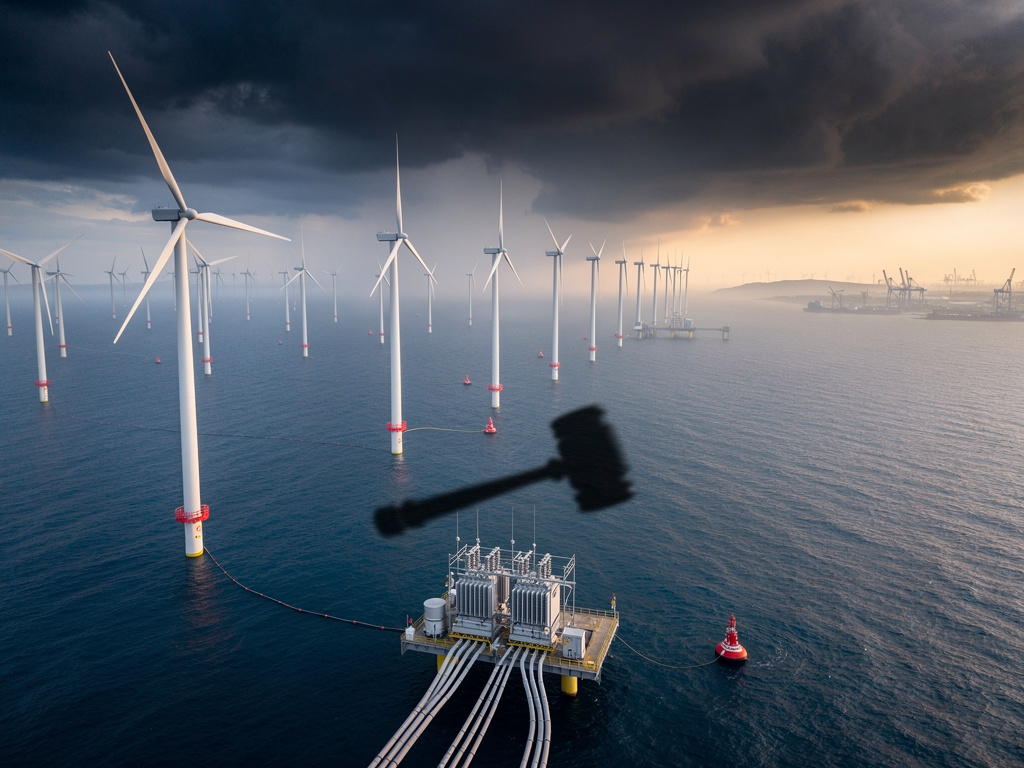
Turbines in Turmoil: Offshore Wind’s Legal Battle Against Trump’s Energy Clampdown
In the early days of 2026, the renewable energy sector finds itself embroiled in a high-stakes legal confrontation with the Trump administration. Multiple offshore wind developers have filed lawsuits challenging a sweeping stop-work order issued by the Department of the Interior, which has effectively halted construction on projects valued at approximately $25 billion. This move, justified by the administration on grounds of national security, has sent shockwaves through the industry, threatening thousands of jobs and delaying the nation’s transition to cleaner energy sources.
The order, announced just before the end of 2025, affects five major offshore wind farms along the Eastern Seaboard, from Virginia to New England. Developers argue that the abrupt suspension not only violates existing leases and permits but also represents an overreach of executive authority. According to court filings, the projects were in various stages of completion, with some nearing operational status, making the halt particularly disruptive.
At the heart of the dispute is the administration’s claim that these wind farms pose unspecified national security risks. While details remain classified, speculation abounds that concerns may involve foreign ownership of components or potential vulnerabilities in the energy grid. Industry experts point out that such fears echo long-standing criticisms from President Trump, who has repeatedly decried wind power as unreliable and economically burdensome.
Escalating Legal Challenges
Lawsuits have been pouring in from prominent developers. For instance, Ørsted, a Danish energy giant, is seeking an injunction to resume work on its Revolution Wind project off Rhode Island, which is reportedly 87% complete and slated to begin generating power imminently. The company’s filing argues that the stop-work order constitutes a constitutional violation, potentially leading to billions in losses if not reversed swiftly.
Similarly, Equinor and BP, partners in the Empire Wind project off New York, have joined the fray with their own legal action. Their complaint highlights the economic fallout, including impacts on supply chains and local economies dependent on these initiatives. Dominion Energy, overseeing the massive Coastal Virginia Offshore Wind farm, has also sued, emphasizing that the project represents the largest of its kind in the U.S. and was poised to power hundreds of thousands of homes.
These cases are being heard in federal courts, with developers requesting preliminary injunctions to allow construction to continue while the merits are debated. Legal analysts suggest that the outcomes could hinge on interpretations of the Outer Continental Shelf Lands Act, which governs federal waters where these projects are located.
Roots of the Administration’s Stance
The Trump administration’s antipathy toward offshore wind is not new. During his previous term and campaign, the president frequently lambasted wind energy for its intermittency and aesthetic impacts, once famously claiming it harms bird populations and views from coastal properties. The recent halt builds on earlier actions, such as the cancellation of $679 million in federal funding for wind infrastructure in 2025, as reported in various outlets.
This policy shift aligns with a broader agenda to prioritize fossil fuels and nuclear power. Interior Secretary Doug Burgum, a former energy executive, has defended the suspension by citing “classified national security risks,” though critics argue this is a pretext to dismantle renewable programs inherited from the Biden era. The move has drawn bipartisan criticism, with even some Republican lawmakers expressing concerns over job losses and energy affordability.
Public sentiment, as gleaned from social media platforms like X, reflects a polarized view. Supporters of the administration celebrate the decision as a blow against what they term a “renewable scam,” while opponents decry it as a setback for climate goals and economic growth. Posts from users highlight the tension, with one noting the potential for lower energy costs from these projects, underscoring the divide in public discourse.
Economic Ramifications Unfold
The financial toll of the halt is staggering. The five affected projects collectively represent over 5 gigawatts of capacity, enough to supply electricity to millions of households. Developers estimate daily losses in the millions due to idled equipment and workforce disruptions. Shares of companies involved, such as Ørsted and Equinor, plummeted following the announcement, wiping out billions in market value.
Beyond immediate costs, the suspension jeopardizes long-term investments in the U.S. offshore wind sector. Foreign firms, which dominate the industry due to their expertise, may reconsider future commitments if regulatory instability persists. Domestic suppliers, from turbine manufacturers to port operators, face uncertainty, potentially stalling the development of a robust American supply chain.
States along the East Coast, which have staked their energy futures on these projects, are also reeling. New York and New Jersey, for example, have ambitious mandates for renewable energy, and delays could force reliance on more expensive or polluting alternatives. Governors and local officials have voiced support for the lawsuits, arguing that federal overreach undermines state-led initiatives.
Industry Responses and Strategies
In response to the legal battles, developers are marshaling extensive evidence to counter the national security claims. Expert testimonies from cybersecurity specialists and energy consultants aim to demonstrate that wind farms pose no greater risk than other infrastructure. Some are even proposing enhanced monitoring or domestic sourcing to alleviate concerns, though skeptics doubt this will sway the administration.
Trade associations like the American Clean Power Association have ramped up lobbying efforts in Washington, seeking congressional intervention. They point to successful offshore wind deployments in Europe as models, where similar projects operate without security incidents. The group’s reports emphasize the sector’s potential to create over 50,000 jobs by 2030, a figure now in jeopardy.
Meanwhile, environmental groups are intervening in the lawsuits, arguing that the halt exacerbates climate change by delaying emission reductions. Organizations such as the Sierra Club highlight the irony: while the administration promotes energy independence, halting renewables increases dependence on imported fossil fuels.
Global Context and Comparisons
Looking abroad, the U.S. situation contrasts sharply with progress in other nations. The United Kingdom, for instance, has expanded its offshore wind capacity dramatically, now generating a significant portion of its electricity from turbines in the North Sea. China’s dominance in wind technology manufacturing adds another layer, as U.S. projects often rely on imported components, fueling the administration’s security worries.
This reliance has prompted calls for bolstering domestic production. Initiatives under previous administrations aimed to do just that, but the current freeze could reverse gains. Analysts from firms like BloombergNEF predict that if the lawsuits fail, the U.S. might lag further behind global peers in renewable adoption, affecting competitiveness in the clean energy market.
The disputes also raise questions about international trade. European developers, facing barriers in the U.S., may redirect investments elsewhere, potentially to markets in South America or Asia where policies are more favorable.
Potential Paths Forward
As the cases progress, attention turns to the judiciary’s role. Federal judges in districts like Rhode Island and New York will decide on injunctions, with appeals likely reaching higher courts. Legal precedents from environmental law, such as those involving pipeline halts, could influence rulings.
The administration, for its part, may seek to renegotiate leases or impose new conditions, though developers resist changes that could increase costs. Some insiders speculate that a compromise might involve phased resumptions for projects deemed low-risk, but optimism is tempered by the president’s staunch opposition.
Broader policy implications loom. If the courts side with developers, it could embolden challenges to other Trump-era energy decisions. Conversely, a win for the administration might accelerate the dismantling of renewable incentives, reshaping the nation’s power mix for years to come.
Voices from the Frontlines
Interviews with industry executives reveal frustration and determination. A project manager from Dominion Energy described the halt as “devastating,” noting that crews were ready to install final turbines when the order came. “We’ve invested years and billions; this isn’t just about energy, it’s about American innovation,” he said.
Union leaders echo these sentiments, warning of layoffs affecting skilled workers in construction and maritime trades. “These are good-paying jobs that families rely on,” one representative stated, urging swift resolution.
Environmental advocates, meanwhile, frame the issue in existential terms. “Every day of delay means more carbon in the atmosphere,” a campaigner noted, linking the lawsuits to global efforts against climate change.
Long-Term Industry Shifts
The controversy is prompting a reevaluation of risk in renewable investments. Financiers are now factoring in political volatility, potentially raising borrowing costs for future projects. Some developers are exploring diversification into solar or hydrogen to mitigate exposure.
Innovation continues apace, with advancements in floating turbines opening new areas for development beyond shallow coastal waters. Yet, without regulatory certainty, these technologies may first flourish overseas.
Ultimately, the lawsuits represent a pivotal moment for U.S. energy policy. As courts deliberate, the fate of offshore wind hangs in the balance, with implications rippling through economies, environments, and international relations.
Sources referenced in this article include insights from TechCrunch, which detailed the initial lawsuits; The New York Times on specific project challenges; Electrek covering Dominion’s suit; Reuters on the share price impacts; POLITICO for policy escalation; BBC on the administration’s opposition; Utility Dive detailing affected farms; Rhode Island Current on Revolution Wind’s injunction; another Electrek piece on growing backlash; and Long Island Press on Empire Wind’s filing. Additional context drawn from posts on X reflecting public and political sentiments.


 WebProNews is an iEntry Publication