
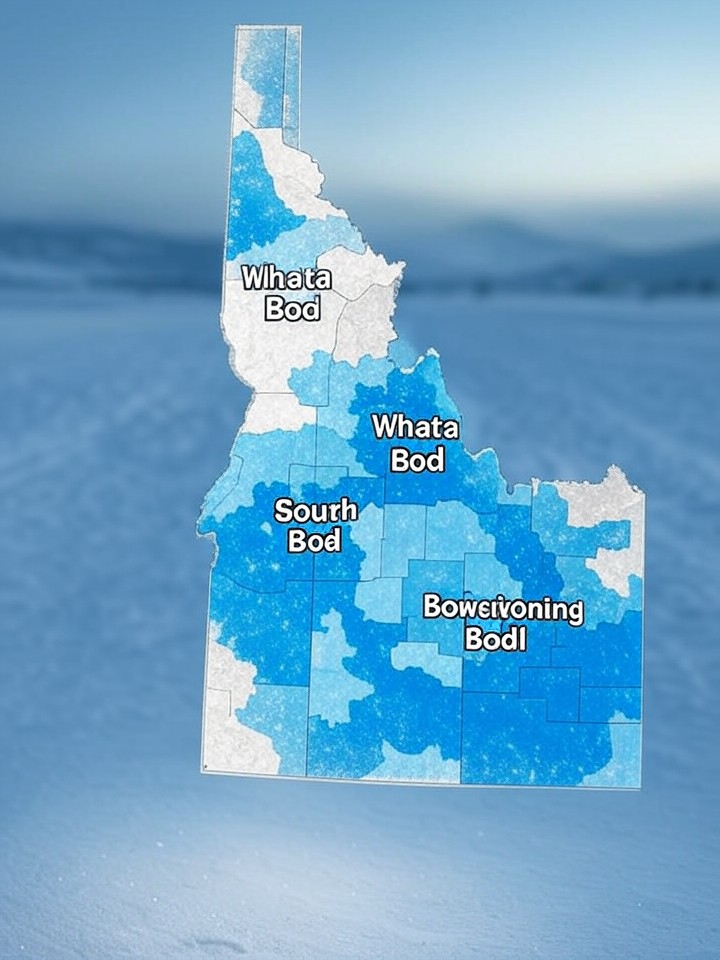
In a bizarre twist that underscores the perils of integrating artificial intelligence into public services, the National Weather Service (NWS) recently found itself in hot water after an AI-generated weather map featured entirely fabricated town names in Idaho. The incident, which unfolded earlier this week, involved a forecast graphic that included nonsensical labels like “Whata Bod,” a phrase that many interpreted as a crude pun. This mishap not only sparked online amusement but also ignited serious discussions about the reliability of AI in critical government operations.
The map, posted on social media by the NWS office in Pocatello, Idaho, was intended to depict snowfall predictions across the region. Instead, it hallucinated several fictional locations, blending real geography with invented ones. According to reports, the graphic was created using AI tools as part of a broader push by the agency to leverage machine learning for faster and more efficient forecasting. But the error quickly drew scrutiny, prompting the NWS to remove the image shortly after it was flagged.
Experts in the field point out that such “hallucinations” – where AI systems generate plausible but entirely false information – are a known vulnerability in large language models and generative technologies. In this case, the AI appears to have drawn from incomplete or noisy datasets, fabricating town names that bore no resemblance to actual Idaho locales. The fallout has been swift, with critics questioning whether the rush to adopt AI in weather prediction is compromising public trust.
The Push for AI in Meteorology
The NWS’s foray into AI isn’t isolated; it’s part of a larger initiative driven by the National Oceanic and Atmospheric Administration (NOAA), the agency’s parent organization. Late last year, NOAA announced the deployment of a new suite of AI-driven global weather models, promising enhanced accuracy and reduced computational demands. As detailed in a NOAA press release, these models aim to process vast amounts of data more efficiently, aiding forecasters in delivering timely alerts.
However, the Idaho incident highlights the teething problems in this transition. Sources indicate that the problematic map was generated using off-the-shelf AI software, possibly integrated with mapping tools, rather than a custom-built system. This approach, while cost-effective, may lack the safeguards needed to prevent errors in high-stakes applications like weather reporting, where accuracy is paramount.
Industry insiders note that the Trump administration’s emphasis on technological innovation has accelerated AI adoption across federal agencies. For instance, the establishment of a “Tech Force” last month, comprising 1,000 specialists tasked with building AI capabilities, reflects this priority. Yet, as one meteorologist anonymously shared, the pressure to innovate can sometimes outpace the development of robust oversight mechanisms.
Hallucinations: A Recurring AI Challenge
AI hallucinations aren’t new, but their appearance in official government communications amplifies the risks. In the NWS case, the fabricated towns included gems like “Whata Bod,” which social media users quickly decoded as a play on words resembling a vulgar expression. Other invented names were less provocative but equally fictional, such as variations that seemed to mash up real place names with random syllables.
This isn’t the first time the NWS has faced backlash over AI-generated content. According to a report from Yahoo News, a similar incident occurred last month when another office posted “lazy AI slop” on social media, prompting internal reviews. The pattern suggests systemic issues in how AI outputs are vetted before public dissemination.
Broader conversations in the tech sector reveal that hallucinations stem from the probabilistic nature of AI models, which predict outputs based on patterns in training data rather than true understanding. When applied to specialized fields like meteorology, where data must align with real-world geography, these models can falter if not fine-tuned properly. Researchers at institutions like MIT have long warned about such pitfalls, emphasizing the need for human-in-the-loop verification.
Public Reaction and Social Media Buzz
The story exploded on platforms like X, formerly Twitter, where users shared screenshots of the erroneous map alongside humorous commentary. Posts from accounts focused on weather anomalies and AI ethics amplified the incident, with some drawing parallels to past glitches in predictive models. For example, one widely viewed thread discussed how AI can “go wacky” when trained on incomplete datasets, echoing sentiments from tech enthusiasts who have observed similar issues in language models.
Mainstream media outlets picked up the thread rapidly. A piece in Futurism detailed how the map was taken down on Monday after notifications from journalists, highlighting the role of external oversight in catching these errors. The article also connected the blunder to the administration’s aggressive AI push, suggesting it could erode confidence in federal forecasting.
On X, reactions ranged from lighthearted memes to pointed criticisms of government efficiency. One user, a self-described meteorologist, explained that such anomalies might resemble “ground clutter” in radar data but are fundamentally different, stemming from generative AI’s creative liberties rather than sensor noise. This online discourse has fueled calls for greater transparency in how agencies like the NWS integrate emerging technologies.
Agency Response and Internal Fallout
In response to the incident, the NWS issued a statement acknowledging the error and reaffirming their commitment to accurate information. Officials explained that the AI tool was experimental and that human review processes are being strengthened. However, internal sources suggest the mishap has led to heated discussions about protocol, with some staff expressing frustration over the rapid rollout of unproven tools.
A deeper look reveals that the Pocatello office, responsible for the map, covers a vast area prone to severe weather events, making any lapse in credibility particularly concerning. As reported by The Washington Post, the graphic was pulled amid a “big agency push” to incorporate AI, but the error underscores the need for better integration strategies.
Comparisons to other sectors show similar growing pains. In healthcare, for instance, AI diagnostic tools have occasionally hallucinated symptoms, leading to misdiagnoses. Meteorology experts argue that weather services must adopt hybrid models, combining AI’s speed with human expertise, to mitigate these risks.
Broader Implications for Government AI Adoption
The Idaho hallucination serves as a cautionary tale for the federal government’s broader AI ambitions. With initiatives like the Department of Government Efficiency – albeit short-lived under Elon Musk’s influence – pushing for streamlined operations, agencies are under pressure to modernize. Yet, as DNYUZ noted, this zeal has sometimes overlooked the technology’s shortcomings.
Critics, including privacy advocates, worry that unchecked AI could lead to more than just embarrassing gaffes; in weather forecasting, inaccurate data might endanger lives during storms or wildfires. The incident has prompted calls from congressional oversight committees for audits of AI use in public safety domains.
Looking ahead, the NWS is likely to refine its AI protocols, possibly incorporating advanced error-detection algorithms. Industry observers predict that this event will accelerate the development of “explainable AI,” where models provide transparency into their decision-making processes, helping to rebuild trust.
Lessons from Idaho’s Phantom Towns
Delving into the technical underpinnings, the hallucinated map likely resulted from an AI model trained on geospatial data that included placeholders or corrupted entries. Tools like those from Google or open-source libraries can generate maps, but without domain-specific tuning, they risk inventing details to fill gaps. In Idaho’s case, the AI may have extrapolated from similar-sounding real towns, creating hybrids that sounded authentic at first glance.
This echoes findings from a Gizmodo article, which quipped about checking the weather in “Whata Bod,” underscoring the absurdity. Experts recommend rigorous testing phases, including adversarial training where models are exposed to edge cases to minimize hallucinations.
For industry insiders, the key takeaway is the importance of governance frameworks. Organizations like the American Meteorological Society are now advocating for standardized guidelines on AI in forecasting, drawing lessons from this and prior incidents.
Path Forward: Balancing Innovation and Reliability
As the NWS navigates this embarrassment, partnerships with tech firms could offer solutions. Collaborations with companies specializing in AI safety, such as Anthropic or OpenAI, might introduce safeguards like output filters that cross-reference generated content against verified databases.
Meanwhile, public sentiment on X continues to evolve, with some users sharing stories of other AI oddities in weather apps, from phantom storms to mislabeled regions. This grassroots feedback could inform future improvements, turning a viral blunder into a catalyst for better practices.
Ultimately, the incident in Idaho reveals the double-edged sword of AI in public service: immense potential tempered by the need for vigilance. As agencies refine their approaches, the focus must remain on ensuring that technological advancements enhance, rather than undermine, the essential work of keeping communities informed and safe. With ongoing scrutiny from media and policymakers, the NWS’s next steps will be closely watched, potentially setting precedents for AI integration across government functions.


 WebProNews is an iEntry Publication