
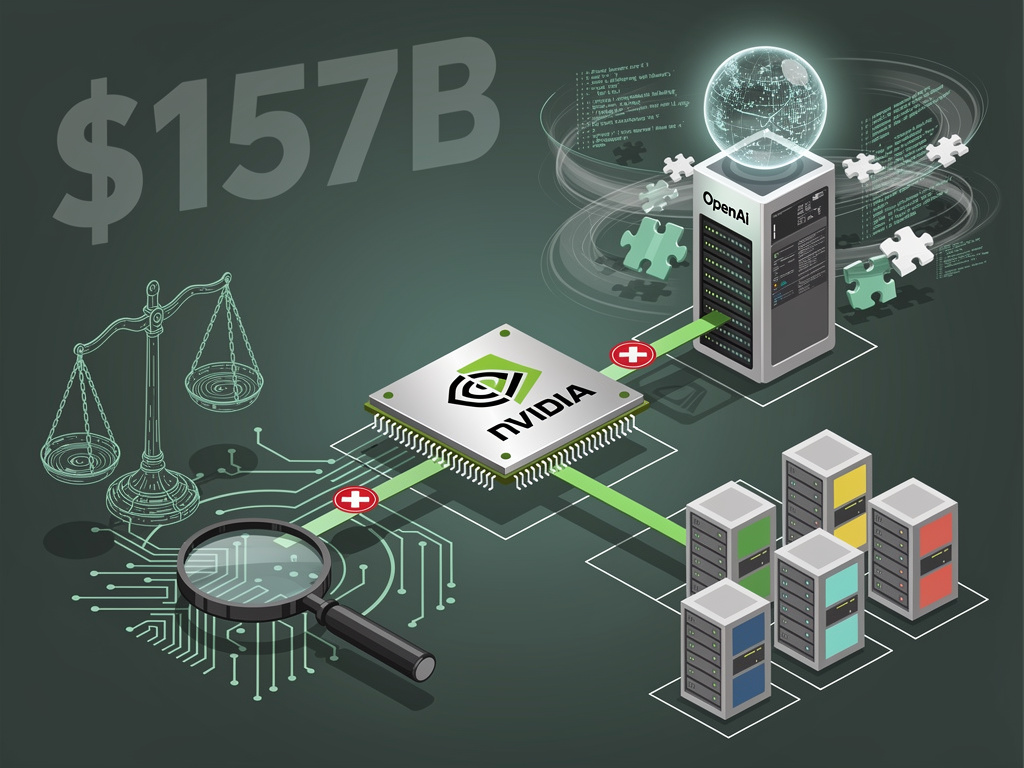
In Silicon Valley, the checkbook often speaks louder than the keynote address. Yet, in a move that has rippled through the venture capital sector, Nvidia CEO Jensen Huang has definitively signaled that the world’s most valuable chipmaker will not be taking an equity stake in OpenAI’s latest funding round. Despite rumors circulating for weeks that Nvidia would join Apple and Microsoft in a historic capital injection, Huang confirmed that such an investment is “not in the cards.”
This decision comes as OpenAI closes a funding round valuing the company at a staggering $157 billion, a figure that places the AI startup among the most valuable private entities in history. According to a report by Business Insider, Huang’s comments effectively end speculation regarding Nvidia’s direct financial participation in this specific tranche of capital raising. While the refusal may seem counterintuitive given the symbiotic relationship between the two companies, a closer examination of Nvidia’s market position reveals a calculated strategy of neutrality and regulatory caution.
The Architect of Neutrality
Nvidia currently enjoys a position of unparalleled dominance. As the primary supplier of the H100 and upcoming Blackwell GPUs—the silicon lifeblood of generative AI—the company functions as the central utility provider for the entire tech sector. Investing directly in OpenAI could compromise this perceived neutrality. By abstaining from the cap table, Nvidia avoids the appearance of favoritism among its clientele, a roster that includes OpenAI’s fiercest rivals: Meta, xAI, Google, and Amazon.
Taking an equity stake in the creator of ChatGPT could complicate relationships with these other hyperscalers, all of whom are racing to build competing foundation models. Huang’s strategy appears to be one of maintaining the “Switzerland” status of hardware. As noted in recent coverage by Reuters, the funding round was ultimately led by Thrive Capital, with participation from Microsoft and SoftBank, but the absence of Nvidia and Apple highlights a divergence in strategy among the tech giants regarding how deeply they wish to entangle themselves with Sam Altman’s enterprise.
Regulatory Headwinds and Antitrust Concerns
Beyond client relations, the specter of antitrust enforcement looms large over this decision. The Federal Trade Commission and the Department of Justice have ramped up scrutiny of “acqui-hires” and strategic investments that could stifle competition in the artificial intelligence sector. Microsoft is already navigating complex regulatory waters due to its massive $13 billion exposure to OpenAI. Had Nvidia joined the fold, it would have concentrated the bulk of the AI industry’s power—compute, capital, and software—into a singular, tightly knit coalition.
Legal experts suggest that Nvidia is keen to avoid giving regulators ammunition. The company is already under investigation in France and faces questions in the United States regarding its software licensing practices. Adding a direct financial tether to the market leader in Large Language Models (LLMs) would likely invite an immediate and aggressive probe. By stepping back, Huang allows Nvidia to focus on shipping hardware without the added burden of defending a vertical monopoly accusation.
The Economics of the “Arms Dealer”
Financially, Nvidia simply does not need the exposure. The company’s stock performance serves as a proxy for the entire AI industry. When OpenAI succeeds, demand for GPUs rises, and Nvidia’s revenue expands. Investing cash into OpenAI would essentially be a double-down on a bet Nvidia has already won. The chipmaker captures value at the top of the supply chain; owning a slice of the downstream application layer offers diminishing returns compared to investing that capital into its own R&D or supply chain resilience.
Furthermore, the valuation mathematics of this round are aggressive. Investing at a $157 billion valuation implies a belief that OpenAI will grow significantly beyond that figure to generate a meaningful return. While plausible, it is far riskier than Nvidia’s core business of selling the shovels for the gold rush. As reported by Bloomberg, Apple also withdrew from talks to invest in this round at the eleventh hour, suggesting that smart money in Cupertino and Santa Clara sees better uses for their balance sheets than fueling a valuation that has nearly doubled in under a year.
Structural Turmoil within OpenAI
The internal dynamics at OpenAI may have also played a role in Nvidia’s reticence. The startup is currently undergoing a painful restructuring from a non-profit governed organization to a public benefit corporation. This transition has sparked an exodus of top talent, including Chief Technology Officer Mira Murati and Chief Research Officer Bob McGrew. Such volatility at the executive level often gives institutional investors pause, regardless of the technological promise.
While Microsoft is deeply committed and effectively locked in, new investors like Nvidia have the luxury of choice. The governance crisis of late 2023, which saw Altman briefly ousted and then reinstated, exposed the fragility of OpenAI’s corporate structure. For a company like Nvidia, which prides itself on disciplined execution and stability, entrusting capital to a board still finding its footing might be viewed as an unnecessary gamble.
The SoftBank Factor and Competitive Capital
Interestingly, while Nvidia stepped aside, Masayoshi Son’s SoftBank stepped in with a $500 million check. SoftBank’s entry creates a complex dynamic. Son has been aggressively seeking to build an AI empire to rival the traditional U.S. tech giants, recently acquiring chip designer Graphcore. Nvidia competes with SoftBank-backed entities in various arenas. By letting SoftBank take the equity slot, Nvidia maintains a transactional relationship with OpenAI without aligning itself with SoftBank’s broader, often chaotic, investment thesis.
This separation allows Nvidia to supply SoftBank’s ventures, OpenAI, and their competitors without conflict. It validates the “platform” approach Huang has championed: Nvidia provides the stage, but it does not write the play. This distinction is vital for maintaining the trust of the developer community, who must believe that Nvidia’s hardware optimizations are not reserved solely for partners in whom it holds stock.
The Future of the AI Capital Stack
The conclusion of this funding round marks a turning point in how AI is financed. The era of universal participation by all Big Tech firms in every major deal appears to be fading. We are seeing a segmentation of the market. Microsoft acts as the cloud and infrastructure partner; Thrive Capital and VC firms provide the risk capital; and Nvidia remains the independent hardware sovereign. This separation of powers may ultimately be healthier for the industry, preventing a complete consolidation of control.
Nvidia’s decision to sit this one out is a flex of power, not a sign of weakness. It signals that the company is confident enough in its product roadmap—specifically the rollout of the Blackwell architecture—that it does not need to buy influence. As the industry moves toward the next generation of reasoning models, the demand for compute will only intensify. Jensen Huang knows that whether OpenAI is valued at $100 billion or $1 trillion, they will still need to call him for chips.


 WebProNews is an iEntry Publication