
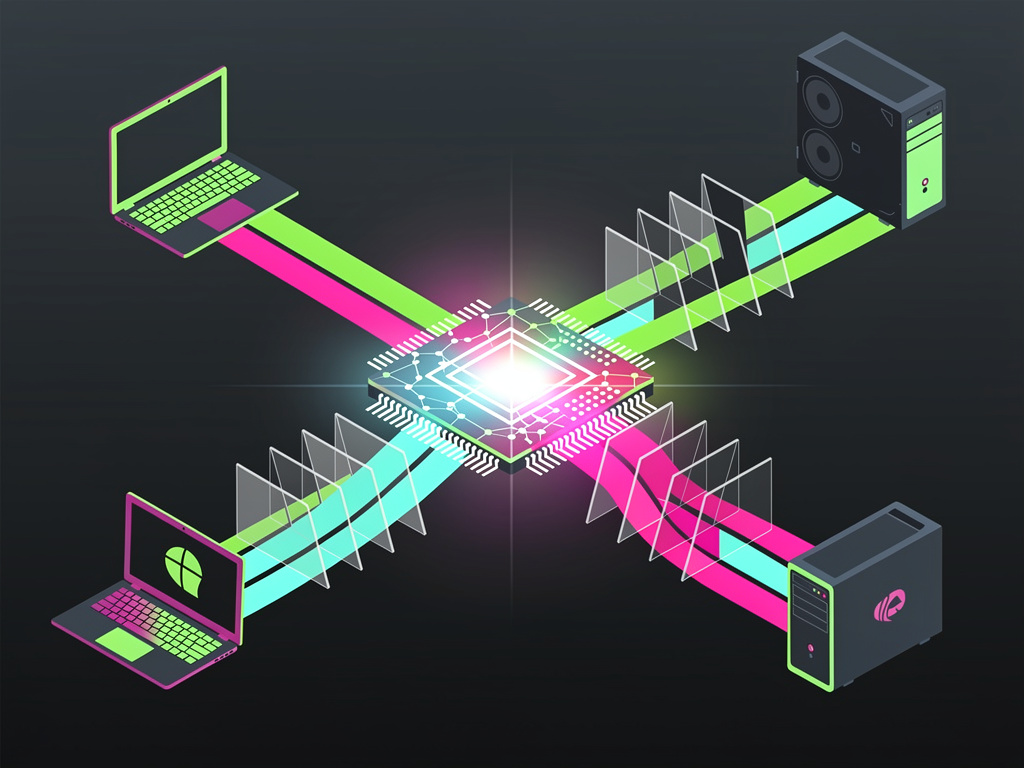
Jensen Huang stood in Taipei on Monday and declared the personal computer reborn. Forty years after the original PC wave, Nvidia’s CEO unveiled the RTX Spark superchip. It packs one petaflop of AI performance, up to 128GB of unified memory, and the full weight of Nvidia’s CUDA and RTX software stack into a single package built for Windows machines.
The chip, developed with partners including MediaTek, aims to run sophisticated AI agents directly on laptops and desktops. No constant cloud calls. No latency lag. Just an intelligent assistant that understands context, reads files, performs research, and acts on commands. “The PC is being reinvented,” Huang said. “For forty years, you launched apps. Click. Type. With RTX Spark and Microsoft Windows, you ask — and the PC does the work.”
That shift from tool to teammate carries heavy implications for the $200 billion-plus PC market. Nvidia, already the world’s most valuable company, now targets the devices millions use daily. New Windows PCs from Dell, HP, Lenovo, Microsoft, ASUS, MSI and others will ship with the technology this fall. Early models focus on content creation, gaming at high resolutions with ray tracing, and local execution of large language models with million-token contexts.
Market reception split between optimism and supply worries
PC makers have chased AI features for years. Microsoft and Qualcomm’s Copilot+ PCs launched with fanfare two years ago yet struggled to gain traction. Demand has proven uneven. HP reported AI-optimized systems made up 44% of its shipments in one recent quarter. Dell executives noted the boom arrived slower than hoped. Memory shortages and rising component costs continue to constrain shipments, with IDC forecasting a decline in overall PC volume for 2026 even as average selling prices rise.
But Huang dismisses past stumbles. He points to the arrival of capable local agents as the true inflection. “When it has an autonomous agent, an agent that’s helping you, that understands you, you could talk to it. It could look at you. You could ask it to read files, go help you do some research. It could do a lot more,” he told the audience at Nvidia’s GTC event. This is the first full-line PC reinvention in four decades, he added.
The technical foundation looks formidable. RTX Spark integrates a 20-core Arm-based Grace CPU with a Blackwell-derived GPU boasting 6,144 CUDA cores. It supports fifth-generation FP4 precision for efficiency. Developers gain access to TensorRT, OptiX, DLSS, and Reflex. Adobe plans to rebuild Photoshop and Premiere Pro around the architecture for faster AI-driven workflows. Gaming targets 1440p frame rates above 100 fps with full ray tracing.
Microsoft’s role runs deeper than co-marketing. The companies spent three years aligning Windows with on-device agents. New security primitives and the NVIDIA OpenShell runtime aim to contain agents safely. Satya Nadella called the combination a breakthrough. Vincent Koc of the OpenClaw Foundation and Nous Research’s Dillon Rolnick both endorsed the stack for private, local execution of powerful models.
Analysts offer measured approval. Lian Jye Su of Omdia sees more consumer choice as positive. Neil Shah of Counterpoint Research described the move as one that could drive agentic AI into every home, turning the PC into a household supercomputer akin to dishwashers or lawn mowers. Huang himself predicted AI supercomputers would become ordinary appliances.
Yet execution risks remain. Previous AI PCs disappointed because on-device models lagged cloud performance and battery life suffered. Memory supply squeezes could limit how many high-end configurations reach shelves. Intel and AMD, already under pressure, saw their shares drop more than 3% in early trading Monday while Nvidia climbed nearly 4%. The chipmaker also highlighted its new Vera CPU for data centers, now in full production with early wins at OpenAI, Anthropic and SpaceX. Huang called it a major new growth driver.
Beyond laptops, Nvidia showed a humanoid robot reference design named Isaac GR00T. Standing nearly six feet tall on a Unitree H2 chassis with dexterous hands from Singapore startup Sharpa, it signals ambitions in physical AI and robotics research, particularly for universities.
The bigger picture centers on agentic AI. Huang devoted much of his keynote to the idea that every company will soon run agents, from personal productivity tools to frontier models. Local execution promises privacy, lower latency, and reduced cloud costs. Whether consumers pay premium prices for these capabilities will decide if this reinvention sticks.
PC shipments have stagnated for years. Software has grown more complex while hardware gains delivered diminishing returns for average users. If agents deliver tangible daily value — summarizing meetings, managing calendars, editing video with simple voice commands — the equation changes. Nvidia brings its data-center dominance, software moat, and manufacturing relationships to bear. Microsoft supplies the operating system backbone.
Success is far from guaranteed. But the announcement carries the confidence of a company that has repeatedly reshaped computing. Huang didn’t mince words. “This is going to be the new PC.”
Industry watchers will track fall launches closely. Early reviews, battery performance, and real-world agent usefulness will set the tone. For now, the message from Taipei is clear: the PC just received its most ambitious upgrade in a generation. And Nvidia intends to power it.


 WebProNews is an iEntry Publication