
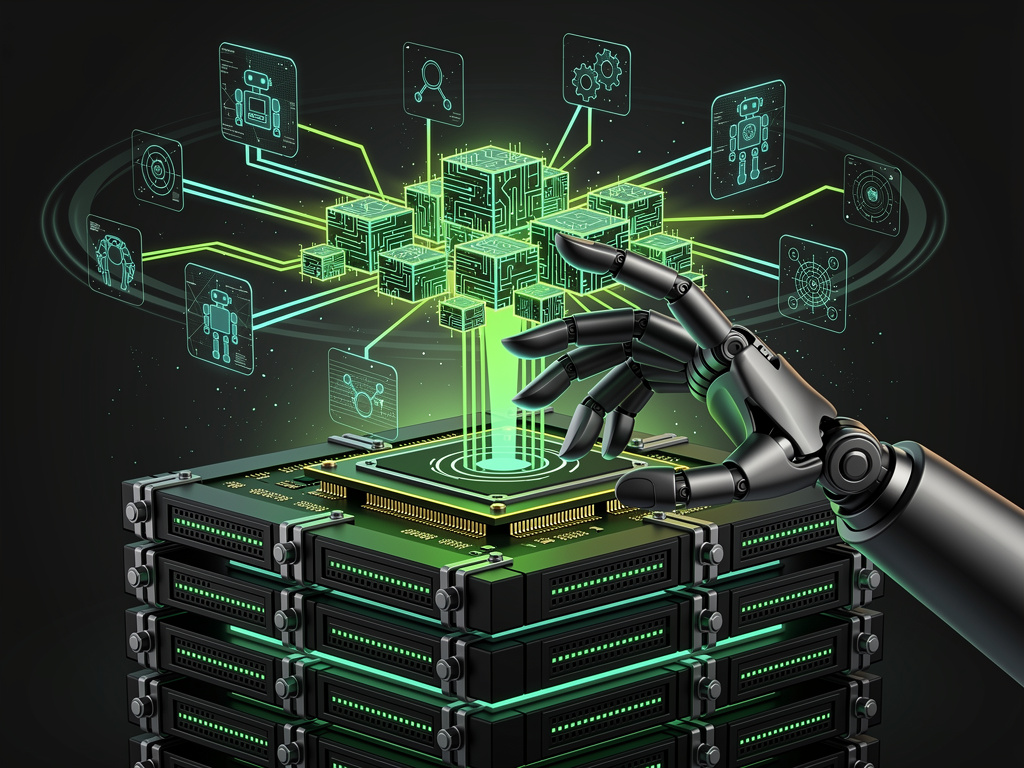
Nvidia CEO Jensen Huang isn’t content with dominating the AI chip market. He wants to own the physical world too — or at least the software layer that controls it. The company’s OpenClaw initiative, a largely under-the-radar open-source robotics project, signals where Huang thinks the next massive wave of AI spending is headed: robots that can actually do things.
And not just any robots. Dexterous, general-purpose machines capable of manipulating objects with human-like precision.
What OpenClaw Actually Is — And Why It Matters
OpenClaw is an open-source platform for robotic hand manipulation, developed by Nvidia Research. Think of it as a standardized toolkit — hardware designs, simulation environments, and trained AI policies — that lets researchers and companies build dexterous robotic hands without starting from scratch. The project was first detailed in a Business Insider report examining Huang’s broader physical AI strategy, which positions Nvidia not just as a chip supplier but as the foundational infrastructure provider for the entire robotics stack.
The hardware component is a low-cost, 3D-printable robotic claw. The software side is where it gets interesting. Nvidia has paired it with Isaac Sim, its GPU-accelerated simulation platform, allowing developers to train manipulation policies in virtual environments before deploying them on physical hardware. The sim-to-real transfer problem — getting AI trained in simulation to work reliably in the messy real world — has historically been one of robotics’ hardest challenges. Nvidia is betting its GPU dominance gives it a structural advantage here.
Huang has been explicit about this vision. During Nvidia’s GTC 2025 keynote, he declared that “the next wave of AI is physical AI” and positioned robotics as a market potentially larger than data center compute. That’s a staggering claim from a company already valued north of $3 trillion on the back of its data center GPU business.
But Huang has a track record of making staggering claims that pan out.
The open-source angle is strategic, not charitable. By releasing OpenClaw freely, Nvidia is running the same playbook that made CUDA the default programming model for AI: give away the software, create dependency on your hardware. Every researcher who builds on OpenClaw trains models on Nvidia GPUs. Every company that adopts Isaac Sim for robot training buys more Nvidia compute. The moat isn’t the claw. It’s the compute underneath.
The Competitive Context
Nvidia isn’t operating in a vacuum. The robotics space has exploded over the past 18 months. Google DeepMind’s RT-2 and its successors have demonstrated increasingly capable robotic foundation models. Tesla continues to pour resources into Optimus, its humanoid robot program. Startups like Figure, Cobot, and 1X Technologies have collectively raised billions. And China’s robotics sector — companies like Unitree and Agibot — is moving at a pace that’s caught Western observers off guard.
So why does Nvidia’s approach stand apart?
Scale. Nvidia controls roughly 80-90% of the AI training chip market, according to estimates from multiple analysts cited by Reuters. That installed base means any Nvidia-native robotics toolchain has an automatic distribution advantage. Researchers already have the hardware. They already know CUDA. The friction to adopt OpenClaw is minimal compared to building proprietary alternatives.
There’s also the simulation advantage. Training a robot in the real world is slow, expensive, and dangerous. Training in simulation is fast and parallelizable — especially on Nvidia’s Omniverse platform, which can spin up thousands of simulated environments simultaneously. A company with 1,000 H100 GPUs can train robotic manipulation policies orders of magnitude faster than one relying on physical trial-and-error. This creates a flywheel: better simulation drives better robots, which drives more demand for Nvidia compute.
Meta has made similar open-source moves in language models with Llama. The parallel is instructive. Meta’s open-source strategy didn’t diminish its competitive position — it expanded Meta’s influence while commoditizing the layer above its core business. Nvidia appears to be doing the same, but for physical AI.
The timing matters too. Huang has reportedly told investors and partners that he sees 2026 as an inflection year for physical AI deployments, per the Business Insider report. Warehouse automation, manufacturing, and logistics are the near-term targets. Humanoid robots in consumer settings remain further out, but the enterprise applications are real and near.
One thing worth watching: the hardware-software integration play. Nvidia’s Jetson Thor platform, announced for humanoid robots, pairs its GPU architecture with robotics-specific computing. OpenClaw feeds into this broader stack. A developer who prototypes with OpenClaw in Isaac Sim, then deploys on Jetson Thor hardware, is locked into Nvidia’s world at every layer. That’s not accidental.
Critics argue that open-source robotics tools from a company with Nvidia’s market power could crowd out independent alternatives and concentrate too much control. There’s precedent for concern — CUDA’s dominance has made it extraordinarily difficult for AMD and Intel to compete in AI training despite offering competitive silicon. If OpenClaw becomes the default starting point for dexterous manipulation research, Nvidia’s grip on physical AI could mirror its grip on digital AI.
But for now, most robotics researchers seem enthusiastic. Free, high-quality tools backed by serious engineering resources? Hard to argue against that when you’re a PhD student or a startup with limited runway.
What Comes Next
The real test for OpenClaw and Nvidia’s physical AI ambitions isn’t whether researchers adopt the tools. They will. The test is whether the sim-to-real gap narrows enough to produce commercially viable robotic manipulation at scale. Picking up objects in simulation is solved. Picking up arbitrary objects in an unstructured warehouse — reliably, thousands of times a day, without breaking anything — is not.
Nvidia is essentially making a trillion-dollar bet that the same brute-force scaling approach that worked for language models will work for robotics. More compute, more simulated data, better policies. It’s an empirical question, not a theoretical one. And Nvidia has more compute than anyone.
For industry professionals, the signal is clear. Nvidia is positioning itself as the default platform for physical AI the same way it became the default for training large language models. Whether you’re building robots, investing in robotics companies, or competing with Nvidia, OpenClaw isn’t just a research project. It’s a strategic declaration.
Huang doesn’t make small bets. This one deserves attention.


 WebProNews is an iEntry Publication