
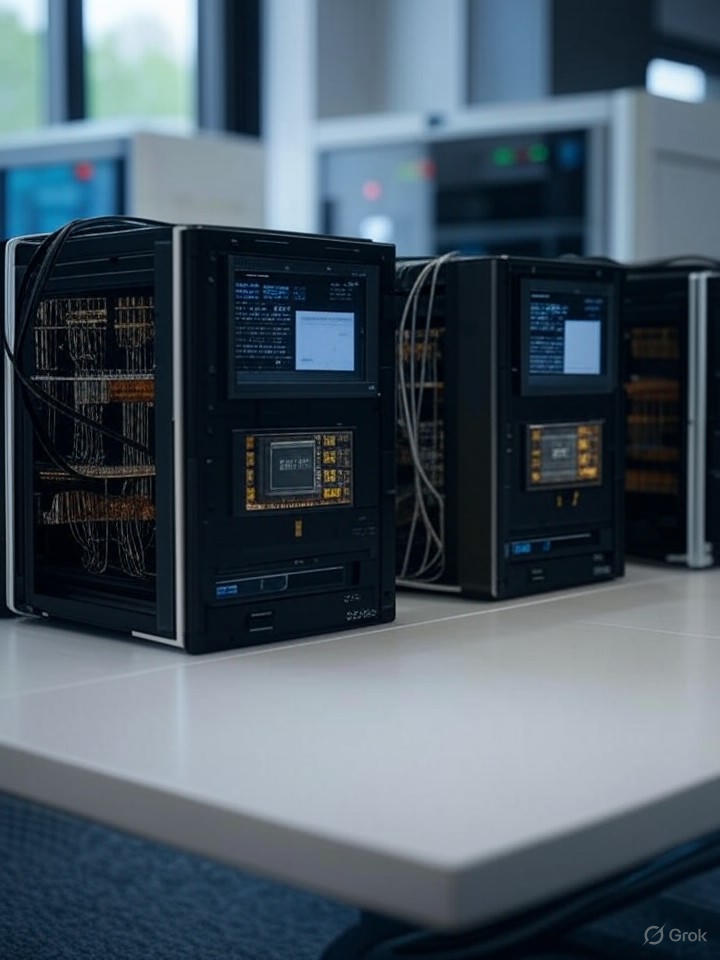
Nvidia’s NVQLink Ushers in Quantum-GPU Era
In a bold move that could redefine the landscape of high-performance computing, Nvidia Corp. has unveiled NVQLink, an innovative interconnect designed to seamlessly bridge quantum processors with classical GPU-based supercomputers. Announced by Nvidia CEO Jensen Huang at the company’s Washington conference on October 28, 2025, this technology promises to accelerate the development of quantum supercomputers by addressing key challenges in error correction and computational integration.
NVQLink acts as a high-speed link, enabling quantum processors to leverage the immense power of AI supercomputers for tasks that quantum systems alone struggle with, such as rapid error correction. As Huang described it in a press release, ‘NVQLink is the Rosetta Stone connecting quantum and classical supercomputers – uniting them into a single, coherent system that marks the onset of the quantum-GPU computing era,’ according to Investing.com.
The Architecture Behind NVQLink
The NVQLink system is an open architecture, allowing quantum hardware builders to integrate their processors directly with Nvidia’s GPU ecosystems. This interconnect facilitates tight coupling, ensuring low-latency communication essential for real-time error correction in quantum computing, where errors from quantum decoherence are a persistent hurdle.
Tim Costa, Nvidia’s general manager of industrial engineering and quantum, emphasized the role of AI in this process: ‘AI will be necessary for full-scale error correction,’ as reported by Slashdot. Earlier attempts at integration fell short in speed and scale, but NVQLink aims to overcome these limitations by providing the bandwidth needed for massive-scale operations.
Partnerships Driving Adoption
Nvidia has already secured commitments from 17 quantum hardware builders and nine scientific labs, including prominent institutions like Brookhaven National Laboratory. This broad ecosystem support underscores the technology’s potential to become a standard in hybrid quantum-classical systems.
The announcement highlights collaborations that will connect quantum processors to world-leading supercomputing labs, enabling advanced research in fields such as materials science and drug discovery. As detailed in a NVIDIA Newsroom release, NVQLink is positioned as critical infrastructure for quantum’s future, without Nvidia building its own quantum computers.
Quantum Computing’s Error Correction Challenge
Quantum processors exploit principles of quantum physics to tackle problems intractable for classical computers, but they are notoriously error-prone. NVQLink addresses this by offloading error correction to GPU-accelerated AI systems, potentially reducing qubit error rates and paving the way for scalable quantum computing.
Industry insiders note that this integration could lead to ‘useful quantum supercomputers in 5 years,’ echoing sentiments from Huang in earlier discussions captured in posts on X, where he predicted exponential growth in logical qubits, akin to Moore’s Law.
Huang’s Vision for Hybrid Computing
Jensen Huang has long championed the synergy between quantum and classical computing. In a keynote, he stated, ‘Every single supercomputing center is going to go quantum classical, every 100%,’ as shared in various X posts and reported by Nextgov/FCW.
This vision aligns with Nvidia’s strategy to dominate the quantum-classical hybrid market. By not competing directly in quantum hardware, Nvidia focuses on enabling infrastructure, much like its role in AI acceleration.
Implications for Scientific Research
The deployment of NVQLink could transform research at labs like those mentioned in GlobeNewswire, where quantum processors will connect to supercomputing resources for simulations in quantum chemistry and physics.
Experts predict this will accelerate breakthroughs in areas requiring immense computational power, such as climate modeling and cryptography. Nvidia’s CUDA-Q platform, mentioned in X discussions, is seen as revolutionary for enabling this hybrid approach.
Market Response and Competitive Landscape
Following the announcement, Nvidia’s stock saw positive movement, reflecting investor confidence in its quantum pivot. Competitors like IBM and Google, active in quantum hardware, may need to adapt to this interconnect standard to remain compatible.
Quantum Machines announced its integration with NVQLink, extending real-time quantum-classical solutions, as per a PR Newswire release, signaling early industry buy-in.
Technological Inflection Point
Huang has described quantum computing as hitting an inflection point, with logical qubits scaling rapidly. ‘I could expect 10x more every 5 years, 100x every 10,’ he said in prior statements echoed on X and in Financial Post.
This scaling, combined with NVQLink, positions hybrid systems to solve ‘interesting’ problems soon, bridging the gap between theoretical quantum advantage and practical application.
Challenges and Future Prospects
Despite the optimism, challenges remain, including the need for cryogenic environments for quantum processors and the high costs of integration. Nvidia’s open architecture aims to mitigate these by fostering collaboration.
Looking ahead, NVQLink could reduce error rates in qubits, as Huang noted in his keynote, potentially leading to a new era of computing where quantum ‘sees’ nature’s ground truth, and AI ‘understands’ it, per insights from X posts and Techbuzz.
Ecosystem Expansion and Global Impact
The involvement of international labs suggests NVQLink’s global reach, potentially standardizing quantum-classical interfaces worldwide. This could democratize access to quantum computing for researchers beyond elite institutions.
As Nvidia continues to innovate, the quantum-GPU era may not only enhance computational capabilities but also drive economic growth in tech sectors, with ripple effects across industries reliant on advanced simulations.


 WebProNews is an iEntry Publication