
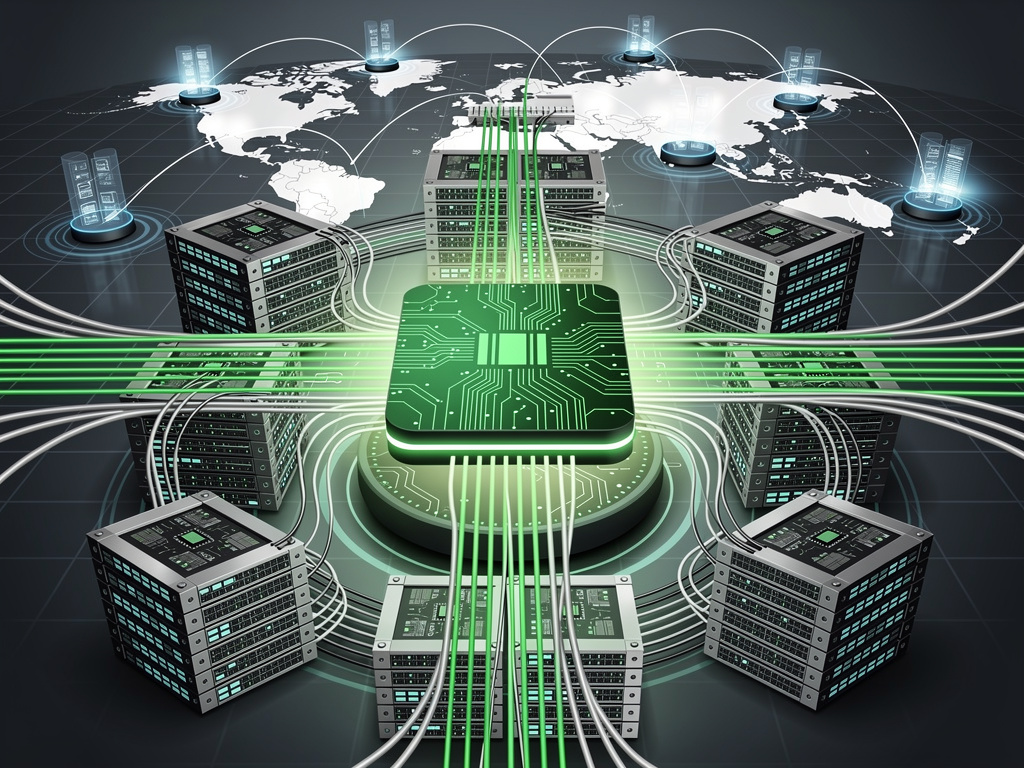
For years, the investment thesis on Nvidia has been almost entirely about GPUs — the processors that power the artificial intelligence boom and have turned the company into one of the most valuable on Earth. But inside Nvidia’s sprawling operations, another business has been quietly compounding into something that demands its own spotlight. The networking division, built on a series of acquisitions and organic engineering bets, is emerging as a multibillion-dollar force that could reshape how the industry thinks about data center infrastructure.
And it’s growing fast enough to make some of Nvidia’s rivals nervous.
According to TechCrunch, Nvidia’s networking segment has been on a trajectory that mirrors the early growth curve of its GPU business — posting revenue gains that outpace the broader networking market by a wide margin. The division, which encompasses high-speed interconnects, switches, network interface cards, and the software that ties it all together, has become indispensable to the hyperscale data centers where AI training actually happens. Without the networking fabric to move data between thousands of GPUs at blistering speeds, even the most powerful chips become bottlenecks.
That’s the fundamental insight driving Nvidia’s push. Raw compute isn’t enough.
From Mellanox to Market Dominance
The roots of Nvidia’s networking ambitions trace back to its $6.9 billion acquisition of Mellanox Technologies in 2020 — a deal that, at the time, raised eyebrows for its price tag but now looks like one of the shrewdest moves in recent semiconductor history. Mellanox brought InfiniBand technology, the high-bandwidth, low-latency interconnect standard that has become the backbone of AI supercomputing clusters worldwide. It also brought a deep bench of networking engineers, many of them based in Israel, who have since become central to Nvidia’s infrastructure strategy.
Jensen Huang, Nvidia’s CEO, has repeatedly framed networking as inseparable from computing in the AI era. During the company’s most recent earnings calls, he’s described the data center as a single unit of computing — not a collection of discrete components but an integrated system where GPUs, CPUs, DPUs, and the network connecting them must be designed together. That vision has translated into concrete product lines. NVLink, Nvidia’s proprietary chip-to-chip interconnect, now scales across entire server racks. The company’s Spectrum-X Ethernet networking platform targets AI workloads specifically, offering what Nvidia claims is dramatically better performance than standard Ethernet for distributed training jobs. And ConnectX network adapters have become standard equipment in high-performance computing environments.
The financial results back up the strategy. While Nvidia doesn’t break out networking revenue as a standalone line item with full granularity, analysts estimate the segment is generating north of $10 billion annually — a figure that would make it one of the largest networking businesses in the world on a standalone basis. For context, Arista Networks, a pure-play networking company considered a major force in cloud data centers, reported approximately $5.9 billion in revenue for its most recent fiscal year.
So Nvidia’s networking business, often treated as a footnote in analyst reports dominated by GPU figures, may already be roughly twice the size of one of its most prominent competitors.
The competitive dynamics here are shifting quickly. Broadcom, which supplies custom AI chips and networking silicon to hyperscalers, has been Nvidia’s most formidable rival in data center networking. Cisco, the legacy networking giant, has been investing heavily to remain relevant in AI-optimized infrastructure. But Nvidia holds a structural advantage that neither can easily replicate: vertical integration. Because Nvidia designs both the compute engines and the networking hardware, it can optimize the entire data path from GPU memory to network fabric, eliminating inefficiencies that arise when components from different vendors must interoperate.
This isn’t a theoretical advantage. Customers building large-scale AI training clusters have reported measurable performance gains when using Nvidia’s end-to-end stack versus mixing and matching components. The performance gap, according to engineers at several hyperscale operators, becomes more pronounced as cluster sizes grow — precisely the direction the industry is heading as frontier AI models demand ever-larger compute footprints.
The InfiniBand vs. Ethernet Battle — and Why It Matters
One of the most consequential technical debates in enterprise infrastructure right now is whether InfiniBand or Ethernet will dominate AI networking. It’s not an abstract question. Billions of dollars in capital expenditure decisions hinge on the answer.
InfiniBand has been Nvidia’s crown jewel since the Mellanox deal. It offers lower latency and higher throughput than traditional Ethernet, making it the preferred choice for tightly coupled AI training workloads where thousands of GPUs must synchronize constantly. Most of the world’s largest AI supercomputers — including systems built for OpenAI, Meta, and various government research labs — run on InfiniBand fabrics supplied by Nvidia.
But Ethernet has scale, ubiquity, and momentum on its side. Nearly every data center on the planet runs Ethernet. The supply chain is deep. The engineering talent pool is vast. And the cost structure is well understood. For many enterprises and cloud providers, the idea of deploying a proprietary interconnect technology controlled by a single vendor — even one as dominant as Nvidia — creates uncomfortable dependencies.
Nvidia recognized this tension early. Rather than betting exclusively on InfiniBand, the company developed Spectrum-X, an Ethernet-based networking platform purpose-built for AI. Spectrum-X uses Nvidia’s own switch silicon and network adapters, combined with software optimizations, to deliver what the company says is 1.6x better AI networking performance compared to traditional Ethernet solutions. It’s a hedge — and a shrewd one. If the market moves toward Ethernet for AI, Nvidia wants to own that transition rather than be disrupted by it.
The Ultra Ethernet Consortium, an industry group that includes AMD, Broadcom, Intel, Microsoft, and Meta, has been working to develop an open Ethernet standard optimized for AI workloads. The consortium’s existence is itself an acknowledgment that standard Ethernet isn’t sufficient for AI networking — and that the industry would prefer an open alternative to Nvidia’s proprietary options. But open standards move slowly. Nvidia is shipping product now.
That timing advantage matters enormously in a market where hyperscalers are spending tens of billions of dollars per quarter on AI infrastructure and can’t afford to wait for standards bodies to reach consensus.
There’s also a less discussed but significant dynamic at play: the networking business provides Nvidia with a strategic moat around its GPU franchise. When a customer deploys Nvidia GPUs connected by NVLink and InfiniBand, switching to a competitor’s chips becomes far more costly and disruptive than simply swapping out processors. The networking layer creates stickiness. It raises switching costs. It turns a hardware sale into a platform commitment.
Wall Street has begun to notice. Several sell-side analysts have published notes in recent months arguing that Nvidia’s networking assets are undervalued in the company’s current stock price. Morgan Stanley, in a research note earlier this year, estimated that Nvidia’s networking business alone could command a valuation of $150 billion to $200 billion if it were an independent company — a figure that reflects both its current revenue trajectory and its strategic importance to the AI infrastructure buildout.
Not everyone is convinced the growth rate is sustainable. Some industry observers point out that networking revenue is inherently tied to the pace of data center construction, which could slow if AI spending hits a plateau or if macroeconomic conditions tighten. Others note that Nvidia’s dominance in networking is partly a function of its dominance in GPUs — customers buy Nvidia networking because they’re already buying Nvidia compute. If competitors like AMD or custom silicon from hyperscalers erode Nvidia’s GPU market share, the networking business could face headwinds too.
These are legitimate concerns. But they also apply to virtually every company in the AI infrastructure supply chain, and Nvidia’s position at the center of that supply chain gives it more resilience than most.
The company’s roadmap suggests it isn’t slowing down. Nvidia has announced plans for next-generation NVLink technology that will enable even larger GPU clusters to communicate as if they were a single processor. Its networking software stack, including DOCA (the data center infrastructure-on-a-chip architecture) and related tools, is designed to make Nvidia’s networking hardware programmable and adaptable — qualities that enterprise customers increasingly demand as workloads diversify beyond pure AI training into inference, retrieval-augmented generation, and other emerging patterns.
And then there’s the DPU — the data processing unit, branded as BlueField, that Nvidia positions as a third major processor category alongside CPUs and GPUs. BlueField offloads networking, storage, and security tasks from the CPU, freeing up compute resources for applications. It’s been slower to gain traction than Nvidia’s GPUs, but adoption is accelerating as cloud providers look for ways to improve infrastructure efficiency. Every BlueField DPU sold is another node in Nvidia’s networking web.
What Comes Next
The broader picture here is one of convergence. Networking, compute, and software are collapsing into integrated platforms, and the companies best positioned to deliver those platforms will capture disproportionate value. Nvidia understood this before most of its competitors. The Mellanox acquisition wasn’t just a bet on InfiniBand — it was a bet on the idea that the network would become as important as the processor in determining AI performance.
That bet is paying off. Spectacularly.
For investors, the networking division represents both an underappreciated growth driver and a source of competitive durability. For Nvidia’s competitors, it represents a problem that’s getting harder to solve with each passing quarter. And for the broader technology industry, it’s a reminder that the AI boom isn’t just about chips. It’s about everything that connects them.
The data center of the future won’t be defined by any single component. It will be defined by the system — and right now, no one is building that system more aggressively, or more profitably, than Nvidia.


 WebProNews is an iEntry Publication