
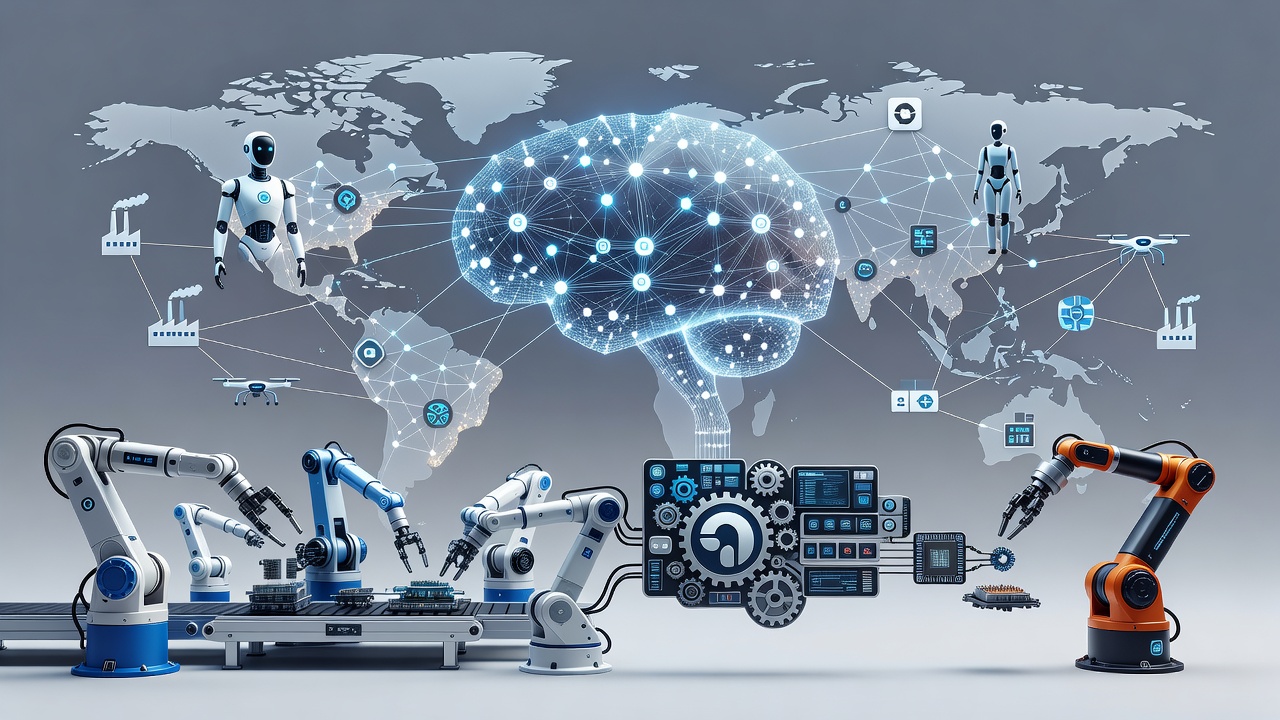
Nvidia just handed the robotics community a powerful new set of tools. The company released updated Isaac GR00T models along with enhancements to its Cosmos world models. These additions arrived through partnerships and open-source channels. Developers now gain direct access via Hugging Face’s LeRobot library.
The moves build on months of rapid iteration. Back in January Nvidia unveiled initial versions of GR00T and Cosmos at CES. Partners such as Boston Dynamics, LG Electronics and Franka Robotics demonstrated next-generation machines powered by the tech. Jensen Huang, Nvidia’s CEO, declared the moment significant. “The ChatGPT moment for robotics is here,” he said in the company’s press release. Breakthroughs in models that understand the real world, reason and plan actions unlock new applications.
Fast forward to July. Nvidia and Hugging Face integrated GR00T 1.7, an open reasoning vision-language-action model built for humanoid robots. They also added Isaac Teleop, a framework that captures high-quality data from human demonstrations. Cosmos 3, described as a frontier world model, is slated to join soon. Thomas Wolf, cofounder of Hugging Face, captured the spirit. “Open source is how a field turns advanced research into something people can study, adapt and build on,” he noted in Nvidia’s blog post.
Why does this matter now? Robotics has long struggled with data scarcity and fragmented tools. GR00T 1.7 changes the equation. It was pretrained on roughly 32,000 hours of real human demonstrations and 8,000 hours of simulation data. The model uses a Cosmos-Reason2-2B backbone based on Qwen3-VL architecture. This setup supports flexible image resolutions without padding. It improves task decomposition, long-horizon reasoning and generalization across different robot bodies.
Developers can fine-tune the model for new tasks or embodiments. Benchmarks show strong performance in complex manipulation and navigation. And the integration into LeRobot lowers the barrier. What once required specialized Nvidia environments now sits alongside millions of other AI projects on Hugging Face. The platform connects Nvidia’s three million robotics-focused developers with Hugging Face’s 16 million AI builders. Distribution, it turns out, may prove as important as the model weights themselves.
Cosmos Reason 2 complements the picture. This vision-language model tops public leaderboards for physical reasoning. Robots and agents use it to perceive scenes more accurately, understand context and decide on interactions. Earlier versions like Cosmos Reason helped GR00T N1.6 achieve better contextual awareness. The latest iteration pushes accuracy higher. Synthetic data generation receives a boost too. Cosmos Transfer and Predict models create realistic video sequences across varied environments. They fill gaps where real-world footage falls short.
Nvidia’s physical AI dataset has surpassed 15 million downloads on Hugging Face. It includes over 350,000 trajectories and 57 million grasps. New additions such as the GRAIL dataset offer 50 hours of humanoid-object interaction footage. Six synthetic video collections cover robotics, physics, digital humans, autonomous driving, warehouse operations and spatial reasoning. These assets train Cosmos 3, which unifies vision, language, video, audio and action in one omnimodal framework. A recent arXiv paper details the architecture. Titled “Cosmos 3: Omnimodal World Models for Physical AI”, it lists hundreds of Nvidia contributors and explains how the mixture-of-transformers design handles multiple input-output configurations.
Hardware keeps pace. The Jetson Thor platform powers many of these systems. It delivers onboard compute for real-time reasoning and control. In June Nvidia introduced an Isaac GR00T Reference Humanoid Robot. Built on a Unitree H2 Plus body with Sharpa five-fingered hands, the platform targets academic researchers. Huang highlighted its potential. “Humanoid robots will bring physical AI to the world’s largest industries, opening a multitrillion-dollar economic opportunity,” he stated in the announcement. The reference design combines simulation, teleoperation, synthetic data and deployment in one package.
Industry adoption accelerates. LG Electronics applies Cosmos and GR00T to video analysis, cutting incident resolution time in half. The same models train surgical robots through transfer learning. Franka Robotics, NEURA Robotics and others use GR00T for simulation, training and validation of manipulation skills. Caterpillar expands its autonomy collaboration with Nvidia. Boston Dynamics integrates the stack for navigation and object handling. Even aviation firms test Jetson-based systems for safety-critical autonomy.
Recent developments add momentum. On July 7 Nvidia published guidance on end-to-end humanoid policy development. The developer blog walks through the full pipeline from Isaac Lab simulation to Jetson deployment. It emphasizes how the new VLM backbone enhances performance over prior Eagle-based versions. Separate coverage from Automate.org examined announcements at GTC. The outlet reported Nvidia’s declaration of a “big bang” in physical AI, with updates to Cosmos world models, Isaac frameworks and GR00T variants.
Yet challenges remain. Real-world deployment demands safety, reliability and cost control. Open models help address the first two by allowing broad scrutiny and iteration. Cost may follow as hardware scales. The Jetson T4000, a Blackwell-powered edge computer, offers four times the performance of previous generations at 70 watts. Priced at $1,999 in volume, it targets industrial and research users. OSMO, Nvidia’s edge-to-cloud orchestration framework, simplifies training workflows across environments. Isaac Lab-Arena provides standardized benchmarking so teams compare policies fairly.
Competitors watch closely. Mistral released its own robotics foundation model in recent weeks. French and Chinese labs push open-weight alternatives. But Nvidia supplies the underlying compute, simulation engines and data pipelines that many rely on. Its full stack spans CUDA, Omniverse, Isaac Sim and now these open foundation models. Partners build on top rather than start from scratch.
The July collaboration with Hugging Face marks a strategic expansion. LeRobot already hosted Nvidia’s largest open physical AI dataset. Adding GR00T 1.7 and Teleop creates end-to-end workflows inside one repository. Developers capture human demos, generate synthetic data with Cosmos, train policies with GR00T and evaluate in Isaac Lab-Arena. Deployment targets Reachy 2 or other compatible hardware via ONNX and TensorRT export.
Analysts see broader economic ripples. Humanoids could transform manufacturing, logistics, elder care and more. Success hinges on models that generalize beyond narrow tasks. GR00T’s focus on full-body control and multistep reasoning aims squarely at that goal. Early results from partner deployments suggest progress. Surgical scopes guided by Thor-powered systems show promise in precision medicine. Warehouse robots handle complex pick-and-place with fewer errors.
Still, the technology sits in early stages. Most demonstrations occur in controlled settings. Scaling to unstructured homes or busy factories will test robustness. Data quality matters as much as quantity. Teleop helps by letting humans provide nuanced examples that pure simulation misses. Cosmos then amplifies those examples into varied scenarios.
Nvidia continues to iterate quickly. New skills libraries pair with Cosmos to accelerate everything from policy training to evaluation. A CVPR paper and accompanying blog detailed physical AI agent capabilities powered by Cosmos 3. Researchers gain tools to move from model training to real-world validation faster than before.
The open approach carries risks and rewards. Weights and datasets are public. Anyone can inspect, modify or compete. For Nvidia the bet is that ecosystem growth drives demand for its chips and enterprise software. So far the strategy appears to pay off. Downloads climb. Partnerships multiply. And the pace of announcements shows no sign of slowing.
Look ahead. Expect tighter integration between simulation and reality. Improved world models will predict not just visuals but physical consequences and optimal actions. Humanoids may soon learn household chores or factory workflows from a handful of demonstrations. The foundation models provide the base. Creative engineers and companies will determine what they build on top.
One thing looks clear. The barrier between AI research and practical robotics has dropped. Nvidia’s latest releases make advanced physical intelligence available to a far wider audience. The real test begins as developers download the models, run the workflows and ship the next wave of intelligent machines.


 WebProNews is an iEntry Publication