
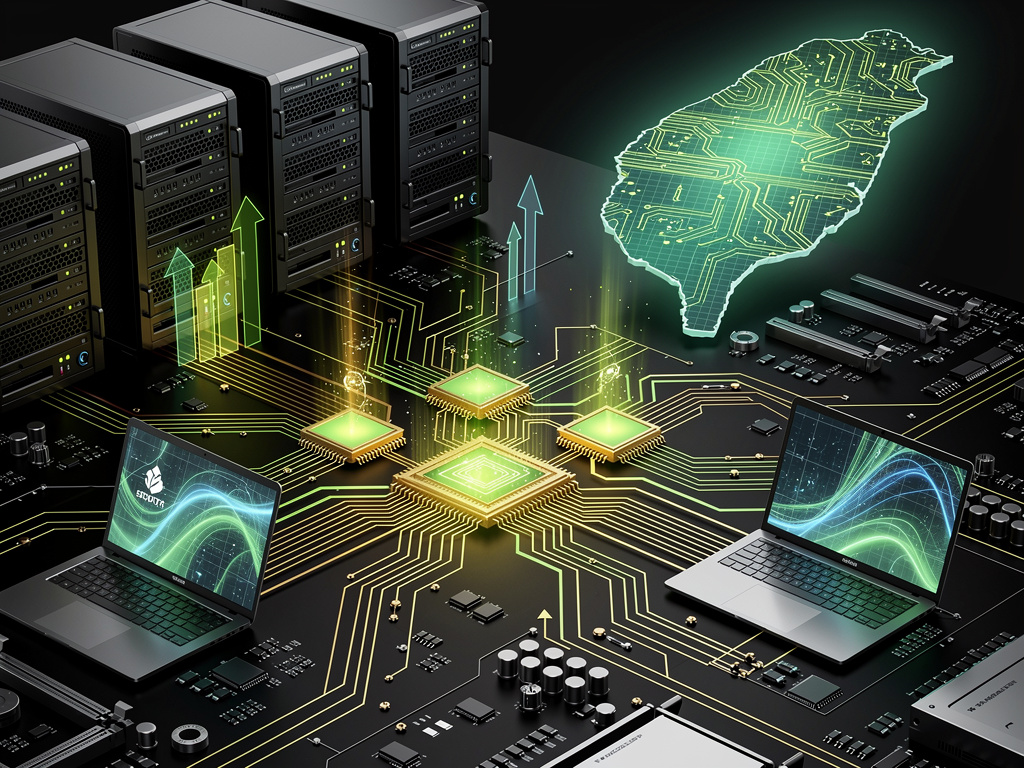
Nvidia’s Jensen Huang stood before an audience in Taipei this week and delivered a message as direct as his black leather jacket. AI agents have arrived. They won’t eliminate software engineers. They will multiply them. And the hardware needed to run those agents locally, in data centers and on personal computers, positions his company for years of expansion.
The Computex keynote and follow-up remarks blended vision with numbers. Nvidia reported $81.6 billion in revenue for its latest quarter, up 85% from a year earlier. Data-center sales jumped 92%. Networking revenue nearly tripled. Yet Huang insists the growth has barely started. Tokens have become profitable units of revenue. Every efficient inference now adds to the bottom line. Every wasted watt subtracts from it.
Huang dismissed fears of AI-driven layoffs with characteristic bluntness. “People talk about AI reducing jobs. Complete nonsense,” he told Bloomberg, as reported by Yahoo Finance. “The number of engineers, software engineers, is actually increasing.” He built the case methodically. Give one engineer tools that generate enormous output and companies will hire more of them. “If you can hire a software engineer and you could generate $9 trillion worth of productive work, why wouldn’t you want to hire more software engineers?” The logic lands hard in an industry still digesting recent headcount reductions at big tech firms.
But Huang’s comments went far beyond labor markets. He unveiled the RTX Spark, a new chip designed to bring advanced AI capabilities directly into laptops and desktops. Set to launch this fall in systems from Dell, Lenovo and others, the part emerged from three years of collaboration with Microsoft. Huang called it part of the biggest reinvention of the PC in 40 years. The goal is clear: shift from cloud-dependent chatbots to local, autonomous agents that act on a user’s behalf.
These agents represent more than convenience. They mark a shift in architecture. Two years ago the industry discussed how AI would change the human-computer interface. Now that change materializes in silicon. Huang told the crowd that 2026 marks the year of agents. The RTX Spark enables them to run on the device rather than query distant servers for every task. Privacy improves. Latency drops. And Nvidia gains a foothold in a market long dominated by Intel, AMD and Apple.
At the same time, the company pushes deeper into data-center CPUs. Its Vera processor has entered full production. Early customers include OpenAI, Anthropic and SpaceX. Huang declared it “going to be our new major growth driver,” according to Reuters. He predicted the CPUs could prove even more popular than the GPUs that built the company’s dominance. The move opens a $200 billion addressable market the chip maker had not previously targeted, The Motley Fool noted.
Supply constraints persist even as demand surges. Huang addressed the issue head-on the day after his keynote. “We’ve secured supply for very robust growth of all of those systems,” he said at a press conference. “We have supply for very, very robust growth, but we’re still supply constrained.” The statement, carried by Reuters, covered both GPUs and the new Vera CPUs, including systems built around the upcoming Vera Rubin architecture.
Taiwan sits at the heart of this expansion. Huang, born in Tainan, praised the island’s manufacturers and its investments in U.S. facilities. Nvidia now spends roughly $150 billion a year there, up dramatically from earlier levels. “Taiwan is such an incredible strategic partner for the United States,” he said. The company works with TSMC, Amkor, SPIL, Wistron and Foxconn to diversify and strengthen the global supply chain. He called Taiwan the epicenter of the AI revolution.
Partners lined up to support the vision. SK Hynix executives joined Huang for dinner during the week. The memory maker plans to double wafer production capacity over the next five years to feed AI demand. Networking suppliers also drew attention. Huang singled out Marvell Technology as a company that could become the next trillion-dollar semiconductor firm, a comment that sent its shares soaring more than 20% in premarket trading, The Wall Street Journal reported.
The broader theme repeated across appearances. AI has moved past research demonstrations and simple productivity aids. It now functions as infrastructure that generates profit and contributes to GDP. Data centers operate like factories. Their output — tokens — carries direct revenue. Efficiency in power and throughput translates immediately to financial results. “If you have 1 gigawatt of power, then throughput per watt is revenues,” Huang explained in remarks summarized by SiliconANGLE.
Physical AI and robotics received attention too. The company showed progress on humanoid platforms and autonomous systems. Yet the spotlight stayed fixed on agentic computing and the hardware layers required to make it practical at scale. Open models, accelerated computing platforms and new software tools all feed into the same flywheel.
Investors have rewarded the execution. Nvidia’s market value crossed $3.5 trillion earlier this year. The stock reacts instantly to Huang’s pronouncements. When he praised Meta’s use of AI or highlighted Marvell’s potential, markets moved within hours. That influence reflects more than charisma. It signals the company’s central place in the supply chain for the next phase of artificial intelligence.
Challenges remain. Competition in inference accelerators intensifies. Power consumption at hyperscale facilities strains grids. Geopolitical tensions around Taiwan add risk to every forecast. Still, Huang projects confidence. The company has lined up capacity for the next wave of growth. Customers from cloud providers to startups continue to place orders. And the shift toward local agents on personal devices could open consumer markets that dwarf today’s data-center opportunity.
So the message from Taipei was both defensive and expansive. Defensive against narratives of job destruction. Expansive about the commercial possibilities ahead. AI agents won’t replace engineers. They will demand more of them. They won’t shrink the PC market. They will transform it. And Nvidia intends to supply the chips that make the transformation possible. The numbers so far suggest that bet is paying off handsomely.


 WebProNews is an iEntry Publication