
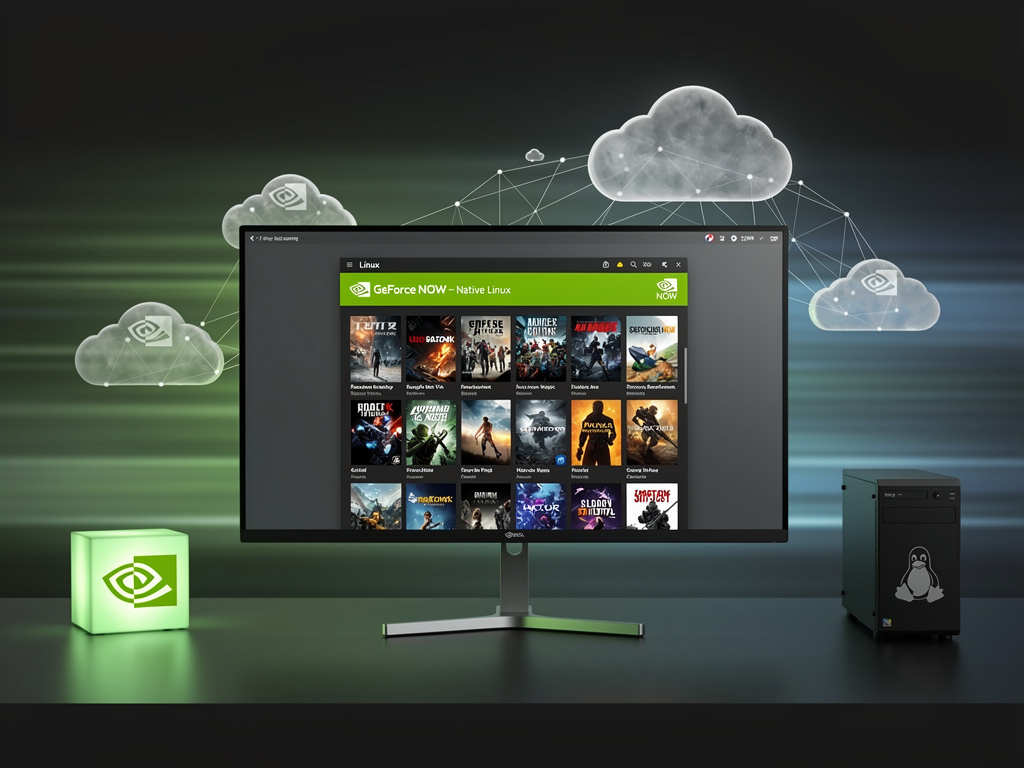
After years of workarounds and community-driven solutions, Nvidia has officially launched native Linux support for its GeForce Now cloud gaming service, marking a significant shift in the company’s approach to the open-source gaming community. The move, announced in late January 2025, represents more than a mere technical update—it signals a strategic recognition of Linux’s growing importance in the gaming ecosystem and could potentially reshape how cloud gaming services approach platform diversity.
According to Slashdot, the native Linux client eliminates the need for users to rely on browser-based access or third-party applications that previously served as makeshift solutions. This development arrives at a critical juncture when Linux gaming has gained unprecedented momentum, driven largely by Valve’s Steam Deck and the maturation of compatibility layers like Proton. Industry observers note that Nvidia’s decision to invest resources in a native Linux client reflects both the platform’s expanding user base and the company’s commitment to comprehensive cloud gaming coverage across all major operating systems.
The timing of this release coincides with broader trends in the gaming industry, where cloud gaming services are increasingly viewed as essential infrastructure rather than experimental offerings. GeForce Now, which allows users to stream games they already own from platforms like Steam, Epic Games Store, and Ubisoft Connect, has steadily built a subscriber base that now numbers in the millions. By extending native support to Linux, Nvidia is effectively acknowledging that the platform’s users represent a valuable and growing segment of the gaming market—one that has historically been underserved by major gaming companies.
Technical Implementation and Performance Considerations
The native Linux client brings several technical advantages over previous access methods. Browser-based streaming, while functional, often introduced latency issues and limited access to advanced features that Windows and macOS users enjoyed. Third-party solutions, though appreciated by the community, lacked official support and could break with updates to either GeForce Now or the underlying Linux distributions. The official client promises optimized performance, better integration with Linux desktop environments, and access to the full feature set available on other platforms.
Early reports from the Linux gaming community suggest that the native client delivers on these promises, with users noting improved responsiveness and stability compared to browser-based streaming. The client supports various Linux distributions, though Nvidia has primarily tested and optimized for popular choices like Ubuntu and its derivatives. This approach mirrors strategies employed by other software vendors entering the Linux space, where supporting the most widely-used distributions first allows for broader compatibility testing before expanding to more specialized variants.
Market Implications for Cloud Gaming Competition
Nvidia’s move places additional competitive pressure on other cloud gaming services, many of which have yet to offer native Linux support. Microsoft’s Xbox Cloud Gaming, Amazon Luna, and other competitors have largely focused on Windows, macOS, and mobile platforms, leaving Linux users to rely on browser access or community-developed solutions. By providing a native Linux experience, GeForce Now differentiates itself in a crowded market and potentially captures users who prioritize open-source platforms.
The decision also reflects Nvidia’s unique position in the cloud gaming market. Unlike competitors who maintain exclusive game libraries, GeForce Now operates on a bring-your-own-game model, allowing users to stream titles they’ve already purchased. This approach reduces Nvidia’s content acquisition costs while appealing to gamers who prefer to maintain ownership of their game libraries. Native Linux support enhances this value proposition, particularly for users who have invested in Linux-compatible game libraries through platforms like Steam, which has significantly expanded Linux game availability in recent years.
The Steam Deck Effect and Linux Gaming Renaissance
The rise of Linux gaming cannot be discussed without acknowledging Valve’s transformative impact through the Steam Deck. Since its launch in 2022, the handheld gaming device has sold millions of units, all running on a custom Linux distribution called SteamOS. This success has demonstrated that Linux can provide a seamless gaming experience when properly implemented, challenging long-held assumptions about the platform’s viability for mainstream gaming.
Valve’s Proton compatibility layer, which allows Windows games to run on Linux with minimal performance penalties, has been instrumental in this transformation. The technology has matured to the point where thousands of Windows-exclusive titles now run smoothly on Linux systems, dramatically expanding the platform’s gaming library. Nvidia’s decision to support Linux natively for GeForce Now likely reflects an understanding that the Steam Deck’s success represents a broader trend rather than an isolated phenomenon—Linux gaming is not merely surviving but thriving.
Developer and Publisher Response to Platform Diversity
The expansion of cloud gaming to Linux also has implications for game developers and publishers, who must now consider how their titles perform across an increasingly diverse array of platforms and streaming services. While most developers don’t need to create Linux-native versions of their games for GeForce Now—since the games run on Nvidia’s Windows-based servers—the growing Linux user base may encourage more studios to develop native Linux versions for local play.
This shift toward platform diversity presents both challenges and opportunities. On one hand, supporting multiple platforms increases development and testing costs. On the other, it opens access to previously untapped markets and demonstrates a commitment to inclusivity that resonates with many gamers. Some independent developers have already embraced Linux support, finding that the platform’s users represent an engaged and loyal community willing to support studios that prioritize cross-platform compatibility.
Enterprise and Professional Gaming Applications
Beyond consumer gaming, native Linux support for GeForce Now has implications for enterprise and professional applications. Many software developers, 3D artists, and other professionals use Linux as their primary operating system for work-related tasks. The ability to access cloud gaming services natively on Linux systems could facilitate use cases beyond entertainment, such as testing game builds, demonstrating software capabilities, or accessing GPU-intensive applications through the cloud.
Nvidia has long positioned itself as a leader in professional graphics and computing, with its GPUs powering everything from scientific research to artificial intelligence development. The company’s decision to support Linux for GeForce Now aligns with this broader strategy, reinforcing its commitment to the platform across both consumer and professional segments. This holistic approach to Linux support could strengthen Nvidia’s position as developers and professionals increasingly seek unified solutions that work seamlessly across their entire workflow.
Privacy and Open-Source Philosophy Alignment
The Linux community has historically valued privacy, transparency, and user control—principles that sometimes conflict with the data collection practices common in modern gaming services. By offering native Linux support, Nvidia demonstrates a willingness to engage with users who prioritize these values, though questions remain about how the service handles user data and whether the client itself incorporates any open-source components.
Some community members have called for Nvidia to open-source portions of the GeForce Now client, arguing that transparency would build trust and allow for community contributions that could improve the software. While Nvidia has not indicated plans to do so, the company’s engagement with the Linux community through native client development represents a significant step toward acknowledging the platform’s distinct culture and values. This engagement could pave the way for more collaborative relationships between proprietary software vendors and open-source communities.
Future Trajectory and Industry Standardization
Looking ahead, Nvidia’s native Linux support for GeForce Now may encourage other cloud gaming providers to follow suit, potentially establishing Linux as a standard platform for cloud gaming services. As the technology matures and user expectations evolve, comprehensive platform support—including Linux—could become a differentiating factor that influences consumer choices and market positioning.
The broader trend toward platform-agnostic gaming experiences, where users can access their game libraries from any device or operating system, aligns with the fundamental principles of cloud computing. Native Linux support represents another step toward this vision, removing artificial barriers that have historically limited where and how users can access their entertainment. As 5G networks expand and cloud gaming technology improves, the importance of supporting diverse platforms will only increase, making Nvidia’s current investment in Linux support a potentially prescient strategic move that positions the company favorably for the next phase of gaming’s evolution.


 WebProNews is an iEntry Publication