
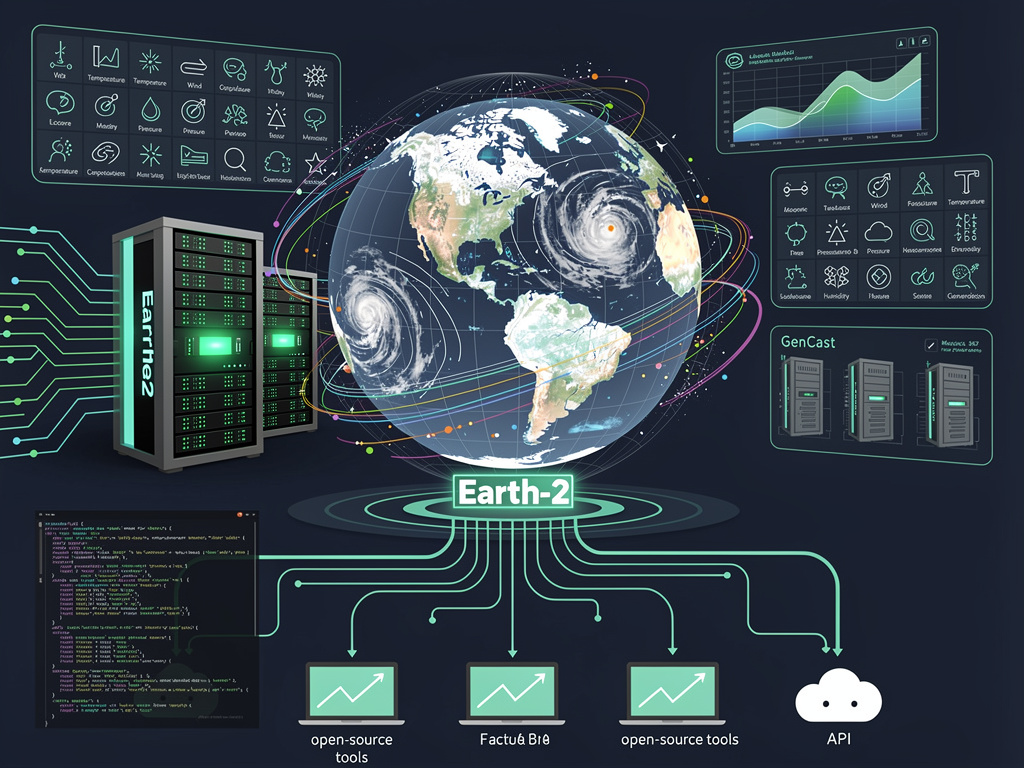
As a brutal winter storm battered the U.S. East Coast on January 26, 2026, with snowfall forecasts swinging wildly across regions, Nvidia Corp. unveiled its Earth-2 suite of open AI weather models at the American Meteorological Society’s annual meeting in Houston. The timing was uncanny: Nvidia’s new Earth-2 Medium Range model, powered by the company’s novel Atlas architecture, claims superior accuracy over Google DeepMind’s GenCast across more than 70 variables like temperature, pressure, wind and humidity for forecasts up to 15 days out, according to TechCrunch.
“Philosophically, scientifically, it’s a return to simplicity,” said Mike Pritchard, Nvidia’s director of climate simulation, emphasizing a shift to scalable transformer architectures over bespoke AI designs, as reported by TechCrunch. Earth-2 Medium Range tops GenCast—itself a benchmark-beater from December 2024—on over 70 variables, per the same report, while delivering medium-range predictions that could have stabilized the chaotic storm forecasts gripping the nation.
The full Earth-2 family marks Nvidia’s bold push into a domain long dominated by physics-based supercomputing behemoths. Traditional forecasts guzzle hours on massive clusters; Earth-2 slashes that to minutes on GPUs, democratizing access for nations and firms lacking supercomputer budgets.
Atlas Powers Medium-Range Mastery
At the core lies Earth-2 Medium Range, built on Atlas, enabling high-accuracy 15-day forecasts across 70+ variables. It outperforms leading open models on industry-standard benchmarks for key metrics, detailed in Nvidia’s research paper linked from its blog post. “On standard benchmarks, it outperforms leading open models on the most common forecasting variables measured by the industry,” Nvidia stated.
Complementing it, Earth-2 Nowcasting uses the StormScope architecture for generative AI-driven, kilometer-resolution predictions of storms and hazards from zero to six hours ahead—in minutes. It’s the first to surpass physics-based models on short-term precipitation by directly simulating storm dynamics and predicting satellite or radar imagery, per Nvidia’s announcement.
Earth-2 Global Data Assimilation, via HealDA, generates initial atmospheric snapshots—temperature, wind, humidity, pressure—at thousands of global spots in seconds on GPUs, versus hours on supercomputers. Paired with Medium Range, it yields the most skillful open AI-only pipeline, Nvidia claims in its blog.
Full Stack Speeds and Scales
Existing tools round out the suite: Earth-2 CorrDiff downscales continental predictions to regional high-resolution up to 500 times faster than legacy methods, while FourCastNet3 delivers superior accuracy on wind, temperature and humidity—beating top ensembles and rivaling diffusion models at 60 times the speed, as outlined by SiliconANGLE and Nvidia’s blog.
All models, pretrained and with frameworks, recipes and libraries, hit GitHub via Earth2Studio and Hugging Face for commercial and noncommercial use. Global Data Assimilation follows later in 2026. Nvidia integrates open efforts from ECMWF, Microsoft and Google, using PhysicsNeMo for training, per the Nvidia blog.
“This provides the fundamental building blocks used by everyone in the ecosystem—national meteorological services, financial service firms, energy companies,” Pritchard told TechCrunch. Sovereignty counts too: “Weather is a national security issue, and sovereignty and weather are inseparable.”
Partners Validate Real-World Edge
Brightband, an AI weather provider, runs Earth-2 Medium Range operationally for daily global forecasts. “Brightband is among the first to run Earth-2 Medium Range operationally, and the model being open-source speeds up innovation,” CEO Julian Green said in Nvidia’s blog.
Israel Meteorological Service uses CorrDiff, planning Nowcasting, slashing compute by 90% at 2.5-km resolution. “NVIDIA Earth-2 models give us a 90% reduction in compute time,” Director Amir Givati noted in the Nvidia blog. TotalEnergies’ Emmanuel Le Borgne hailed Nowcasting: “NVIDIA Earth-2 represents a major step forward in how advanced weather intelligence can be operationalized at scale,” per SiliconANGLE and Nvidia.
Others testing: Taiwan’s Central Weather Administration, The Weather Company, U.S. National Weather Service, Eni, GCL Technology, S&P Global Energy, Southwest Power Pool with Hitachi, Jua, Metdesk, AXA and JBA Risk Management, as listed in Nvidia’s blog and SiliconANGLE.
Timing Amid Storm Chaos
The launch synced with a U.S. storm where predictions varied wildly, underscoring legacy limits. Nvidia’s tools, processing satellite data globally for Nowcasting, adapt anywhere with coverage, Pritchard added to TechCrunch. Bloomberg noted Earth-2’s two-week predictions and nowcasts for severe weather impacts.
On X, Nvidia’s newsroom posted: “We are proud to announce the NVIDIA Earth-2 family of open models—the world’s first fully open, accelerated AI weather stack,” linking the blog, with users like @StockMKTNewz amplifying the video demo.
In parallel, Warsaw’s Rainbow Weather raised $5.5 million in seed funding from investors including Flo Health founder Yuri Gurski to extend its ML-driven, hyperlocal precipitation forecasts from four to 24 hours, fusing radar, satellites and barometers, per The Next Web. Co-founder Alexander Matveenko critiqued legacy optical flow: “That’s a fast but simplistic method that treats clouds as shapes in motion, without any understanding of atmospheric physics.”
Industry Momentum Builds
Nvidia’s move challenges supercomputer gatekeepers, empowering smaller players. Earth-2 Global Data Assimilation alone cuts 50% of traditional supercomputing loads to minutes, Pritchard said in TechCrunch. Partners like TotalEnergies eye short-term risk in energy, where “minutes and local impacts matter,” Le Borgne told Nvidia.
X buzz from @nvidianewsroom and @SiliconANGLE highlighted the stack’s reach, while TechCrunch’s coverage tied it to the storm, positioning Earth-2 as prescient. As AI eclipses physics in speed and access, Nvidia cements its pivot from chips to domain-specific stacks, fueling forecasts that could avert billions in storm damages.


 WebProNews is an iEntry Publication