
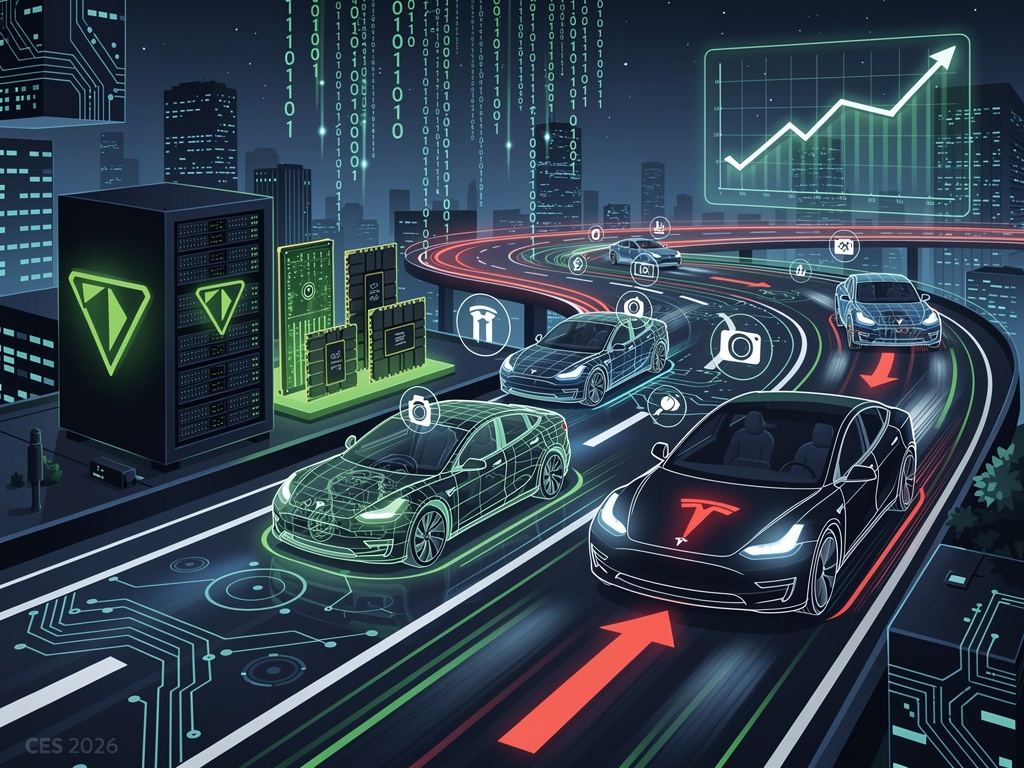
At CES 2026, Nvidia Corp. unveiled its latest push into autonomous driving, introducing the Alpamayo family of open AI models aimed at enabling vehicles to ‘understand, reason and act in the real world.’ The announcement, delivered by Chief Executive Jensen Huang, positioned the technology as a rival to Tesla Inc.’s Full Self-Driving software. Yet beneath the fanfare, industry observers see confirmation of Tesla’s entrenched advantage in real-world deployment.
Phil Beisel, a vocal Tesla investor, captured the sentiment on X, stating that Nvidia’s presentation offered ‘a platform, not a product—a set of tools for partners still attempting to solve problems Tesla is already confronting in the real world.’ He emphasized the absence of ‘demonstrated path to large-scale deployment’ or mastery of rare driving scenarios, areas where Tesla has logged millions of miles (Phil Beisel on X).
Elon Musk, Tesla’s chief executive, downplayed the threat on X, noting Nvidia provides ‘helpful tools to the automotive industry, but the automotive industry is doing very little on their own.’ He highlighted Tesla’s cumulative $10 billion spend on Nvidia hardware for training, combined with in-house AI4 chips for inference (Elon Musk on X).
Tesla’s Data Edge in Edge Cases
The core divide lies in data. Tesla’s fleet generates vast real-world driving data, essential for tackling the ‘long tail’ of rare events that simulations struggle to replicate. Beisel argued, ‘Real-world AI requires real-world data. Synthetic data cannot solve the autonomy problem.’ Tesla has been iterating in Austin and the Bay Area since June, targeting safety-driver removal.
A Verge reporter tested Nvidia’s point-to-point system and warned ‘Tesla should be worried,’ praising its 2026 rollout potential to challenge Tesla and Waymo. However, the demo lacked Tesla’s scale: Tesla operates vehicles autonomously in live environments, systematically addressing edge cases (The Verge).
Analyst Ferragu noted on X that CES validates Tesla’s strategy but reveals a ‘big lag for rivals,’ with legacy makers trailing in execution (Teslarati).
Nvidia’s Hardware Play
Nvidia’s incentive remains silicon sales. Huang’s keynote steered partners toward more GPUs for processing real-world data, framing autonomy as the narrative to drive demand. Beisel observed, ‘NVIDIA sells high-end training and inference hardware,’ underscoring the business model divergence from Tesla’s vertical integration.
Tesla moves at ‘software speed,’ while legacy original equipment manufacturers plod along. Musk estimated on X that even after FSD proves safer than humans—several years away—legacy firms won’t integrate cameras and AI at scale for years more, creating a ‘competitive moat’ (Elon Musk on X).
Electrek reported Nvidia’s open-source AI will ship in Mercedes-Benz CLA in Q1 2026, but this relies on OEMs like Mercedes, who lag Tesla’s pace (Electrek).
Vision-Only Convergence
Nvidia’s CES messaging endorsed vision-first autonomy, centering cameras, neural networks and compute—mirroring Tesla’s unpopular early bet now gaining traction. Beisel called it ‘explicit validation’ of Tesla’s approach, sidelining LiDAR-heavy stacks.
The BBC described Nvidia’s tech as part of a ‘physical AI push’ beyond software into products, but without Tesla’s fleet data or iteration speed (BBC).
Teslarati quoted Musk giving an ‘honest take’ on FSD competition: not imminent from legacy players (Teslarati).
Robotaxi’s True Prize
Tesla eyes transportation-as-a-service via Robotaxi, turning every vehicle into a fleet asset akin to Airbnb. Competitors like Waymo and Uber loom larger than Mercedes or Ford. Nvidia’s partners face execution risks inherent to slow-moving OEMs.
The Verge roundup of Nvidia’s CES highlights included Vera Rubin chips and gaming, but autonomy demos underscored platform status over product readiness (The Verge).
Yahoo Finance covered Musk’s ‘surprise take’ amid Nvidia’s reveal, where he expressed no concern and hoped for their success (Yahoo Finance).
Deployment Timelines Diverge
Tesla targets Robotaxi expansion in weeks, potentially sans safety drivers post-CES hype fades, per Beisel. Nvidia’s timeline hinges on partners achieving what Tesla pursues daily.
TeslaNorth.com detailed Nvidia’s ‘thinking, reasoning’ AI as a self-driving rival, but real differentiation is Tesla’s live operations (TeslaNorth).


 WebProNews is an iEntry Publication