
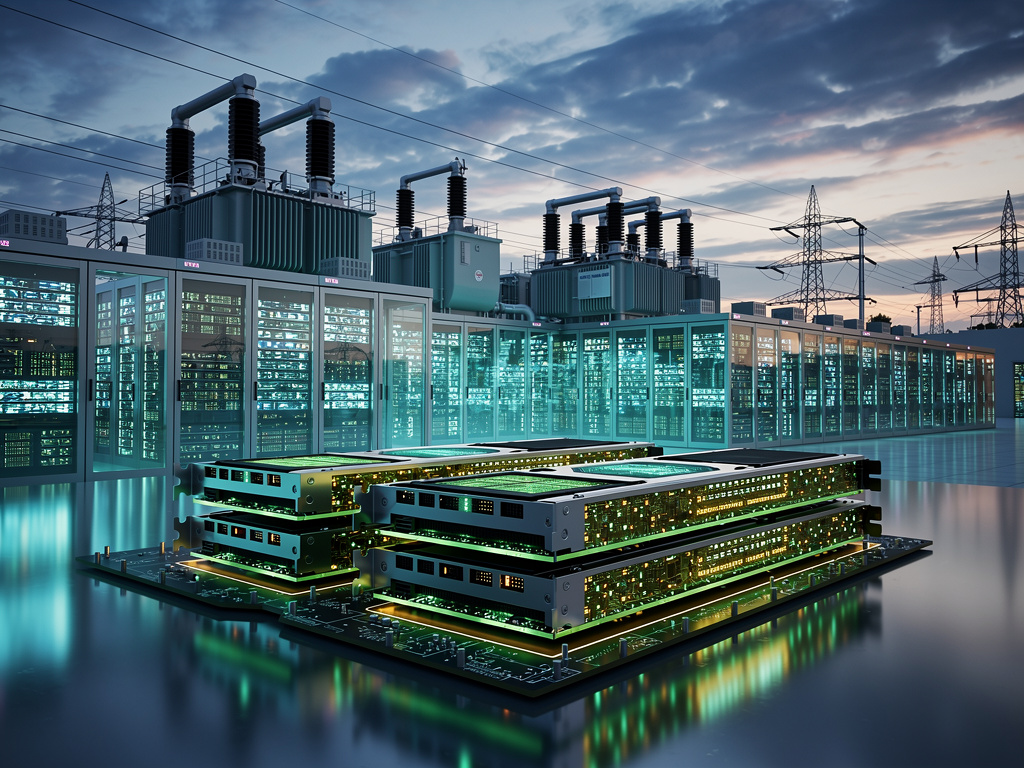
NEW YORK – In a move that signals a dramatic escalation in the battle for artificial intelligence supremacy, Nvidia Corp. has committed to a $2 billion strategic investment in specialized cloud provider CoreWeave, a deal aimed squarely at tackling the single greatest emerging bottleneck in AI: electrical power. The investment, intended to help the rapidly growing but heavily leveraged CoreWeave build out a staggering five gigawatts of new AI-focused data center capacity, underscores a fundamental shift in Silicon Valley’s balance of power. The chipmaker is no longer just a supplier; it is now a key financier and kingmaker in the infrastructure that underpins the entire AI economy.
The deal, first reported on January 26, 2026, by TechCrunch, is more than a vote of confidence in a key partner. It is a calculated, defensive maneuver by Nvidia to ensure that the voracious demand for its high-end processors, such as the H100 and forthcoming B200 GPUs, is not throttled by the physical constraints of the world’s power grids. For CoreWeave, the capital infusion provides a crucial lifeline and a powerful validation of its high-risk, high-reward strategy of leveraging its GPU assets to fund one of the most aggressive data center expansions the industry has ever seen.
A Strategic Shift from Silicon to Substations
Nvidia’s investment marks a significant evolution in its corporate strategy. The Santa Clara, California-based company has long used investments to nurture the ecosystem around its CUDA software platform, but this $2 billion check represents its most direct intervention yet into the hard-asset world of infrastructure. With AI models growing exponentially in complexity, the demand for computational power is outstripping the ability of even the largest cloud providers to build and power new facilities. By directly funding the expansion of a favored partner, Nvidia is effectively underwriting future demand for its own chips, ensuring that its multi-billion dollar manufacturing pipeline won’t hit a wall of insufficient electrical sockets.
This move is a tacit acknowledgment that the primary constraint on AI’s growth is no longer the production of silicon wafers, but the generation and transmission of electricity. Industry insiders see the investment as a way for Nvidia CEO Jensen Huang to secure a dedicated, high-capacity channel for his products, insulating a portion of his sales from the broader scramble for data center space. It also tightens the symbiotic relationship between the two companies, making CoreWeave, already one of the largest holders of Nvidia GPUs, even more critical to the chipmaker’s dominance. This strategy helps build a competitive moat, not just with software, but with privileged access to the physical power required to run it.
CoreWeave’s High-Wire Financial Act
For CoreWeave, the investment arrives at a pivotal moment. The company has been on a meteoric rise, building a multi-billion dollar business by offering bare-metal access to Nvidia’s most sought-after chips—a service that has attracted AI developers frustrated by the limited availability at larger rivals like Amazon Web Services and Microsoft Azure. As highlighted by CNBC, CoreWeave’s entire model was built on an early, bold bet on Nvidia’s hardware, securing massive allocations long before the generative AI boom sent demand into overdrive. This foresight gave it a crucial head start.
However, this aggressive expansion has been fueled by enormous amounts of debt, structured in unconventional ways. Last year, the company secured a staggering $7.5 billion debt facility led by Blackstone and Magnetar Capital, using its vast inventory of Nvidia GPUs as collateral, a financing arrangement detailed by Bloomberg. While innovative, this strategy ties the company’s financial health directly to the secondary-market value of its hardware, a variable that could introduce volatility. Nvidia’s direct equity investment serves to de-risk that position in the eyes of lenders and other investors, providing a powerful stamp of approval from its most important supplier and effectively backstopping the value of the very assets securing its loans.
The Five-Gigawatt Challenge to the Grid
The headline figure of five gigawatts (5GW) of new compute capacity is difficult to overstate and represents the core of the industry’s next great challenge. To put that figure in perspective, a single gigawatt can power approximately 750,000 homes. This expansion alone is equivalent to the power consumed by a major metropolitan area or the output of several nuclear power plants. It is a project that will test the limits of local utility providers, regional power grids, and the global supply chain for electrical hardware like transformers and switchgear, which are already facing long lead times.
The soaring energy consumption of the digital economy is a growing concern for governments and grid operators worldwide. The International Energy Agency has warned that electricity consumption from data centers, cryptocurrency, and AI could double by 2026. A report from Reuters noted that this surge threatens to consume an amount of energy equivalent to Germany’s entire national consumption. CoreWeave’s plan to add 5GW of demand to the system highlights how AI cloud providers are now among the most significant energy consumers on the planet, forcing them to become experts in energy procurement and grid politics.
Reshaping the Cloud Provider Pecking Order
Nvidia’s direct backing of CoreWeave sends a powerful message to the established hyperscale cloud providers. For years, Amazon, Microsoft, and Google have been Nvidia’s biggest customers, but they have also been developing their own custom AI silicon in an effort to reduce their dependence on the chipmaker. By anointing CoreWeave with a strategic investment and, presumably, preferential access to its latest hardware, Nvidia is fostering a formidable competitor and reminding the market’s giants of its pivotal role in the AI value chain. This move signals the potential rise of a new class of specialized, high-performance cloud providers that can move faster and offer more tailored AI infrastructure than their larger, more diversified rivals.
This investment follows a period of intense capital raising for CoreWeave, which secured a $1.1 billion funding round in the spring of 2024, as reported by Reuters, further fueling its expansion plans. The combination of massive equity and debt funding, now crowned with a strategic investment from the industry’s most important company, positions CoreWeave to potentially capture a significant share of the high-end AI training and inference market. It also provides a blueprint for how other hardware-centric companies might vertically integrate to secure their growth trajectories.
A Market Bracing for a Power-Hungry Future
The implications of Nvidia’s investment extend far beyond the two companies. It sets a new precedent for how the AI infrastructure layer will be financed and built, suggesting a future of tighter alliances between chip designers and the cloud companies that deploy their products. This could make it more difficult for new, unfunded startups to access the elite hardware necessary to compete, further concentrating power within a small circle of heavily capitalized players. The market’s reaction will be closely watched, particularly the valuations of other specialized AI cloud providers and the strategic responses from the hyperscale incumbents.
Ultimately, the deal is a bet not just on CoreWeave, but on the enduring demand for centralized, large-scale AI. As The Wall Street Journal and other observers have noted, the soaring valuations in the AI sector carry echoes of past technology booms, and any slowdown in AI adoption could leave companies like CoreWeave dangerously exposed with billions in hardware-backed debt. For now, however, Nvidia is using its unprecedented market power and financial might to ensure that the AI revolution it started is not short-circuited by a simple lack of power, rewriting the rules of infrastructure finance in the process.


 WebProNews is an iEntry Publication