
Nvidia’s Bold Leap: Unveiling the Vera Rubin Era at CES 2026
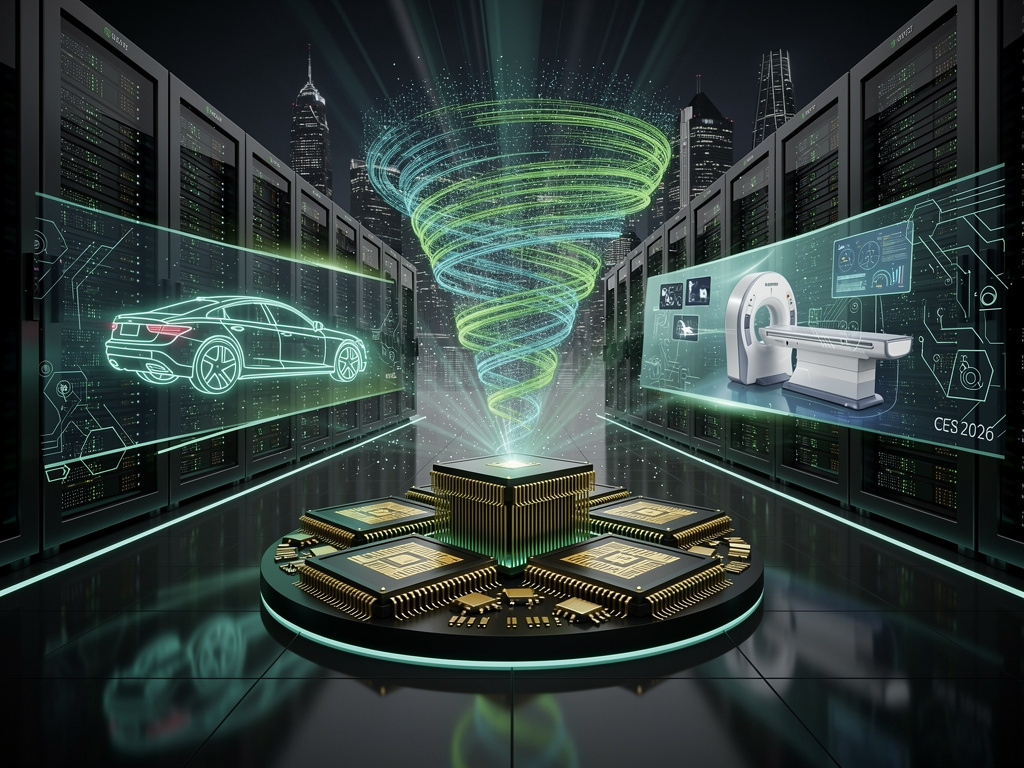
In a packed auditorium at the Las Vegas Convention Center, Nvidia Corp. chief executive Jensen Huang took the stage at CES 2026 to reveal what could be the company’s most ambitious push yet into the heart of artificial intelligence infrastructure. The announcement centered on the Vera Rubin platform, a comprehensive suite of technologies designed to power the next wave of AI applications, from autonomous vehicles to advanced healthcare diagnostics. Named after the pioneering astronomer Vera Rubin, whose work on dark matter reshaped our understanding of the universe, Nvidia’s new platform aims to illuminate the opaque complexities of massive-scale AI computing.
Huang, known for his charismatic keynotes, described the Vera Rubin as more than just a chip—it’s an integrated ecosystem comprising six new chips that together form what Nvidia calls an “AI supercomputer.” This launch comes at a pivotal moment for the tech industry, as demand for AI capabilities skyrockets amid investments from hyperscalers like Google and Microsoft. According to reports from the event, the platform promises dramatic improvements in efficiency, with up to five times greater inference performance and a tenfold reduction in cost per token compared to its predecessor, the Blackwell architecture.
The Vera Rubin platform includes the new Vera CPU, Rubin GPU, and a suite of networking and interconnect technologies optimized for AI workloads. Industry observers note that this holistic approach sets Nvidia apart from competitors who often focus on standalone components. By co-designing these elements, Nvidia aims to minimize bottlenecks in data transfer and processing, enabling faster training and deployment of large language models and other AI systems.
Pushing Boundaries in AI Hardware Design
At the core of the Vera Rubin is the Rubin GPU, which Nvidia claims will handle million-token processing tasks with unprecedented speed. This is particularly crucial for applications like coding assistants and video generation, where context windows are expanding rapidly. The platform’s NVL72 configuration, a rack-scale supercomputer, integrates 72 GPUs and is slated for availability in the second half of 2026. Sources from Tom’s Hardware highlight how this setup could reduce operational costs significantly, making advanced AI more accessible to enterprises beyond the tech giants.
Complementing the GPU is the Vera CPU, featuring 88 custom Olympus cores with spatial multi-threading, delivering 176 threads and a massive 1.8 TB/s NVLink-C2C bandwidth. This CPU is engineered to work seamlessly with the GPUs, supporting up to 1.5 TB of system memory—three times that of Nvidia’s Grace CPU. Such specifications underscore Nvidia’s strategy to create tightly coupled systems that excel in agentic AI, reasoning models, and mixture-of-experts workloads, where multiple AI components collaborate dynamically.
Beyond hardware, Nvidia emphasized open models for sectors like healthcare and robotics. During the keynote, Huang showcased a Mercedes-Benz CLA vehicle demonstrating AI-defined autonomous driving, powered by Rubin technology. This integration hints at broader implications for industries reliant on real-time AI, from manufacturing to urban planning.
Strategic Implications for Market Dominance
Nvidia’s timing couldn’t be more strategic. With shares soaring in recent years on the back of AI hype, the company is keen to maintain its lead over rivals like AMD and Intel, who are ramping up their own AI offerings. The Vera Rubin platform’s promise of lower costs per token—potentially slashing expenses for running generative AI—could solidify Nvidia’s position in data centers worldwide. As detailed in a CNN Business analysis, this release has major ramifications given the industry’s heavy dependence on Nvidia’s tech for AI development.
Financial analysts are already buzzing about the potential revenue boost. Posts on X from tech investors suggest that the Rubin CPX GPU, tailored for massive-context processing, could drive 7.5 times more AI performance than current systems. While these social media insights reflect enthusiasm, they also underscore the speculative nature of early reactions, with some users predicting a surge in Nvidia’s stock following the announcement.
Moreover, the platform’s emphasis on energy efficiency addresses growing concerns about the power consumption of AI data centers. Nvidia claims the Vera Rubin will convert power into intelligence more effectively, aligning with global pushes for sustainable computing. This aspect was echoed in coverage from NVIDIA Newsroom, where the company positioned the launch as the kickoff to AI’s “industrial phase.”
Innovations in Networking and Integration
Delving deeper into the technical weeds, the Vera Rubin incorporates advanced networking silicon, including a scale-up NVLink switch and silicon photonics processors. These components facilitate ultra-fast data sharing across chips, crucial for scaling AI models to trillions of parameters. The complete chipset overhaul, as reported in posts on X from hardware enthusiasts, indicates that all six Rubin chips have been taped out at TSMC, ensuring on-schedule mass production later this year.
One standout feature is the NVL144 CPX platform, which pairs the Vera CPU with Rubin GPUs for handling million-token contexts. This enables AI systems to process vast amounts of data without the latency issues plaguing older architectures. For insiders, this means developers can build more sophisticated models for tasks like natural language understanding and predictive analytics, potentially transforming fields such as finance and scientific research.
Nvidia’s collaboration with partners like Mercedes-Benz illustrates the platform’s versatility. The autonomous driving demo at CES featured real-time reasoning AI, allowing vehicles to make split-second decisions based on complex environmental data. Such applications could accelerate the adoption of self-driving technology, though regulatory hurdles remain a topic of ongoing debate.
Broader Ecosystem and Future Roadmap
Looking ahead, Nvidia outlined a roadmap that includes the Vera Rubin NVL576, expected in 2027, boasting 14 times the performance of current top-tier systems. This future iteration will feature 576 GPUs, 2,304 memory chips, and over 1,300 trillion transistors, pushing the boundaries of what’s possible in AI hardware. Early leaks from X posts dating back to 2024, when Huang first teased the Rubin family at Computex, show how Nvidia has been methodically building toward this moment.
The open models announced alongside the hardware are equally compelling. Nvidia is releasing frameworks for healthcare AI, enabling faster drug discovery and personalized medicine, and for robotics, facilitating more intuitive human-machine interactions. As covered in the NVIDIA Blog, these models are designed to be adaptable, fostering innovation across industries.
Critics, however, point out potential challenges. The high cost of entry for Vera Rubin systems could limit accessibility for smaller players, potentially widening the gap between AI haves and have-nots. Additionally, supply chain dependencies on manufacturers like TSMC introduce risks amid geopolitical tensions.
Competitive Dynamics and Industry Response
In the broader arena of semiconductor competition, Nvidia’s integrated approach contrasts with efforts from companies like AMD, which recently unveiled its own AI accelerators. Yet, Nvidia’s full-stack offering, combining hardware, software, and networking, gives it a unique edge. Insights from Yahoo Finance suggest that the Vera Rubin superchip could redefine cost structures in AI deployment, making it a game-changer for cloud providers.
Industry insiders are also watching how this affects Nvidia’s partnerships. The Mercedes-Benz showcase not only highlights automotive applications but also signals deeper integrations in consumer electronics and enterprise solutions. Posts on X from AI researchers express excitement about the platform’s potential for “reasoning” AI in self-driving cars, as mentioned in coverage from The Guardian.
Furthermore, the launch reinforces Nvidia’s narrative of AI as an always-on factory, continuously generating value from data. This vision, articulated in the NVIDIA Technical Blog, positions the company as the architect of AI’s future infrastructure.
Economic and Societal Impacts
Economically, the Vera Rubin could fuel job creation in AI-related fields while raising questions about workforce displacement. As AI systems become more efficient, industries may see accelerated automation, prompting calls for reskilling programs. On a societal level, the platform’s advancements in healthcare models could lead to breakthroughs in disease prediction, potentially saving lives through earlier interventions.
From a global perspective, Nvidia’s dominance raises antitrust concerns, with regulators scrutinizing its market share. Yet, the company’s innovation pace, as evidenced by this CES reveal, continues to outstrip oversight efforts. Reports from WIRED note that the chips are already in full production, signaling rapid deployment.
Investors, meanwhile, are parsing the details for long-term value. The promised 10x lower cost per token could democratize AI, enabling startups to compete with established players. This shift might spur a new wave of innovation, much like how previous Nvidia platforms enabled the rise of generative AI tools.
Technical Deep Dive and Performance Metrics
For those steeped in hardware specifics, the Vera Rubin’s architecture merits closer examination. The Rubin GPU variants incorporate HBM4 memory, offering bandwidth leaps that support the platform’s 4.6 PB/s aggregate in larger configurations. Combined with 12,672 Vera CPU cores in top-end systems, this creates a powerhouse for exascale computing.
Benchmark claims from Nvidia indicate up to 5x inference gains, but real-world tests will be key. Early adopter feedback, gleaned from X discussions, suggests optimism, though verification through independent reviews is essential.
Ultimately, the Vera Rubin platform encapsulates Nvidia’s bet on AI as the defining technology of our era. By blending cutting-edge hardware with ecosystem-wide software, Nvidia is not just supplying tools—it’s shaping the very framework of intelligent computing. As CES 2026 wraps up, the industry watches closely to see how this launch will influence the trajectory of AI adoption worldwide.


 WebProNews is an iEntry Publication