
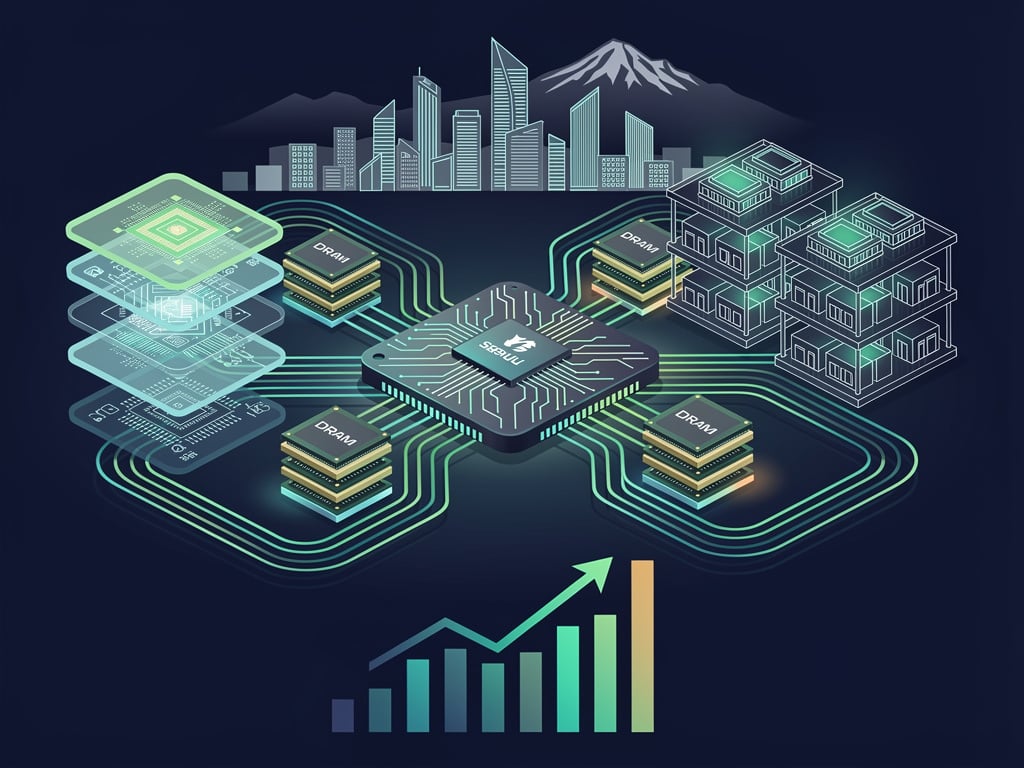
Jensen Huang flew into Seoul. He sat down for dinner with the chairman of SK Group and the chief executive of SK Hynix. Hours later the Nvidia leader stood outside the restaurant and told reporters something that sent shares higher the next trading day. The new Vera central processing unit will rely on SK Hynix memory chips.
“We had a very big year this year with SK Hynix, and we are preparing for a very, very large second half of the year and next year,” Huang said, according to Fortune. “We introduced Vera CPU, which is a revolutionary CPU, and it will also use SK Hynix’s DRAM.”
Simple words. Yet they capture a shift now underway across the semiconductor supply chain. Nvidia no longer depends solely on its own graphics processors to power artificial intelligence systems. The company is building a broader platform. Processors, accelerators, memory and interconnects all must work together at extreme scale. SK Hynix has positioned itself at the center of that effort.
The Vera CPU targets data-center workloads that demand fast inference and efficient agentic AI operations. Unlike traditional server chips from Intel or AMD, Vera integrates tightly with Nvidia’s GPU architectures. Memory choice matters here. Bandwidth, latency and power consumption determine how quickly these systems can reason, plan and act. SK Hynix’s DRAM solution apparently meets the bar.
But this announcement forms only one thread in a much larger fabric. Days earlier at events tied to Computex and GTC Taipei, Huang declared the Vera Rubin AI platform in full production. He confirmed that Samsung Electronics, SK Hynix and Micron Technology had all passed qualification for HBM4, the next-generation high-bandwidth memory essential to Rubin’s performance. Bloomberg reported the details shortly after.
SK Hynix holds the largest slice of Nvidia’s HBM supply. Analysts estimate its share for the Vera Rubin generation sits near 60 to 70 percent. The company doubled down on HBM years ago when many competitors hesitated. That bet now pays dividends. Its stock has climbed more than 200 percent so far in 2026. Market capitalization topped one trillion dollars in recent weeks.
Huang did not stop at memory. He praised the technical difficulty of producing advanced HBM. “HBM may look simple, but it is actually an extremely complicated technology,” he told partners in Taipei, according to The Elec. “We work very closely with SK.” The relationship extends beyond components. The two companies now co-develop memory solutions for multiple Nvidia platforms. Those include Vera Rubin supercomputers, the Vera CPU itself, RTX Spark PCs and Jetson Thor robotics systems.
SK Hynix will apply Nvidia’s CUDA-X libraries and PhysicsNeMo simulation tools to speed its own chip design. It plans to build digital twins of its fabrication plants using Nvidia Omniverse software. The goal is autonomous operation. Factories that run with minimal human intervention. The announcement, shared widely on X in recent hours, underscores how deeply the two firms have intertwined their technology road maps.
Such collaboration carries risks. Supply concentration can create vulnerabilities. Yet for now the arrangement appears to suit both sides. Nvidia secures reliable access to advanced memory at a time when demand outstrips capacity. SK Hynix gains preferred status and early insight into Nvidia’s architectural needs. The South Korean firm also plans to double wafer production capacity over the next five years.
Investors reacted immediately. SK Hynix shares surged in early Monday trading in Seoul. Samsung and other Korean tech names posted gains as well. The pattern repeats. Each time Huang lands in the region and signals tighter cooperation, local stocks jump. This time the catalyst was explicit. Vera CPU. SK Hynix DRAM. A very large second half and next year.
The broader context matters. Nvidia’s data-center revenue continues to grow at extraordinary rates. Analysts project the company could approach two hundred billion dollars in annualized sales tied to AI infrastructure. Much of that depends on memory availability. HBM remains the primary bottleneck. By qualifying all three major suppliers for HBM4, Nvidia spreads risk while still favoring its longest-standing partner.
Huang’s dinner companion, SK Group Chairman Chey Tae-won, leads a conglomerate with deep roots in energy, chemicals and semiconductors. SK Hynix CEO Kwak Noh-Jung joined as well. SK Telecom executives rounded out the table. The gathering signaled alignment across the SK ecosystem. Telecom networks will carry the traffic. Chips will power the servers. Memory will feed the processors.
And the implications stretch further. Robotics represents a major focus. Jetson Thor platforms aim to bring advanced AI into physical machines. Autonomous factories, warehouses and vehicles all need compact, efficient computing. Vera-derived technology could appear in those systems. SK Hynix memory helps make the power and thermal budgets work.
Competition has not vanished. Samsung pushes hard to regain HBM leadership. Micron qualified for HBM4 alongside its rivals and ships product. Intel and AMD continue to develop their own AI accelerators. Yet Nvidia’s software moat, built on CUDA, gives it enormous pull. Partners line up to ensure their components work first and best with Nvidia platforms.
Huang himself seems aware of the stakes. He has urged SK Hynix to produce more. He has celebrated the company’s growth. During visits he hands out food to reporters and poses for photos with employees. The gestures project accessibility. They also reinforce a message. This partnership is personal as well as strategic.
Production timelines remain aggressive. Vera Rubin systems are slated for volume shipments in the second half of 2026. The Vera CPU will appear in configurations that support large-scale inference clusters. Hyperscalers and enterprise customers have already begun testing early versions. Success depends on flawless execution from the memory side.
SK Hynix has expanded capacity in South Korea and abroad. It upgraded processes at its Wuxi fab in China. Yields on advanced HBM stacks have improved. Still, the industry as a whole faces tight supply into 2027. Any delay in one supplier’s ramp affects the entire chain.
That reality explains why Nvidia certified all three memory makers. It also explains why the company invests so heavily in co-development. When SK Hynix engineers use Nvidia tools to simulate new memory designs, the resulting parts arrive better optimized for Vera architectures. Iteration cycles shorten. Performance margins widen.
Financial markets have taken notice. Nvidia shares trade near all-time highs. SK Hynix has become one of the best-performing large-cap stocks globally over the past year. Investors now price in continued AI spending even as some skeptics warn of potential slowdowns in 2027. The partnership news removes one layer of uncertainty.
So what comes next? Further meetings between Huang and Korean executives are likely. Talks with Samsung and Hyundai reportedly occurred during the same trip. Broader investments in local research and development could follow. Nvidia already maintains a significant presence in the country. Deeper ties would accelerate talent recruitment and custom silicon projects.
The Vera CPU itself marks an evolution. Earlier Grace CPUs paired with Hopper and Blackwell GPUs. Vera appears designed for the Rubin generation and beyond. Its integration of SK Hynix DRAM suggests a focus on lower power consumption and higher memory bandwidth per core. Those attributes suit the move toward smaller, more numerous AI agents rather than massive training runs.
Industry watchers expect details on clock speeds, core counts and exact memory configurations in coming quarters. For now the public message is simpler. Nvidia and SK Hynix are preparing for much larger volumes. The dinner in Seoul was not ceremonial. It was operational.
Shares of SK Hynix opened sharply higher Monday. Trading volume spiked. Analysts at local brokerages raised price targets. The pattern feels familiar. Each major Nvidia endorsement has lifted its Korean partners. This time the endorsement named a specific product. The Vera CPU will use SK Hynix memory. The words carry weight.
Yet seasoned semiconductor executives know better than to declare victory too early. Technical qualification is one thing. Sustained high-volume manufacturing is another. Thermal issues, yield curves and packaging challenges have tripped up memory makers before. SK Hynix must deliver at scale.
Huang has bet that it will. His public comments, his personal visits and the expanding scope of technical collaboration all point the same direction. Nvidia’s future platforms will carry more SK Hynix silicon than ever. The memory maker’s future, in turn, rests heavily on Nvidia’s continued dominance.
That mutual dependence defines today’s AI supply chain. No single company can do it all. Success requires orchestration across continents and specialties. In Seoul last weekend, two key players in that orchestra rehearsed their next movement. The music, so far, sounds promising.


 WebProNews is an iEntry Publication