
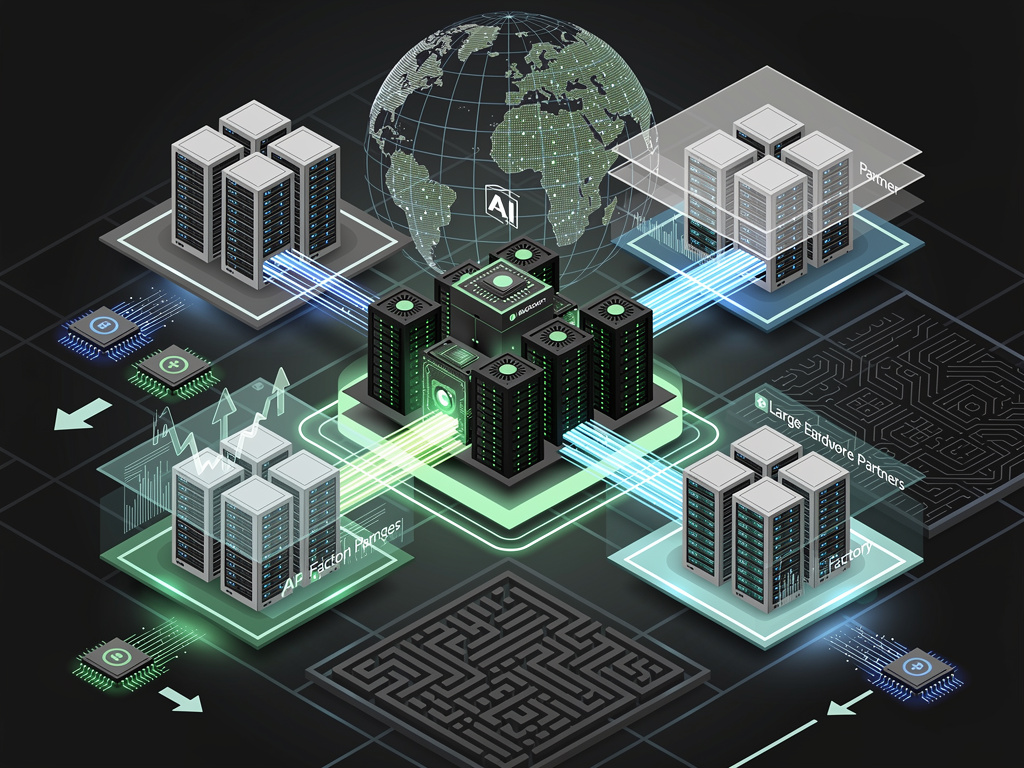
Nvidia no longer wants to sell just its powerful graphics processors. The company aims to deliver entire AI factories. Complete, integrated systems that turn massive amounts of electricity into usable intelligence at scale. This marks a profound change in how the chip giant approaches its biggest growth opportunity.
The idea surfaced clearly in recent commentary. Investors once saw Nvidia strictly as a semiconductor firm. Now the focus expands to full-stack offerings. These encompass GPUs, networking gear, storage, software and rack-scale designs. Buyers receive ready-to-run infrastructure instead of piecing components together themselves. Short. Direct. And potentially far more profitable.
According to a Yahoo Finance article from The Motley Fool, Nvidia wants to sell AI factories, not chips. The piece highlights how this strategy moves the company beyond traditional hardware sales. It positions Nvidia as the architect of the new industrial infrastructure powering artificial intelligence worldwide.
But the shift didn’t appear overnight. Nvidia spent years building the necessary pieces. Its CUDA software platform locked in developer loyalty. Networking acquisitions such as Mellanox strengthened data movement capabilities. Custom CPU development with Grace and Vera chips completed the compute picture. Together they create what Nvidia calls AI factories. Facilities that function like token production lines. Power and data flow in. Intelligence flows out.
Recent announcements reinforce the direction. On May 31, 2026, Nvidia detailed how its Vera Rubin platform ramps into full production. The system promises 10 times the agent throughput at scale compared with the prior Grace Blackwell generation. Taiwan’s manufacturing partners already assemble more than one million MGX rack components across 25 factory sites to support this next wave. The NVIDIA Newsroom report makes clear the focus remains on agentic AI factories. Systems capable of autonomous, reasoning-driven workloads rather than simple pattern matching.
Partners line up to help deliver these factories. Dell, HPE, Cisco, Lenovo, Supermicro and others integrate Nvidia’s reference designs into their offerings. In March 2026 Cisco expanded its Secure AI Factory framework with Nvidia. The update reaches from central data centers to edge locations in hospitals, warehouses and vehicles. Jensen Huang, Nvidia’s founder and chief executive, stated that AI factories transform every industry. Security must embed from silicon to software. The Cisco newsroom release captured his exact words.
HPE took a similar step in late 2025. The company opened an AI Factory Lab in Grenoble, France. Customers there test sovereign, air-cooled systems that meet European data residency rules. This addresses growing demand for controlled, compliant infrastructure. The HPE press release from December 2025 shows how regulatory pressures shape factory deployments across borders.
Yet the economics prove complex. A single gigawatt-scale AI factory can require hardware spending approaching $50 billion. Nvidia captures a large share through its full stack. But power, cooling, land and construction costs add up fast. Some analysts question whether every enterprise needs its own factory. Others see cloud providers and specialized operators absorbing much of the buildout. Still, Nvidia’s approach reduces integration risk for buyers. They avoid stitching incompatible systems. Deployment timelines shrink from months to weeks.
Amazon’s recent move adds competitive pressure. The cloud leader now offers its own on-premises AI Factories. Customers supply the data center and power. AWS installs, manages and connects the systems. These factories can use Nvidia’s Blackwell GPUs or Amazon’s Trainium3 chips. The Yahoo Finance coverage from December 2025 notes the direct overlap in terminology. Nvidia popularized the factory concept. Now competitors adopt and adapt it.
CoreWeave, a specialized AI cloud operator, pushes even harder. The firm works toward more than five gigawatts of capacity by 2030. Its expanded partnership with Nvidia gives early access to new architectures including Vera CPUs and BlueField storage systems. The collaboration validates strong customer demand across the ecosystem. A CoreWeave blog post from January 2026 outlines the scale these operators pursue.
GMI Cloud announced support for the Vera Rubin platform in early June 2026. The Taiwan-based provider targets production AI and large-scale inference. Its choice underscores how the full Nvidia stack appeals for agentic workloads that demand low latency and high reliability. Details appear in the PR Newswire release.
At CES in January 2026, Jensen Huang reset expectations once again. He described how new architectures improve token-per-watt efficiency and accelerate time to production. The updates matter because electricity costs dominate total ownership expenses. Higher efficiency translates directly into better returns. SiliconANGLE’s analysis from January 10, 2026, breaks down the economic impact. The SiliconANGLE article shows why these repeated resets keep competitors off balance.
Nvidia runs its own internal AI factory too. Hundreds of autonomous agents now assist engineering, software and operations teams. The setup serves as both test bed and proof point. Productivity gains appear across the company. The Nvidia blog from May 27, 2026 presents this as practical evidence that factories can transform daily work.
Of course challenges remain. Supply chains stretch thin. Advanced packaging, high-bandwidth memory and liquid cooling all face constraints. Geopolitical tensions complicate global deployments. Sovereign nations demand local control. Data privacy rules vary. Nvidia’s reference designs and digital twin tools using Omniverse aim to ease these pains. They let operators simulate entire factories before breaking ground.
The Vera Rubin DSX reference design released in March 2026 offers one such blueprint. It coordinates compute, networking and storage for maximum efficiency. Broad industry support suggests the approach gains traction. The NVIDIA Newsroom announcement highlights how these tools shorten build times and reduce risk.
So what comes next? Nvidia’s bet looks bigger than chips. It bets on becoming the indispensable partner for any organization serious about production AI. Not everyone will build their own factory. Many will rent capacity from hyperscalers or specialized clouds. But the underlying architecture, software and system design likely carry Nvidia’s imprint. That sustained influence could support premium pricing and recurring revenue through software and services.
Recent X discussions echo the excitement. One post noted Nvidia shifts focus from selling AI chips to offering complete AI factories. Another highlighted that the company builds compute, networking, software and rack-scale systems around the AI factory concept. The sentiment on the platform shows investors grasp the strategic expansion. Yet questions linger about valuation and execution at such massive scale.
Nvidia’s trajectory appears set. From graphics cards to data center GPUs to full AI factories. Each step widens the moat. Each generation raises the performance bar. And each factory built reinforces the company’s central role in the intelligence economy. The coming years will test whether this vision scales as boldly in practice as it does in presentation. But the direction looks clear. Nvidia intends to sell the factories. Not just the pieces inside them.


 WebProNews is an iEntry Publication