
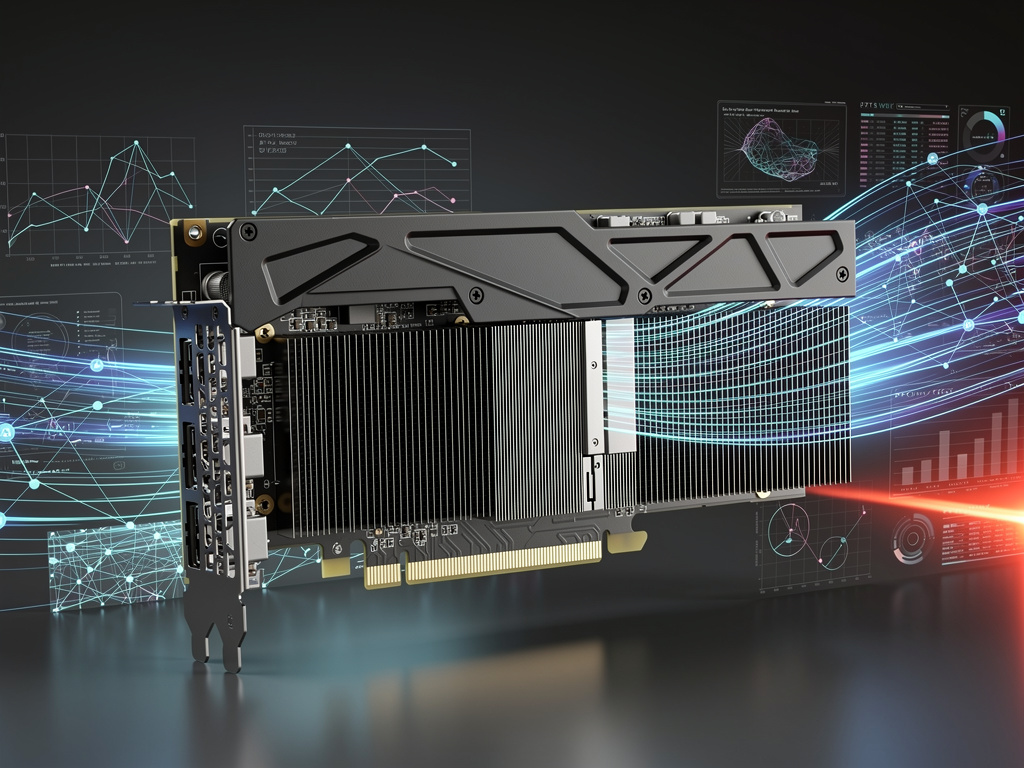
Nvidia’s Colossal Leap: The RTX Pro 5000 Blackwell and Its 72GB Revolution
In the relentless pursuit of computational dominance, Nvidia has once again pushed the boundaries with its latest workstation graphics card, the RTX Pro 5000 Blackwell featuring a staggering 72GB of GDDR7 memory. This release marks a significant escalation in the capabilities available to professionals handling massive datasets and complex AI models. Announced amid a flurry of industry buzz, the card promises to redefine performance thresholds for fields like generative AI, neural rendering, and high-fidelity simulations. But as with any technological advancement, the true value lies in dissecting its specifications, market positioning, and real-world implications for enterprise users.
Drawing from Nvidia’s own announcements, the RTX Pro 5000 Blackwell is built on the cutting-edge Blackwell architecture, which integrates advanced AI acceleration and ray-tracing prowess. The card boasts 14,080 CUDA cores, a substantial upgrade that enables it to tackle demanding workloads with unprecedented efficiency. Its 72GB of GDDR7 memory, equipped with error-correcting code (ECC) for reliability, addresses a critical need in professional environments where data integrity is paramount. This memory capacity represents a 50% increase over the standard 48GB variant, allowing users to load larger models without resorting to cumbersome multi-GPU setups.
Industry observers note that this launch comes at a time when AI-driven tasks are exploding in complexity. For instance, agentic AI—systems that can autonomously perform multi-step processes—requires immense memory to maintain context over extended operations. The RTX Pro 5000’s design directly caters to this, offering bandwidth speeds that can hit up to 1.8TB/s in optimized scenarios. Early adopters in sectors like film production and scientific research are already eyeing its potential to streamline workflows that previously bogged down even high-end systems.
Architectural Marvels Under the Hood
Nvidia’s Blackwell architecture isn’t just about raw specs; it’s a holistic rethink of how GPUs handle parallel processing. At its core, the RTX Pro 5000 incorporates tensor cores optimized for AI inference and training, delivering up to 1,300 TOPS (trillions of operations per second) in certain configurations. This is a leap from previous generations, enabling real-time neural rendering that blurs the line between virtual and reality in applications like virtual production sets.
Pricing details, gleaned from various reports, position the card in the premium segment. According to a post on ServeTheHome, the RTX Pro 5000 with 72GB is available starting around $5,000 to $9,000, depending on the vendor. This hefty tag reflects not just the hardware but also the enterprise-grade support and certifications that come bundled, such as compatibility with professional software suites from Autodesk and Adobe. Critics, however, point out that while the memory boost is impressive, it may not justify the cost for all users, especially when consumer-grade cards like the RTX 5090 offer competitive performance at lower prices.
On social platforms like X, sentiment around the release has been mixed but enthusiastic. Users in tech communities have highlighted the card’s potential for AI workstations, with one post noting its ability to handle “larger AI models without breaking a sweat.” This echoes broader discussions where professionals debate the trade-offs between memory capacity and overall system cost, particularly in an era of escalating hardware expenses.
Market Positioning and Competitive Edges
To understand the RTX Pro 5000’s place in the ecosystem, it’s essential to compare it with predecessors and rivals. The previous Ampere-based RTX A6000, with its 48GB, was a staple for visual effects artists, but the Blackwell’s enhanced architecture provides double the ray-tracing performance and significantly better energy efficiency. Nvidia claims a 30% reduction in power consumption for similar tasks, which could translate to lower operational costs in data centers or creative studios running 24/7.
A detailed review from CG Channel emphasizes its strengths in GPU rendering and simulation. The site reports that the extra memory allows for rendering scenes with billions of polygons without out-of-memory errors, a common bottleneck in tools like Blender or Houdini. This is particularly relevant for industries like architecture and automotive design, where photorealistic visualizations are crucial for client presentations and prototyping.
Furthermore, the card’s release aligns with Nvidia’s broader push into agentic AI, as detailed in their official blog. The NVIDIA Blog highlights how the 72GB variant expands options for desktop-based AI development, enabling professionals to prototype complex models locally before scaling to cloud resources. This democratizes access to high-end AI tools, potentially accelerating innovation in fields like drug discovery and climate modeling.
Real-World Applications and User Feedback
Professionals in creative fields are already integrating the RTX Pro 5000 into their pipelines. For example, in film and animation, the card’s neural rendering capabilities can generate lifelike environments in real-time, reducing the need for extensive post-production. A report from VideoCardz.com confirms the general availability of the card, noting its formal announcement and immediate stocking by partners like PNY.
User experiences shared on X underscore its appeal for AI enthusiasts. Posts describe scenarios where the 72GB memory handles massive datasets for machine learning tasks, such as training large language models or processing high-resolution medical imaging. One thread praised its ECC memory for preventing data corruption in long-running simulations, a feature absent in many consumer GPUs.
However, not all feedback is glowing. Some industry insiders question the pricing, especially when modders are experimenting with adding extra VRAM to consumer cards like the RTX 5080. A piece from Tom’s Hardware discusses these modifications, suggesting that for non-professional users, such hacks could offer a cost-effective alternative, albeit without official support or warranties.
Challenges and Broader Implications
Despite its strengths, the RTX Pro 5000 isn’t without hurdles. Recent incidents with Blackwell-based cards, including power cable issues on the RTX 5090, have raised concerns about reliability. As reported in NotebookCheck.net, a fire incident involving a power connector highlights potential risks in high-power draws, though Nvidia attributes these to user error or subpar power supplies.
In terms of market adoption, the card’s high cost could limit its reach to large enterprises. Smaller studios might opt for cloud-based solutions, but Nvidia counters this with arguments for on-premises security and lower latency. The PNY product page touts its suitability for “unprecedented rendering, AI, graphics, and compute workloads,” positioning it as an investment in future-proofing.
Looking ahead, the RTX Pro 5000’s influence could extend beyond workstations. Its technology trickle-down to consumer products might enhance gaming and content creation, fostering a new wave of accessible high-performance computing.
Evolving Ecosystem and Future Prospects
The ecosystem surrounding the RTX Pro 5000 is rapidly evolving, with software developers optimizing for its features. Nvidia’s CUDA toolkit updates ensure seamless integration, while partnerships with companies like Siemens accelerate its use in industrial design. This interconnectedness amplifies the card’s value, turning it into a cornerstone for digital twins and virtual prototyping.
From an economic perspective, the release reflects Nvidia’s dominance in the GPU market, where demand for AI hardware continues to surge. Analysts project that workstation GPUs could see double-digit growth, driven by sectors recovering from supply chain disruptions. Posts on X from financial watchers, such as those tracking Nvidia’s stock, indicate optimism, with mentions of the card bolstering the company’s professional segment revenues.
Yet, competition looms. AMD’s Radeon Pro series offers viable alternatives with competitive memory options, though they lag in AI-specific accelerations. Nvidia’s edge lies in its software ecosystem, which locks in users through proprietary tools like Omniverse for collaborative 3D workflows.
Strategic Insights for Industry Players
For decision-makers in tech firms, the RTX Pro 5000 represents a strategic tool for maintaining competitive advantages. Its ability to process vast amounts of data in real-time can shorten development cycles, from concept to deployment. In healthcare, for instance, it could power AI-driven diagnostics with higher accuracy, handling petabyte-scale datasets effortlessly.
Environmental considerations also come into play. With improved efficiency, the card aligns with sustainability goals, consuming less power per operation than older models. This is crucial as data centers grapple with energy demands.
Ultimately, the RTX Pro 5000 Blackwell 72GB embodies Nvidia’s vision for a memory-rich future, where limitations on data handling become relics of the past. As professionals integrate it into their arsenals, its impact on productivity and innovation will likely resonate across industries, setting new standards for what’s possible in computational power.


 WebProNews is an iEntry Publication