
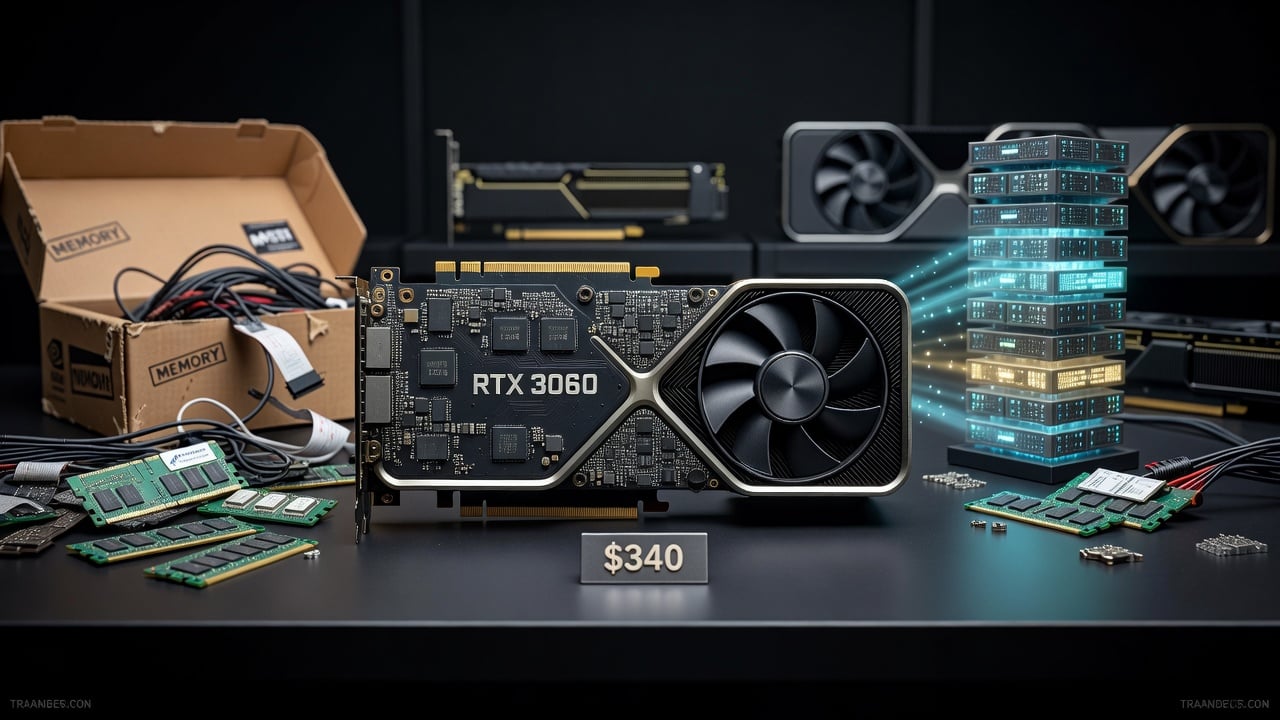
The PC graphics market has rarely looked so fractured. New flagship cards command thousands. Entry-level options sit at prices that once bought high-end silicon. And now, five years after its debut, the GeForce RTX 3060 is back on retail shelves.
Memory constraints force old silicon into new production runs.
Retailers such as Newegg list fresh Gigabyte Windforce OC RTX 3060 12GB cards, marked Rev 2.0, for $339.99. That’s just $10 above the original 2021 MSRP. Similar models from MSI, ASUS and others have surfaced in Europe and Asia. The cards appear identical to the first wave yet carry that revision tag. Something changed behind the scenes. (Tom’s Hardware)
Nvidia CEO Jensen Huang floated the idea at CES 2026. Reintroducing older GeForce models built on trailing-edge nodes made sense, he said, to ease pressure on pricing and availability for the RTX 50-series. “It’s a good idea,” Huang stated. The remark now reads like prophecy. Production of the Ampere-based chip, originally paused, resumed in the first half of 2026. Partners received updated roadmaps in January. The driver? A global memory crunch that redirected GDDR6 and advanced process capacity toward data-center AI accelerators. (PCMag)
Shortages hit harder than expected. HBM memory for AI servers pulled capacity from consumer GDDR. Even mature 8nm Samsung wafers became contested. New Blackwell GPUs for desktops suddenly carried higher opportunity costs. So Nvidia dusted off a proven design that sidesteps those constraints. The RTX 3060 uses older GDDR6 on a 192-bit bus. Twelve gigabytes. Enough headroom that many newer budget cards with eight gigabytes cannot match in memory-sensitive titles or creative workloads.
But here’s the rub. The card trails modern mid-range silicon. It lacks the latest DLSS features, Multi-Frame Generation and efficiency gains of Ada or Blackwell. Real-world tests show it roughly 10-15% slower than an RTX 5050 in rasterization. Yet at comparable street prices the older card’s VRAM advantage matters. Especially when games and AI tools keep raising memory floors.
Steam data tells the deeper story. In the May 2026 Hardware Survey the RTX 3060 held the top spot among discrete GPUs at 3.85 percent. It edged the RTX 4060 Laptop GPU and desktop RTX 4060. Newer RTX 5060 and 5070 chips climbed but still trailed. The 3060 has topped or nearly topped the chart for years. Its persistence reveals what gamers actually install and keep. (Steam Hardware Survey)
Why does this five-year-old design endure? Twelve gigabytes of VRAM delivers breathing room at 1080p and 1440p. DLSS upscaling extracts extra frames without demanding the absolute fastest silicon. Many users pair it with mid-tier CPUs in builds that prioritize longevity over bleeding-edge settings. The card also serves entry-level content creators who value raw framebuffer over ray-tracing prowess. And yes, some local AI inference workloads favor the memory capacity.
Market reaction splits. One TechRadar colleague described the revival as “like a s**t Frankenstein.” Reddit threads echo the sentiment. “Even Nvidia enthusiasts would be hard-pressed to get this for $339.99. At that point, just get an RTX 5060,” one commenter wrote. Another noted the VRAM focus “so we all know who this is really for — the AI crowd.” Yet listings continue to sell. Supply remains tight for anything newer at reasonable cost. (TechRadar)
Broader forces shape this odd revival. AI demand consumed wafer starts and memory supply that would have fed consumer graphics. Nvidia’s data-center revenue soared. Consumer margins suffered. Rather than force low-volume, high-cost Blackwell entry cards, the company revived a mature product. The strategy buys time. It offers a sub-$350 discrete option when alternatives creep toward $400 or more. But it also signals deeper structural problems. New-node capacity stays locked behind AI contracts. Consumer graphics innovation slows for all but the highest price tiers.
Recent coverage confirms the trend. Tom’s Hardware reported additional re-releases of RTX 3050 and 3060 variants in Asian channels as memory famine persists into mid-2026. PCMag tracked the initial January rumor that proved accurate. No one expected a 2021 GPU to appear in new stock in 2026. Yet here it sits on virtual shelves next to far newer hardware.
Buyers face a calculation. Spend $340 on proven 12GB silicon that runs today’s games acceptably with upscaling. Or stretch for a newer card that may offer better efficiency and features but less immediate memory. Many choose the former. Steam numbers don’t lie. The installed base grows even as new sales of the card resume.
Nvidia itself stays quiet on volumes. Partners ship quietly. The Rev 2.0 boards carry minor board tweaks at best. Drivers remain unchanged. The product feels like a stopgap. But stopgaps can last years when economics align this way.
Longer term the picture stays cloudy. Memory supply must ease. AI buildout cannot consume every advanced node forever. When it does, the RTX 3060 will fade again. Until then this ghost from 2021 fills a gap that newer architectures left open. Gamers notice. They vote with their wallets and their survey responses. And the old card keeps winning.


 WebProNews is an iEntry Publication