
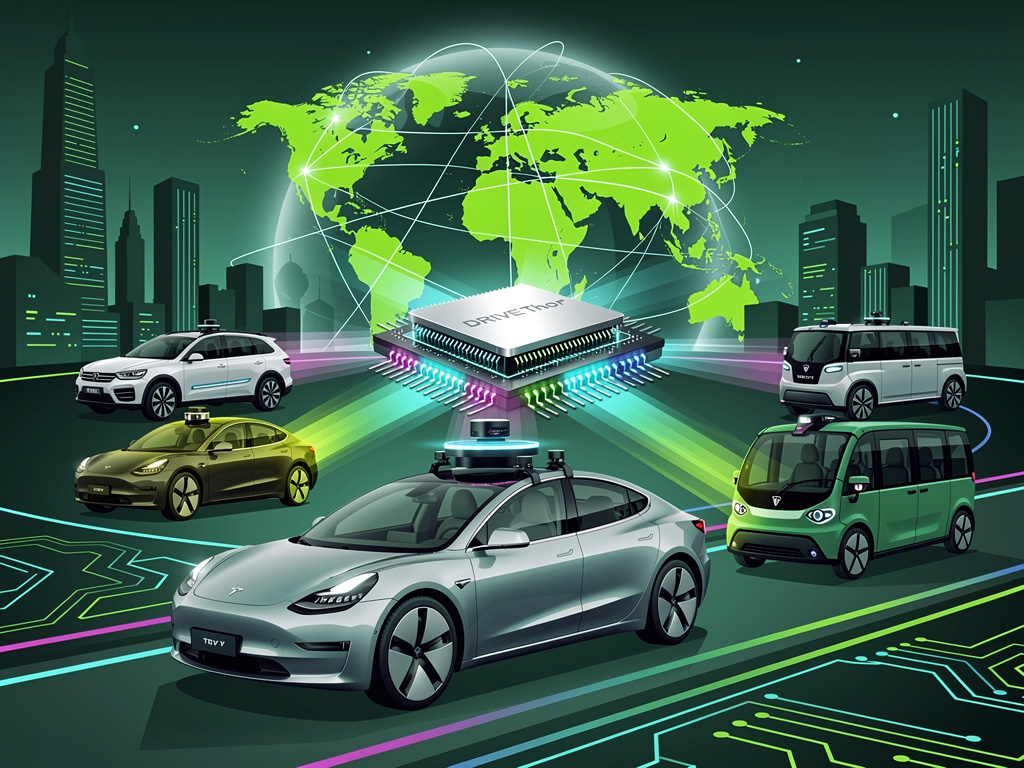
Nvidia isn’t just powering AI data centers anymore. The company is aggressively positioning itself as the essential computing platform behind autonomous vehicles, and the latest wave of partnerships makes that ambition unmistakable. According to The Verge, Nvidia has struck deals with BYD, Geely, Hyperion, Lyft, and Halos — a collection of automakers, startups, and ride-hail companies that together represent a significant cross-section of the self-driving future.
The timing matters. These announcements landed during Computex 2025, where Nvidia CEO Jensen Huang continued his campaign to make the company synonymous with autonomous driving infrastructure. Not just chips. Not just software. The full stack.
BYD, the world’s largest electric vehicle maker by volume, is the headline partner here. The Chinese automaker will use Nvidia’s Thor processors to power advanced driver-assistance systems across its lineup, with plans to eventually support fully autonomous driving. That’s a massive win for Nvidia. BYD sold more than 4.2 million vehicles in 2024 and is expanding rapidly across Europe, Southeast Asia, and Latin America. Getting Nvidia silicon into those cars at scale could dwarf anything the company has done in automotive to date.
Geely, another Chinese automotive giant that owns Volvo Cars and Polestar, is also deepening its Nvidia relationship. The company will deploy Nvidia’s DRIVE platform across multiple brands, which means the technology could show up in everything from budget-friendly Geely sedans to premium Volvo EVs. The breadth of that deployment is significant — it’s not a single-model pilot program but an architecture-level commitment.
Then there’s the robotaxi angle. Halos, a relatively new entrant focused on purpose-built autonomous vehicles, announced it will build its fleet on Nvidia’s platform. And Lyft confirmed a partnership that positions Nvidia’s technology as central to the ride-hail company’s autonomous vehicle strategy. Lyft has been notably cautious about self-driving compared to its rival Uber, which has signed deals with Waymo and others. This Nvidia partnership signals Lyft is getting more serious — and more specific — about how it plans to integrate driverless cars into its network.
Hyperion, a hydrogen-powered vehicle startup, rounds out the announcements. Less established than the others, but its inclusion shows Nvidia casting a wide net across powertrain types and company stages.
So what does Nvidia actually provide here? The core product is the DRIVE Thor system-on-a-chip, which Nvidia says can deliver up to 2,000 teraflops of AI performance. That’s enough compute to run multiple deep neural networks simultaneously — handling perception, mapping, planning, and driver monitoring all on a single chip. Nvidia also supplies the software stack, including its DRIVE OS operating system and simulation tools that let automakers train and validate autonomous systems in virtual environments before deploying them on real roads.
This is Nvidia’s playbook from the data center, applied to cars. Own the hardware. Own the software layer. Make it hard to leave. And it’s working. According to Nvidia, more than 30 automakers and autonomous vehicle companies now use the DRIVE platform. That number has grown steadily over the past two years as the industry has shifted away from building custom silicon in-house — a path that proved expensive and slow for most companies outside of Tesla and Waymo’s parent Alphabet.
The competitive picture is getting interesting. Qualcomm has been pushing hard into automotive with its Snapdragon Ride platform and recently won a major design win with General Motors. Mobileye, the Intel-owned ADAS company, remains a dominant supplier for Level 2 and Level 2+ systems globally. And then there’s Tesla, which designs its own chips and has no interest in buying from Nvidia.
But Nvidia’s advantage is scale and developer mindshare. Thousands of AI engineers already know how to build on Nvidia’s CUDA platform. That familiarity translates directly into automotive — the same developers training models on Nvidia GPUs in the cloud can deploy them on Nvidia chips in the car. It’s a flywheel effect that competitors haven’t been able to replicate.
The BYD deal deserves extra scrutiny. China’s autonomous driving market is evolving at a pace that rivals — and in some respects exceeds — the U.S. market. Companies like Baidu’s Apollo, Pony.ai, and WeRide are already operating robotaxi services in multiple Chinese cities. BYD choosing Nvidia’s platform over domestic Chinese chip alternatives, such as those from Horizon Robotics or Huawei’s MDC platform, is a notable endorsement. It also raises questions about supply chain resilience given ongoing U.S.-China tensions around semiconductor exports. Nvidia has previously had to create modified chips for the Chinese market to comply with export restrictions, and any tightening of those rules could complicate the BYD relationship.
For Lyft, the partnership is as much about signaling as substance — at least for now. The company hasn’t disclosed specific timelines for deploying Nvidia-powered autonomous vehicles in its fleet, and ride-hail companies have learned the hard way that self-driving timelines tend to slip. But aligning with Nvidia gives Lyft a credible technology partner and potentially a faster path to integrating vehicles from multiple AV manufacturers, since many of them already build on the same Nvidia platform. Interoperability matters when you’re a network trying to onboard cars from different makers.
The financial implications for Nvidia are substantial but still emerging. Automotive revenue was $570 million in fiscal Q1 2026, up 72% year-over-year, according to Nvidia’s earnings report. That’s a fraction of the company’s $44.1 billion in total quarterly revenue, but it’s growing fast. And the design wins being announced now won’t generate meaningful revenue for two to four years — the automotive development cycle is long. What they do generate immediately is lock-in. Once an automaker commits to a chip architecture, switching costs are enormous.
Jensen Huang has said repeatedly that he views autonomous vehicles as one of the largest addressable markets for AI. These partnerships suggest the industry increasingly agrees. Not every deal will pan out. Some of these companies will stumble, pivot, or get acquired. But the pattern is clear: Nvidia wants to be to self-driving cars what it already is to AI training. The picks-and-shovels provider that wins regardless of which robotaxi company ultimately dominates.
And right now, nobody else is signing this many deals this fast.


 WebProNews is an iEntry Publication