
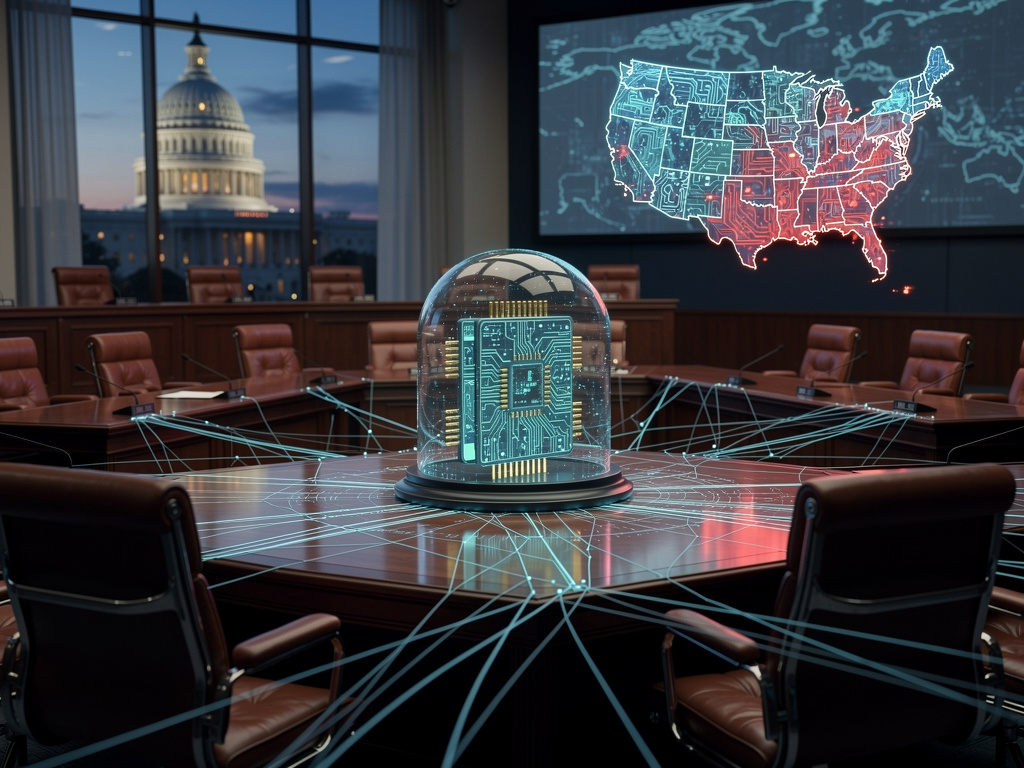
Jensen Huang’s High-Stakes Pitch: Steering U.S. AI Policy Away from Fragmentation and Restrictions
In a pivotal moment for the artificial intelligence sector, Nvidia Corp.’s chief executive, Jensen Huang, descended upon Washington this week to engage directly with President Donald Trump and key congressional figures. The discussions centered on the thorny issues of export controls for advanced AI chips and the potential pitfalls of varying state-level regulations on AI technologies. Huang’s visit underscores the growing influence of tech leaders in shaping national policy, particularly as the U.S. grapples with maintaining its edge in a global race for AI supremacy. According to reports from CNBC, Huang met with Trump and emphasized a general dialogue on export controls, wishing the president happy holidays amid the policy talk.
Huang’s agenda was clear: advocate against overly restrictive limits on AI chip sales, especially to markets like China, while warning against a patchwork of state-specific AI rules that could stifle innovation. This comes at a time when Nvidia, a dominant force in graphics processing units essential for AI training, faces scrutiny over how its products are distributed internationally. The CEO’s Capitol Hill appearance followed a period of intensifying U.S. efforts to curb China’s access to cutting-edge semiconductors, a policy that has direct implications for Nvidia’s bottom line. Sources indicate that Huang expressed support for some export controls but cautioned against degrading chips destined for foreign markets, arguing that such measures could harm American competitiveness.
The broader context reveals a delicate balancing act for the Trump administration, which has signaled a tough stance on China while courting domestic tech giants. Huang’s meetings extended beyond the Oval Office; he also conferred with Republican lawmakers, some of whom voiced skepticism about easing restrictions on high-end AI chips to China, as detailed in coverage from Fast Company. This skepticism stems from national security concerns, with fears that advanced chips could bolster China’s military capabilities or surveillance apparatus. Yet Huang positioned Nvidia as a partner in U.S. reindustrialization, crediting past Trump policies for spurring domestic chip manufacturing.
Export Controls in the Spotlight: Balancing Security and Innovation
Delving deeper into the export control debate, Huang’s advocacy highlights the tension between safeguarding sensitive technologies and fostering global trade. The U.S. has imposed successive rounds of restrictions on semiconductor exports to China, aiming to prevent the transfer of AI-enabling hardware. However, Nvidia has navigated these by offering modified, less powerful versions of its chips to comply with regulations while maintaining market presence. In his discussions, Huang reportedly urged a measured approach, suggesting that outright bans or severe degradations could backfire by pushing innovation elsewhere. This perspective aligns with Nvidia’s business interests, as China represents a significant revenue stream despite the curbs.
Industry insiders note that the proposed rules under consideration in Congress could further tighten these controls, potentially limiting sales to a broader array of countries. Huang’s intervention appears timed to influence this legislative push, which has faltered amid competing priorities. Drawing from posts on X (formerly Twitter), there’s evident sentiment that easing some restrictions could benefit Nvidia, with users speculating on the company’s gains from a more permissive policy under Trump. For instance, discussions online highlight how previous administrations’ tariffs acted as catalysts for U.S.-based production, a point Huang echoed in crediting Trump for reindustrializing efforts.
Moreover, the economic stakes are immense. Nvidia’s stock has soared on the AI boom, but export limits have introduced volatility. A recent report from Blockonomi analyzed how Huang dismissed concerns over GPU smuggling, even presenting physical evidence to lawmakers to underscore the impracticality of such illicit activities. This anecdote illustrates Huang’s hands-on style in lobbying, using tangible demonstrations to sway opinions. As the U.S. seeks to onshore more chip production, Nvidia’s role becomes even more critical, with Huang advocating for policies that support this without unduly hampering international sales.
The Perils of Fragmented Regulation: A Warning from the Front Lines
Shifting focus to domestic policy, Huang was vocal in his opposition to state-by-state AI regulations, arguing that such a fragmented approach would “drag this industry to a halt.” This stance resonates with tech executives who fear a regulatory mosaic similar to varying data privacy laws across states, which complicate compliance and innovation. In his Capitol Hill remarks, as captured by TechRadar, Huang steered conversations toward favoring federal oversight to ensure uniformity. He warned that disparate state rules could create barriers to AI deployment, slowing down advancements in fields like healthcare, autonomous vehicles, and financial services.
The call for federal preemption isn’t new, but Huang’s high-profile endorsement amplifies it. States like California and New York have already begun exploring their own AI governance frameworks, covering aspects from algorithmic bias to data usage. Huang’s critique suggests these could lead to inefficiencies, where companies must navigate a web of conflicting requirements, ultimately diverting resources from research and development. Insights from recent news on X reveal a mix of support and criticism; some users view Huang’s position as self-serving, protecting Nvidia’s market dominance, while others applaud the push for streamlined national standards.
Furthermore, this regulatory debate ties into broader AI ethics discussions. Huang emphasized that while oversight is necessary, it should not impede the rapid pace of technological progress. Nvidia’s investments in AI infrastructure position it at the heart of these conversations, with the company advocating for policies that encourage ethical AI without bureaucratic overreach. Reports from The Hill detail how Huang’s meeting with Trump included holiday well-wishes, but the core was policy-oriented, reflecting the administration’s openness to tech input amid escalating U.S.-China tech tensions.
Global Implications: Nvidia’s Role in the AI Arms Race
On the international front, Huang’s lobbying efforts reflect Nvidia’s strategic positioning in what many describe as an AI arms race. By meeting with Trump, Huang aimed to influence policies that could either open or close doors to key markets. The administration’s plans, as speculated in online forums, might involve scrapping certain diffusion rules, allowing broader chip sales—a move that could boost Nvidia’s revenues but raise security alarms. Historical context from X posts recalls how past Trump policies emphasized reindustrialization, with tariffs pressuring companies to build in the U.S., a narrative Huang leveraged to align Nvidia with national interests.
Critics, however, point to potential risks. Allowing high-end chips to flow to China could accelerate that nation’s AI capabilities, potentially eroding U.S. advantages in defense and economic spheres. Huang countered this by supporting controlled exports, ensuring that only non-sensitive technologies are shared. This nuanced position is evident in analyses from Breitbart, which notes Huang’s opposition to state-level regs while discussing export strategies with the president.
Economically, the ripple effects are profound. Nvidia’s market capitalization has ballooned, making it a bellwether for the tech sector. Any policy shifts influenced by Huang could impact supply chains, investment flows, and even geopolitical alliances. Insiders speculate that successful lobbying might lead to a more business-friendly environment, encouraging further U.S. investments in AI R&D.
Industry Reactions and Future Trajectories
Reactions within the tech community have been swift and varied. Some executives echo Huang’s concerns, fearing that regulatory fragmentation could mirror the challenges faced in Europe’s GDPR compliance. Others, particularly in startups, worry that federal rules might favor incumbents like Nvidia, consolidating power among a few giants. Posts on X capture this sentiment, with discussions around AI sovereignty and the risks of over-reliance on U.S. proprietary technologies, as voiced by international users concerned about export restrictions extending to non-U.S. chips.
Looking ahead, Huang’s visit may catalyze legislative action. Congress is considering bills that could formalize AI export controls and establish national guidelines. Huang’s input, backed by Nvidia’s clout, could tip the scales toward policies that prioritize innovation over restriction. As reported in Communications Today, Huang reiterated support for administration leadership, signaling alignment with Trump’s direction.
The interplay between tech titans and policymakers will likely intensify as AI permeates more sectors. Huang’s proactive engagement sets a precedent, demonstrating how CEOs can directly shape the rules governing their industries. For Nvidia, the outcomes of these discussions could define its trajectory in an era where AI is not just a tool but a strategic asset.
Strategic Maneuvers: Lessons from Huang’s Washington Foray
Strategically, Huang’s approach combines charm with data-driven arguments, a hallmark of his leadership style. By presenting physical evidence against smuggling fears and articulating clear economic benefits, he bridges the gap between tech jargon and policy realities. This tactic has proven effective in past dealings, and its application here underscores Nvidia’s investment in government relations.
Broader industry implications include potential shifts in how other companies lobby on AI matters. Competitors like AMD and Intel may follow suit, advocating for similar flexibilities. Meanwhile, the debate over state versus federal regulation could influence upcoming elections, with AI policy becoming a campaign flashpoint.
Ultimately, Huang’s Capitol Hill gambit highlights the intricate dance between innovation, security, and regulation. As the U.S. charts its AI course, voices like his will continue to resonate, shaping an environment where American tech leads without being hamstrung by its own rules. With ongoing discussions, the sector watches closely for policy evolutions that could redefine global AI dynamics.


 WebProNews is an iEntry Publication