
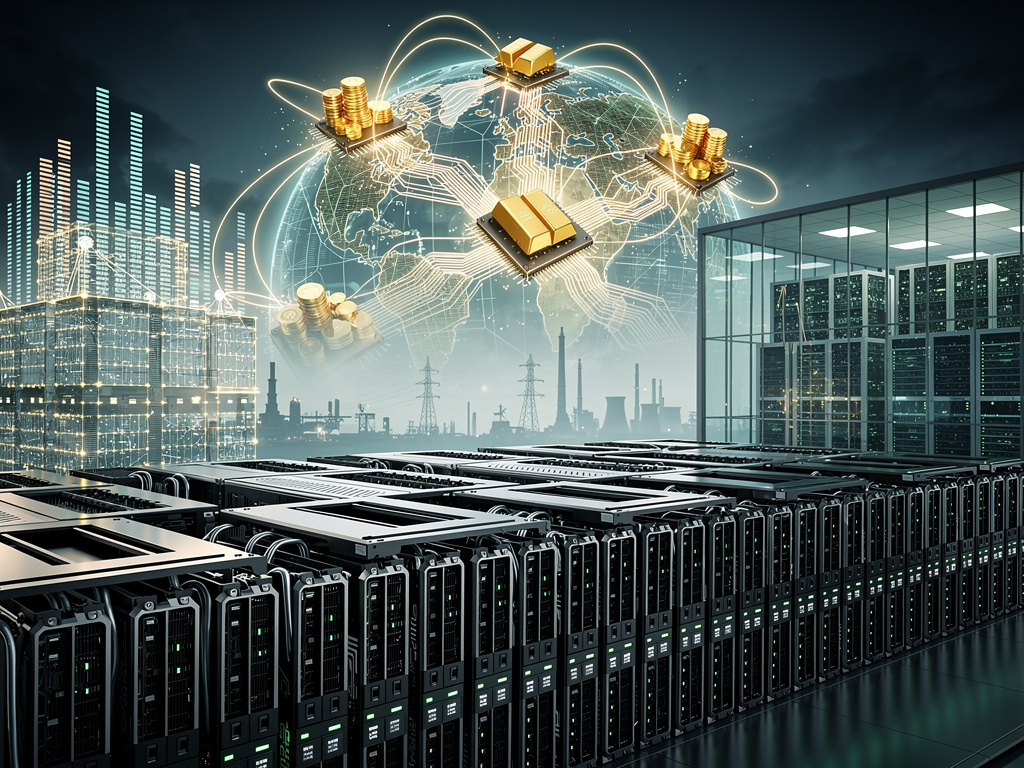
Jensen Huang, the chief executive of Nvidia, made a striking declaration during a recent appearance when he stated that compute equals money. The comment, delivered with his characteristic directness, underscores a fundamental shift in how businesses and economies assign value to processing power. As artificial intelligence systems grow more sophisticated and data volumes expand at unprecedented rates, the ability to perform massive calculations has taken on the characteristics of a core financial asset. Huang’s observation reflects both the soaring demand for graphics processing units and the broader recognition that raw computational capacity now directly translates into economic output across multiple industries.
The idea that compute holds monetary worth emerges from several converging trends. Companies engaged in training large language models or running complex simulations report that their single largest operational expense often centers on access to high-performance hardware. Data centers packed with thousands of specialized chips consume electricity at the scale of small cities while delivering the mathematical operations that power everything from recommendation engines to drug discovery platforms. This reality has prompted financial analysts to begin treating compute resources with the same seriousness once reserved for traditional commodities like oil or rare earth minerals.
Nvidia has positioned itself at the center of this transformation. The company’s data center revenue has grown dramatically in recent quarters, driven primarily by demand for its H100 and newer Blackwell series accelerators. Organizations ranging from hyperscale cloud providers to national research laboratories now allocate billions of dollars specifically for GPU clusters. Huang’s assertion that compute equals money captures the way these purchases are no longer viewed as mere capital expenditures but as strategic investments expected to generate measurable returns through AI-driven products and services.
Market observers have taken notice of this dynamic. According to an article on Yahoo Finance, Huang emphasized that the economic equation has flipped. Where previous generations of technology leaders spoke about software eating the world, the current environment suggests that access to sufficient compute may determine which companies survive and which fall behind. The piece highlights how enterprises are adjusting their balance sheets to account for compute as a distinct category of assets with depreciation schedules and return-on-investment calculations that mirror those applied to factories or real estate.
This perspective carries implications for corporate strategy. Chief financial officers now find themselves evaluating proposals for GPU purchases alongside decisions about opening new manufacturing facilities or acquiring competitors. The math is straightforward in many cases. A single large language model training run can cost tens of millions of dollars in electricity and hardware amortization. Yet the resulting models can generate recurring revenue through application programming interfaces or power entirely new product categories. The companies that can secure reliable supplies of advanced processors gain a measurable competitive advantage that appears in their financial statements as higher margins and faster growth.
The linkage between compute and money also appears in the behavior of sovereign governments. Several nations have launched initiatives aimed at building domestic AI infrastructure, viewing computational capacity as a matter of national economic security. These programs often involve direct subsidies for chip fabrication plants, tax incentives for data center construction, and partnerships with semiconductor manufacturers. The underlying assumption aligns with Huang’s statement: control over compute resources equates to control over future economic value creation. Countries that fall behind in acquiring or producing sufficient processing power risk ceding ground in industries from autonomous transportation to advanced materials science.
Energy considerations add another dimension to the equation. Training and inference operations for modern AI systems require substantial electrical power, leading some analysts to forecast that data center electricity consumption could rival that of entire countries within the next decade. This reality has sparked renewed interest in alternative energy sources, more efficient cooling technologies, and novel chip designs that deliver more operations per watt. Utility companies in certain regions report that requests for new data center connections now exceed their available capacity, forcing delays in project timelines and driving up power prices. The financial markets have begun pricing these constraints into the valuations of both semiconductor suppliers and the cloud service providers that depend on them.
Investment patterns reflect the growing consensus around compute as a monetizable resource. Venture capital firms increasingly ask startups about their compute strategy before committing funds. Some early-stage companies now list access to GPU clusters as a key competitive moat alongside traditional intellectual property. On the public markets, Nvidia’s market capitalization has at times surpassed the combined value of several long-established industrial giants, a reflection of the premium investors place on the company’s ability to supply the processors that turn electricity into intelligence.
The shift carries consequences for talent allocation as well. Engineers skilled in distributed systems, low-level optimization, and hardware-software co-design command compensation packages that rival those offered to top product managers or sales executives. Universities have expanded curricula focused on high-performance computing, while established technology companies offer specialized training programs to convert traditional software developers into specialists capable of extracting maximum performance from GPU architectures. This talent competition further reinforces the monetary value of compute because organizations need qualified people to make effective use of their expensive hardware investments.
Hardware innovation continues at a rapid pace in response to these pressures. Nvidia’s annual announcements of new architectures typically highlight improvements in both raw performance and energy efficiency. Competing silicon providers, including established players like AMD and Intel as well as newer entrants focusing on domain-specific designs, have accelerated their roadmaps. The result is a virtuous cycle in which better hardware enables more ambitious AI models, which in turn drive demand for even more capable processors. Each generation of chips tends to command higher prices per unit while delivering proportionally larger economic benefits to the organizations that deploy them.
Cloud computing providers have structured their offerings to reflect this new reality. Major platforms now sell compute in forms that allow customers to reserve GPU capacity months in advance, much like booking industrial machinery or leasing office space. Pricing models have grown more sophisticated, with options for spot instances, committed use discounts, and specialized clusters optimized for particular workloads. These services make compute available as a variable expense for companies that cannot justify owning their own data centers, further embedding the concept that processing power functions as a form of currency within the digital economy.
Smaller organizations benefit from this democratization even as they compete with better-funded rivals. Open-source models and cloud-based training services have lowered the barrier to entry, allowing teams with modest budgets to experiment with sophisticated AI techniques. However, the most advanced capabilities still tend to concentrate among those with the deepest pockets and earliest access to the latest hardware. This dynamic raises questions about market concentration and whether compute abundance will eventually spread widely enough to prevent a small number of players from dominating AI development.
Educational institutions have begun treating compute resources as a form of scholarly infrastructure comparable to telescopes or particle accelerators. Research grants increasingly include line items for cloud credits or dedicated GPU allocations. Publications in top machine learning conferences often list the computational budget used to produce results, allowing readers to assess the scale of experimentation that went into each finding. This transparency helps the academic community understand the relationship between available compute and scientific progress.
The financial services industry has developed new instruments to manage compute-related risks and opportunities. Some banks now offer specialized lending products backed by GPU inventories, treating the chips themselves as collateral with established secondary markets. Futures contracts on semiconductor production capacity remain rare but have been discussed in trading circles. Insurance products have appeared that protect against supply disruptions or sudden obsolescence of particular chip architectures. These developments indicate that compute has begun to behave like other asset classes with their own derivatives, risk management tools, and specialized financial expertise.
Looking forward, the equation Huang articulated seems likely to grow even more pronounced. As AI systems tackle increasingly complex tasks, from molecular modeling to climate simulation, the computational requirements continue to scale. New algorithmic approaches may improve efficiency, yet historical patterns suggest that demand tends to outpace gains in hardware performance. The organizations that can consistently secure, manage, and apply large amounts of compute will likely maintain advantages across multiple business metrics, from revenue growth to market valuation.
This environment places pressure on the entire supply chain. From silicon wafer fabrication to advanced packaging technologies and high-speed networking components, every element that contributes to delivered compute receives intense scrutiny. Shortages in any single area can create bottlenecks that ripple through the global economy. The chip industry has responded by investing heavily in new production facilities, though the multi-year timelines for bringing such plants online mean that supply constraints may persist for the foreseeable future.
Consumers experience the effects of this compute economy indirectly through the capabilities of the applications they use daily. Features that once seemed futuristic, such as real-time language translation or personalized content generation, have become commonplace because sufficient processing power exists to run them at scale. The monetary value of that compute is embedded in subscription fees, advertising rates, and corporate balance sheets even if end users never see the underlying infrastructure.
Huang’s straightforward declaration cuts through much of the surrounding hype to focus on a basic truth. In an economy increasingly powered by artificial intelligence, the ability to perform calculations at scale has become a primary driver of value creation. Companies, governments, and research organizations that treat compute as a strategic financial asset rather than a technical afterthought position themselves to capture the economic benefits that flow from intelligence at scale. The coming years will test which participants best understand this relationship and allocate resources accordingly. The markets have already begun keeping score.


 WebProNews is an iEntry Publication