
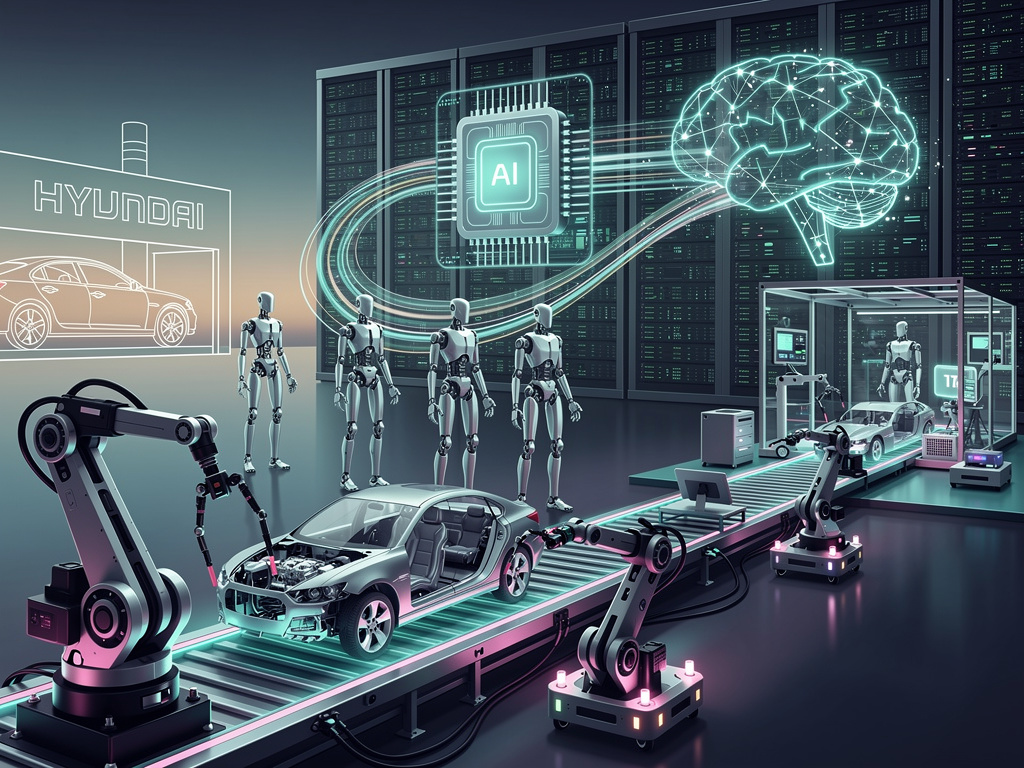
Jensen Huang stood in the lobby of Hyundai’s Seoul headquarters this week. Robots watered plants and handled deliveries around him. The Nvidia chief executive had come to talk with Hyundai Motor Group Executive Chair Euisun Chung. Their message proved direct. The pair are very close to moving robotics from laboratories into full-scale production.
Hyundai owns Boston Dynamics. That ownership gives the automaker control over Atlas, the electric humanoid once known for acrobatic videos. Now Atlas carries real industrial ambitions. Production versions will enter Hyundai factories. Initial deployments begin in 2026. Full integration at the Georgia Metaplant follows in 2028. The carmaker aims to manufacture as many as 30,000 units annually by then. And the hardware runs on Nvidia technology.
The alliance stretches back years. Boston Dynamics expanded its work with Nvidia in March 2025. Boston Dynamics made Atlas an early adopter of the Isaac GR00T platform and the Jetson Thor computing module. Jetson Thor delivers the onboard muscle for complex multimodal models. Those models coordinate whole-body control and dexterous manipulation. Training happens first inside simulation environments built on Nvidia Isaac Lab and Omniverse. The approach shrinks the gap between digital rehearsal and factory floor execution.
Hyundai Motor Group laid out its broader AI robotics plan at CES in January 2026. The company pledged tens of billions in fresh capital. A new robotics factory will rise in the United States as part of a $26 billion American investment. In Korea the group committed 125.2 trillion won through 2030. Part of that money funds a robot manufacturing cluster in Saemangeum. Local officials call the site an AI Valley. Huang suggested it could consume tens of thousands of Blackwell GPUs.
Physical AI sits at the center of these plans. The term describes systems that perceive, reason and act directly in the physical world. Nvidia has released open foundation models to speed progress. Its Cosmos platform generates synthetic video data at scale. GR00T offers humanoid-specific reasoning and transfer learning. Partners including Boston Dynamics, LG Electronics and others demonstrated robots powered by the stack at the same CES event. NVIDIA quoted Huang saying the ChatGPT moment for robotics has arrived.
But hardware alone does not finish the job. Boston Dynamics announced a separate tie-up with Google DeepMind in early 2026. DeepMind’s Gemini Robotics models supply high-level cognition. The combination pairs Atlas’s agile body with advanced planning and rapid task learning. Hyundai Vice Chair Jaehoon Chang captured the intent in April 2025 remarks. “Physical AI and humanoid robots will transform our business,” he said, according to Boston Dynamics.
Executives on both sides stress manufacturing scale as the decisive advantage. Hyundai builds cars at volumes few rivals match. Its plants already test autonomous guided vehicles and collaborative arms. Adding humanoids opens new possibilities. Robots could sequence parts, handle hazardous assembly steps or adapt to model-year changes without retooling entire lines. Initial field tests at a Georgia parts warehouse showed Atlas sorting components autonomously. The 5-foot-9, 200-pound machine performed repetitive logistics tasks under Nvidia chip supervision.
Challenges remain. Safety certification for close human collaboration demands rigorous validation. Current robots still struggle with long-horizon tasks in unstructured settings. Data collection at scale requires fleets that do not yet exist. Nvidia’s simulation-first strategy aims to solve part of that problem. Synthetic environments let engineers generate millions of edge cases without risking hardware. Yet bridging the reality gap from simulation to metal still requires real-world fine-tuning.
Investors responded positively to the latest signals. Hyundai Motor shares rose nearly 7 percent after the Seoul meetings. Nvidia gained more than 6 percent the same day. The market sees potential for an entirely new category of capital expenditure. Carmakers could spend heavily on robot fleets the way they once bought welding robots and paint booths.
Hyundai’s strategy extends beyond its own walls. The group envisions offering robots as a service to other manufacturers. Its Robotics Metaplant Application Center, opening this year, will serve as a proving ground. There engineers will integrate Nvidia infrastructure, DeepMind models and Boston Dynamics hardware into complete solutions. The company also signed a memorandum of understanding with the Korean government and Nvidia to strengthen national capabilities in the field.
Competitors watch closely. Tesla develops its Optimus humanoid on similar principles. Figure, backed by OpenAI and others, pursues commercial pilots. Chinese firms pour resources into their own platforms. Yet few possess Hyundai’s combination of automotive expertise, robotics pedigree and willingness to commit capital at this scale. Boston Dynamics brings decades of dynamic control research. Nvidia supplies the computational backbone. The pieces appear to be snapping into place.
Recent conversations in Seoul reinforced the momentum. Huang and Chung discussed expanding the partnership into robotaxis, AI factories and additional mobility forms. Hyundai evaluates Nvidia’s Alpamayo platform for Level 4 autonomy. The two sides may build a joint data hub inside the Saemangeum project. Such infrastructure would feed continuous model improvement across vehicles and robots alike.
The original vision that drew Hyundai to acquire Boston Dynamics in 2021 has evolved. What began as a search for new mobility concepts has become a bet on intelligent machines that share factory floors with people. Spot quadrupeds already inspect construction sites. Stretch robots automate warehouse unloading. Atlas now targets the far more complex domain of general manufacturing.
Success hinges on execution. Timelines for mass production have slipped before in robotics. Regulatory approval for widespread humanoid deployment could take years. Still the convergence of three powerful organizations creates unusual force. One supplies the brains. One supplies the bodies. One supplies the factories that will test them at volume.
Factory managers once asked how many robots they could afford. Soon the question may flip. How many human workers will remain once fleets of Atlas units learn to perform most repetitive and dangerous jobs? The answer will shape labor markets, corporate balance sheets and competitive advantage for years ahead. For now the machines keep improving. And the partnerships keep deepening.


 WebProNews is an iEntry Publication