
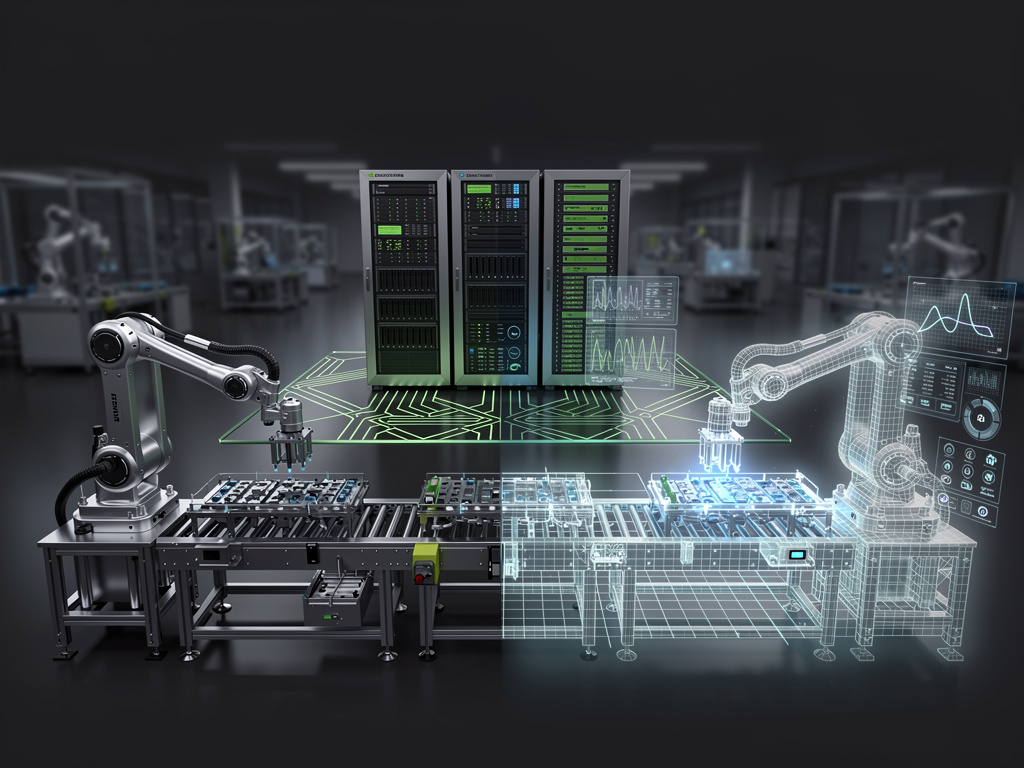
For decades, manufacturers have chased the promise of a fully digital factory — a virtual replica so precise that engineers could test, optimize, and validate every process before a single physical component was ever produced. That vision is now accelerating toward reality, driven by a deepening partnership between two of the most consequential technology companies in the industrial sector: NVIDIA and Dassault Systèmes.
The two firms are integrating their respective platforms — NVIDIA’s Omniverse and accelerated computing infrastructure with Dassault Systèmes’ 3DEXPERIENCE platform — to create what they describe as a unified industrial AI environment capable of producing physically accurate, validated digital twins at unprecedented speed and scale. The collaboration, which has been building over recent months, represents a significant strategic bet that the convergence of AI, simulation, and cloud computing will fundamentally transform how products are designed, manufactured, and maintained across industries ranging from aerospace and automotive to energy and life sciences.
A Platform Play Built on Physics and AI
At the core of this partnership is the integration of NVIDIA’s Omniverse — a platform for building and operating Universal Scene Description (OpenUSD)-based 3D applications and digital twins — with Dassault Systèmes’ 3DEXPERIENCE, which serves as the backbone for product lifecycle management, simulation, and collaborative engineering for many of the world’s largest manufacturers. According to Technology Magazine, the combined platform enables enterprises to build digital twins that are not merely visual representations but are grounded in validated physics, allowing engineers and operators to trust the outputs for critical decision-making.
The significance of this distinction cannot be overstated. Traditional digital twins have often been limited to static 3D models or narrowly scoped simulations. What NVIDIA and Dassault Systèmes are constructing is a dynamic, AI-enhanced environment where simulations run in real time, informed by sensor data, historical performance metrics, and physics-based modeling. NVIDIA CEO Jensen Huang has repeatedly emphasized that the future of computing is not just about faster chips but about building virtual worlds that obey the laws of physics — and this partnership is a direct manifestation of that thesis.
Why Validated Digital Twins Matter Now More Than Ever
The industrial sector is under mounting pressure from multiple directions: supply chain volatility, regulatory demands for sustainability, the accelerating pace of electrification, and a persistent shortage of skilled labor. In this environment, the ability to simulate and validate manufacturing processes digitally before committing capital and resources to physical production is not a luxury — it is becoming a competitive necessity.
As Technology Magazine reported, the partnership aims to deliver digital twins that “boost speed, accuracy and confidence” in industrial decision-making. This means that an automotive OEM, for instance, could simulate an entire assembly line — including robotic movements, material flow, thermal dynamics, and worker ergonomics — in a virtual environment that mirrors real-world physics with high fidelity. Errors that would previously be discovered only during physical commissioning, at enormous cost, can now be identified and corrected in the digital domain.
The Technical Architecture: Omniverse Meets 3DEXPERIENCE
From a technical standpoint, the integration leverages NVIDIA’s accelerated computing stack — including its GPU architecture, AI frameworks, and the Omniverse platform’s support for OpenUSD — alongside Dassault Systèmes’ deep expertise in multi-physics simulation through its SIMULIA, CATIA, and DELMIA brands. The OpenUSD standard is critical here: it provides a common language for describing 3D scenes, enabling interoperability between different software tools and data sources that have historically existed in silos.
NVIDIA has been aggressively promoting OpenUSD as the “HTML of 3D” — a universal format that allows different applications to contribute to and consume a shared digital twin. By building on this standard, the NVIDIA-Dassault Systèmes platform avoids the vendor lock-in that has plagued industrial software for decades, instead offering an open framework where data from CAD systems, IoT sensors, ERP platforms, and AI models can converge into a single, coherent virtual representation of a factory, product, or process.
Industrial AI: From Buzzword to Operational Reality
The partnership also reflects a broader shift in how industrial companies are thinking about artificial intelligence. For years, AI in manufacturing was largely confined to narrow applications — predictive maintenance alerts, quality inspection via computer vision, or demand forecasting. What NVIDIA and Dassault Systèmes are enabling is something far more ambitious: AI that is deeply embedded in the engineering and manufacturing workflow, capable of optimizing designs, suggesting process improvements, and even autonomously managing aspects of production.
NVIDIA’s recent advances in generative AI and large language models are playing a role here as well. The company has been developing AI agents and copilots that can interact with complex engineering data, allowing non-specialists to query digital twins using natural language. Imagine a plant manager asking, “What happens to throughput if we add a second robotic arm to station 14?” and receiving a physics-validated simulation result within minutes rather than weeks. This is the kind of capability the partnership is working to deliver.
Competitive Dynamics and Market Implications
The NVIDIA-Dassault Systèmes alliance does not exist in a vacuum. Siemens, which has its own deep partnership with NVIDIA through the Siemens Xcelerator platform and its Tecnomatix and Teamcenter products, has been pursuing a similar vision of AI-powered industrial digital twins. Microsoft, through its Azure Digital Twins platform and partnership with various industrial software vendors, is also competing for this space. PTC, with its Creo and ThingWorx platforms, represents another formidable player.
What distinguishes the NVIDIA-Dassault Systèmes approach is the depth of physics-based simulation that Dassault Systèmes brings to the table, combined with NVIDIA’s unmatched GPU computing power and its growing ecosystem of AI tools. Dassault Systèmes has spent decades building simulation capabilities that are trusted by aerospace giants like Boeing and Airbus, automotive leaders like Toyota and BMW, and life sciences companies developing complex therapeutics. Marrying that domain expertise with NVIDIA’s AI and visualization capabilities creates a proposition that is difficult for competitors to replicate quickly.
Real-World Deployment and Industry Adoption
While the full scope of the platform’s capabilities is still being rolled out, early adoption signals are encouraging. Major manufacturers in the automotive and aerospace sectors have been piloting integrated digital twin environments that combine Dassault Systèmes’ simulation tools with NVIDIA’s Omniverse for visualization and real-time collaboration. These pilots have demonstrated significant reductions in time-to-market and engineering rework, according to industry reports.
The energy sector, particularly companies involved in the energy transition, is another area of intense interest. Designing and validating new battery manufacturing lines, hydrogen production facilities, or wind turbine components requires the kind of multi-physics simulation that the combined platform excels at. As regulatory requirements for carbon accounting and lifecycle analysis become more stringent, the ability to simulate environmental impacts digitally will become increasingly valuable.
The Road Ahead for Industrial Digital Twins
Looking forward, the NVIDIA-Dassault Systèmes partnership is likely to deepen further as both companies invest in next-generation capabilities. NVIDIA’s roadmap includes increasingly powerful GPU architectures — the Blackwell platform and beyond — that will enable even more complex real-time simulations. Dassault Systèmes, meanwhile, continues to expand its 3DEXPERIENCE platform’s cloud capabilities, making it accessible to a broader range of enterprises, including mid-market manufacturers that have historically lacked the resources for sophisticated digital twin deployments.
The convergence of AI, simulation, and accelerated computing is creating a new category of industrial software — one that transcends the traditional boundaries between design, engineering, manufacturing, and operations. For industry executives, the message is clear: the companies that master this convergence will gain a decisive advantage in speed, efficiency, and innovation. And at the center of this transformation, NVIDIA and Dassault Systèmes are building the infrastructure that will underpin the next generation of industrial enterprise.
For the broader technology sector, this partnership underscores a critical truth: the most consequential applications of AI may not be chatbots or image generators, but the invisible, physics-grounded simulations that determine how the physical world is designed, built, and operated. The factory of the future is being constructed today — and it exists first in silicon.


 WebProNews is an iEntry Publication