
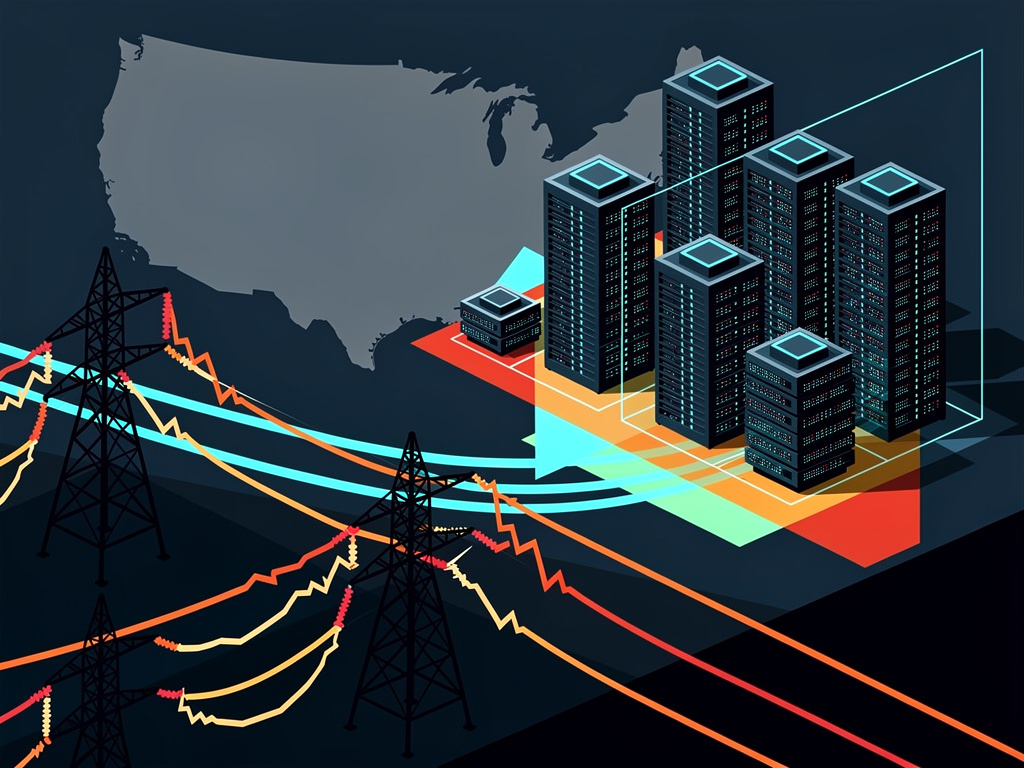
LOUDOUN COUNTY, Va. — The most valuable farmland in America doesn’t grow corn or soybeans. It grows servers. Row after row of them, humming inside windowless concrete buildings that stretch across what was once horse country in Northern Virginia, consuming enough electricity to power small nations. And now the grid is breaking under the weight.
Northern Virginia’s Loudoun County has long held the title of the world’s largest concentration of data centers. More than 300 facilities operate here, handling an estimated 70% of the world’s internet traffic on any given day. For years, this was a point of pride — a tax revenue bonanza that helped fund schools, roads, and one of the wealthiest counties in the United States. But the artificial intelligence boom has turned that pride into panic.
The numbers are staggering. Politico reported that data center electricity demand in Virginia is projected to more than double by 2030, driven almost entirely by the computational hunger of AI training and inference workloads. A single modern AI data center can consume as much power as 100,000 homes. Dominion Energy, the state’s primary utility, has warned that it cannot build new generation and transmission infrastructure fast enough to keep pace.
This isn’t a theoretical problem. It’s happening now.
Dominion has already imposed interconnection delays of four to seven years for new data center projects seeking grid connections in parts of Northern Virginia. That timeline would have been unthinkable five years ago, when a new facility could plug into the grid within 18 to 24 months. The bottleneck has sent shockwaves through the technology industry, prompting some of the world’s largest cloud computing companies to reconsider their expansion plans — or look elsewhere entirely.
Amazon Web Services, Microsoft, and Google collectively have billions of dollars in planned or under-construction data center capacity in Virginia. Amazon alone has invested more than $35 billion in the state. But the power constraints have created a strange new reality: companies are sitting on approved building permits they can’t use because there’s no electricity to feed the buildings. Land is purchased. Steel is ordered. And then everyone waits.
“We’re in a situation where demand has completely outstripped our ability to supply,” a Dominion Energy spokesperson told reporters earlier this year. The utility has proposed a massive buildout that includes new natural gas plants, solar farms, battery storage, and even a small modular nuclear reactor. The price tag runs into the tens of billions, and ratepayers are furious.
That fury has turned political. Virginia Governor Glenn Youngkin, who initially courted data center investment aggressively, now faces a backlash from residents who say their electric bills are subsidizing Silicon Valley’s AI ambitions. Dominion has filed for rate increases that would raise residential bills by roughly 10% to help finance grid upgrades driven predominantly by data center load growth. Consumer advocates argue the tech companies should bear more of the cost.
The math is brutal. According to Dominion’s own integrated resource plan, data centers account for the vast majority of new electricity demand in its service territory. Residential and commercial growth is essentially flat. Yet under Virginia’s current regulatory framework, the cost of new generation and transmission is spread across all ratepayers, not allocated proportionally to the customers driving the need. A retired schoolteacher in Richmond is, in effect, helping pay for the power lines that feed a Meta AI training cluster in Ashburn.
So the political ground is shifting. State legislators introduced multiple bills in the 2026 session aimed at making data center operators pay a larger share of infrastructure costs. One proposal would impose a per-megawatt surcharge on facilities above a certain size. Another would require data center companies to fund dedicated generation assets before receiving grid interconnection approval. Neither has passed yet, but the debate is intensifying.
The environmental dimension adds another layer of complexity. Virginia had committed to significant carbon reduction targets, but meeting surging data center demand with renewables alone is mathematically difficult. Solar and wind are intermittent. Battery storage at the scale needed remains prohibitively expensive. And so Dominion’s plans lean heavily on natural gas — a fuel that produces roughly half the carbon emissions of coal but still moves the state in the wrong direction relative to its climate goals.
Environmental groups have filed formal objections. The Sierra Club and other organizations argue that approving new gas plants to serve data centers locks Virginia into decades of fossil fuel dependence. They want the state to mandate that data center operators procure 100% renewable energy, either through direct power purchase agreements or by building their own generation. Some companies are already doing this voluntarily — Amazon claims to be the world’s largest corporate buyer of renewable energy — but critics say the commitments are based on accounting tricks involving renewable energy credits rather than actual electrons flowing from clean sources to servers.
Meanwhile, the land use battles are getting uglier. Prince William County, just south of Loudoun, has become the new frontier for data center development as Loudoun runs out of suitable parcels. Residents in Prince William have organized fierce opposition, showing up at planning commission meetings by the hundreds to protest proposed facilities near schools and neighborhoods. The complaints center on noise from industrial cooling systems, light pollution, loss of green space, and declining property values.
In January, the Prince William Board of County Supervisors imposed a temporary moratorium on new data center zoning applications — a move that drew immediate legal threats from developers. The moratorium is set to expire in July, but the political message was clear: communities are no longer willing to absorb unlimited growth without a say in the terms.
The ripple effects extend far beyond Virginia. Other states are watching closely, seeing both a cautionary tale and an opportunity. Georgia, Texas, Ohio, and Indiana have all ramped up efforts to attract data center investment, touting available power capacity and friendlier regulatory environments. But many of these states face their own grid constraints, and the pattern could easily repeat itself.
Texas is particularly instructive. ERCOT, the state’s independent grid operator, has seen data center interconnection requests surge to more than 50 gigawatts — roughly equivalent to the entire current peak demand of the Texas grid. Not all of those projects will materialize, but even a fraction would strain a system that famously collapsed during Winter Storm Uri in 2021. ERCOT officials have publicly acknowledged they don’t have a plan to accommodate this level of growth without significant new generation investment.
The federal government is getting involved too. The Department of Energy has launched a task force to study data center energy demand and its implications for grid reliability. Congressional hearings held in February featured testimony from utility executives, tech company representatives, and grid reliability experts, all painting a picture of a system approaching its limits. Senator Mark Warner of Virginia called the situation “a five-alarm fire” and urged bipartisan action to streamline permitting for new transmission lines and generation facilities.
Permitting is arguably the deepest structural problem. Building a new high-voltage transmission line in the United States takes an average of 10 to 12 years from proposal to energization. A new natural gas plant takes four to six years. A nuclear plant? A decade or more, assuming it gets approved at all. But AI companies are making investment decisions on 18-month cycles. The temporal mismatch between how fast the tech industry moves and how slowly the energy sector builds is the central tension driving this crisis.
Some companies are trying to engineer around the bottleneck. Microsoft signed a deal to restart the Three Mile Island Unit 1 nuclear reactor in Pennsylvania, which had been shut down for economic reasons in 2019. Amazon purchased a nuclear-powered data center campus from Talen Energy near the Susquehanna plant. Google has invested in next-generation geothermal technology. These are creative solutions, but they’re also drops in the bucket relative to the scale of projected demand.
The private equity and infrastructure investment communities smell opportunity. Brookfield Asset Management, BlackRock, and KKR have all made significant bets on data center power infrastructure, financing everything from dedicated gas plants to utility-scale solar installations designed specifically to serve hyperscale facilities. A new asset class is emerging: power-as-a-service for AI, where investors build generation capacity and sell the output directly to tech companies under long-term contracts.
But even money can’t solve the physics. Electrons must travel over wires, and wires must be strung on towers, and towers must cross somebody’s land. The not-in-my-backyard dynamics of transmission siting are ferocious, especially in densely populated corridors like Northern Virginia and its surrounding counties. Dominion’s proposed 500-kilovolt transmission line through parts of Fauquier and Prince William counties has drawn thousands of public comments, overwhelmingly negative.
Back in Loudoun County, the mood among longtime residents is one of resigned frustration. The data centers brought prosperity — the county has no car tax, excellent public schools, and a AAA bond rating. But the quality of life is eroding. Traffic from construction vehicles clogs rural roads. The hum of generators is audible in neighborhoods that were quiet a decade ago. And the landscape that attracted people to Virginia horse country in the first place is disappearing behind concrete walls and razor wire.
“We sold our soul for a tax base,” one Loudoun County supervisor said at a recent public meeting, according to local press coverage. The comment drew applause.
The technology industry’s response has been to emphasize the economic benefits — jobs, tax revenue, the strategic importance of AI infrastructure — while quietly accelerating plans to diversify geographically. Microsoft, Amazon, and Google are all expanding aggressively in international markets, including Sweden, Japan, and the United Arab Emirates, partly to reduce their dependence on any single grid. But the United States remains the center of gravity for AI development, and Virginia remains its capital.
The question now is whether the political and physical infrastructure can adapt fast enough. Virginia’s data center industry generated an estimated $3.2 billion in state and local tax revenue last year. Killing that golden goose isn’t an option any elected official will seriously entertain. But neither is the status quo, where unchecked growth threatens grid reliability for millions of people who have nothing to do with artificial intelligence.
Something has to give. Either the permitting process for new energy infrastructure gets dramatically faster, or data center growth gets capped by the physical limits of the grid, or ratepayers and communities absorb costs and disruptions they never signed up for. Most likely, it’ll be some messy combination of all three.
And the AI models keep getting bigger. OpenAI’s next-generation systems, by the company’s own projections, will require computing clusters that consume gigawatts of power — quantities previously associated with entire metropolitan areas, not single facilities. Anthropic, xAI, and other competitors are on similar trajectories. The demand curve isn’t flattening. It’s steepening.
Northern Virginia built the internet’s physical backbone. Now it’s discovering that the backbone has a spine problem. The rest of America should pay attention, because the same forces heading for Virginia’s grid are heading everywhere else too. Just a few years behind.


 WebProNews is an iEntry Publication