
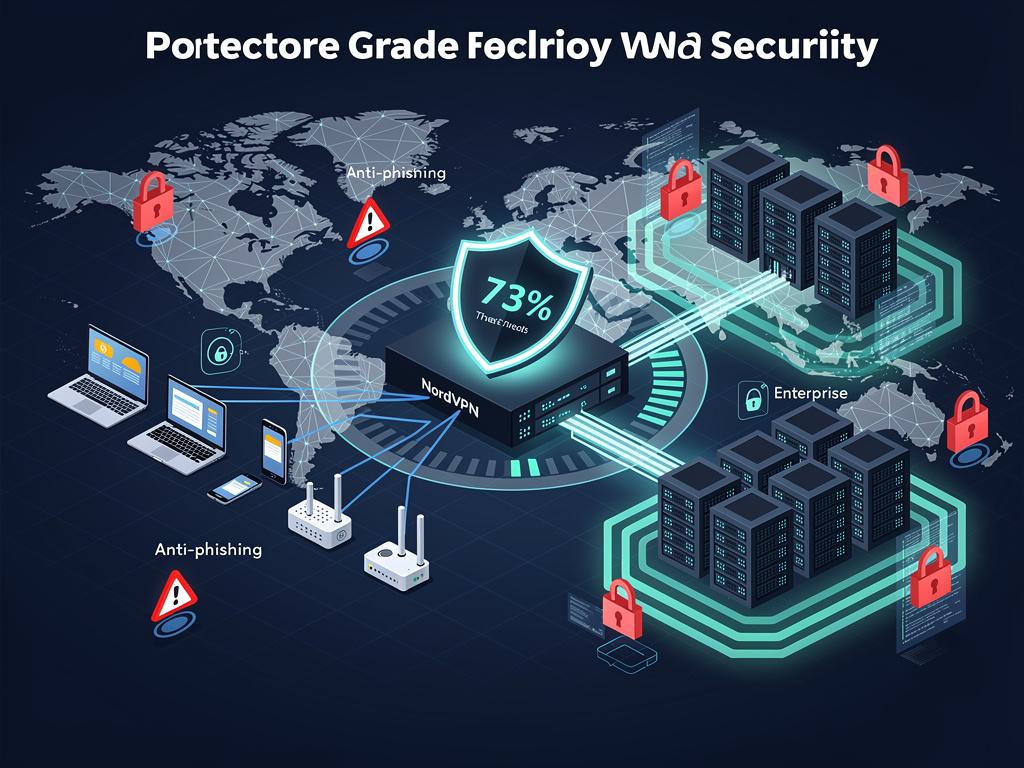
The virtual private network industry has long marketed itself on privacy promises, but a new frontier in consumer security demands more than encrypted tunnels and masked IP addresses. As phishing attacks surge to unprecedented levels—with the FBI’s Internet Crime Complaint Center reporting losses exceeding $10 billion in 2023—VPN providers are racing to prove their worth beyond basic anonymity. NordVPN’s recent laboratory testing reveals both the potential and limitations of integrated anti-phishing tools, offering industry insiders a sobering look at where consumer security products stand in the escalating war against digital deception.
According to comprehensive testing conducted by CNET, NordVPN’s Threat Protection feature demonstrated a 73% detection rate against known phishing sites during controlled laboratory conditions. While this performance places the service above baseline browser protections, it falls short of enterprise-grade security solutions that routinely achieve detection rates in the high 90th percentile. The testing methodology involved exposing the VPN’s threat detection system to a curated database of verified malicious websites, measuring both initial detection capabilities and response times to emerging threats.
The implications extend far beyond a single product review. With remote work normalizing and personal devices increasingly handling sensitive corporate data, the convergence of consumer and enterprise security requirements has created a market opportunity worth billions. Gartner projects the global VPN market will reach $77.1 billion by 2026, with threat protection features becoming a key differentiator among providers competing for both individual subscribers and small business clients who lack dedicated IT security teams.
The Technical Architecture Behind Modern Threat Detection
NordVPN’s Threat Protection operates through a multi-layered approach that combines traditional blacklist databases with behavioral analysis algorithms. The system intercepts web requests before they reach the user’s browser, cross-referencing destination URLs against continuously updated threat intelligence feeds. When a match occurs, the connection is terminated and the user receives a warning notification. This architecture mirrors enterprise solutions but operates with significantly fewer computational resources and smaller threat databases due to the constraints of consumer-grade devices and network performance expectations.
The 73% detection rate, while respectable for a consumer product, highlights fundamental challenges in real-time threat identification. Phishing operations have evolved into sophisticated, rapidly-shifting campaigns that often utilize legitimate cloud infrastructure and freshly-registered domains that haven’t yet appeared in threat databases. Security researchers at Palo Alto Networks estimate that the average phishing site remains active for just 15 hours before being taken down or relocated, creating a constant race between detection systems and attackers who deliberately stay ahead of blacklist propagation cycles.
Comparative Performance Metrics Across the Industry
Industry testing reveals significant variation in anti-phishing effectiveness across VPN providers. While NordVPN’s 73% detection rate represents a mid-to-upper tier performance, competitors show a wide range of capabilities. ExpressVPN’s ThreatManager feature, according to independent testing by AV-Comparatives, achieved a 68% detection rate in similar conditions, while Surfshark’s CleanWeb functionality demonstrated a 71% success rate. These figures contrast sharply with dedicated anti-phishing solutions like Cloudflare’s Gateway or Cisco Umbrella, which consistently exceed 95% detection in enterprise environments.
The performance gap stems primarily from resource allocation and specialization. Dedicated security platforms invest heavily in machine learning models trained on millions of phishing samples, employ teams of threat researchers who manually verify suspicious sites, and maintain infrastructure specifically designed for microsecond-level threat analysis. VPN providers, by contrast, must balance security features against their core value proposition of network performance and privacy, leading to compromises in database size, update frequency, and computational overhead that directly impact detection capabilities.
The Economics of Bundled Security Features
From a business perspective, integrated threat protection serves multiple strategic purposes for VPN providers. The features justify premium pricing tiers—NordVPN charges $12.99 monthly for plans including Threat Protection versus $11.99 for basic VPN service—while reducing customer churn by positioning the product as a comprehensive security solution rather than a single-purpose tool. Market research from Parks Associates indicates that consumers who utilize multiple features within a security product demonstrate 34% higher retention rates compared to those using only core functionality.
However, the marketing of these capabilities raises questions about consumer expectations versus delivered value. When VPN providers advertise “complete protection” or “comprehensive security,” users may reasonably assume protection levels comparable to enterprise solutions, creating potential liability concerns if sophisticated phishing attacks bypass the integrated defenses. Legal experts note that the industry currently operates in a regulatory gray area, with few jurisdictions establishing clear standards for what constitutes adequate consumer security product performance.
Real-World Attack Scenarios and Detection Limitations
The controlled laboratory environment used in CNET’s testing, while valuable for establishing baseline performance metrics, differs substantially from real-world phishing scenarios that employ social engineering tactics alongside technical deception. Modern phishing campaigns frequently utilize legitimate services like Google Forms, Microsoft SharePoint, or DocuSign to host credential-harvesting pages, making URL-based detection nearly impossible. These attacks rely on contextual manipulation—a fake shipping notification, an urgent password reset request, or a fraudulent invoice—that no automated system can reliably identify without understanding the recipient’s specific circumstances.
Security researchers have documented increasingly sophisticated attack chains that combine multiple vectors to bypass layered defenses. A typical enterprise-targeted campaign might begin with a legitimate-looking email containing a QR code that, when scanned with a mobile device, directs to a phishing page hosted on compromised infrastructure. Because the initial email contains no malicious links and the QR code destination changes frequently, traditional threat protection systems—including those integrated into VPN services—provide no defense. The Anti-Phishing Working Group reports that QR code phishing attacks increased 587% in 2023, representing a attack vector that current VPN-based protections cannot address.
The Role of User Education in Security Effectiveness
Industry experts increasingly emphasize that technological solutions, regardless of sophistication, cannot substitute for informed user behavior. The most effective security posture combines automated detection with user awareness training, creating redundant layers that catch threats missed by either approach alone. Dr. Jessica Barker, a leading cybersecurity researcher, argues that over-reliance on automated tools can create a false sense of security that actually increases vulnerability by reducing user vigilance.
This perspective has significant implications for how VPN providers should market and position their threat protection features. Rather than suggesting that enabling Threat Protection provides comprehensive security, more responsible messaging would frame these tools as one component of a broader security strategy that includes strong unique passwords, multi-factor authentication, regular software updates, and healthy skepticism toward unexpected communications requesting sensitive information or urgent action.
Enterprise Adoption and Small Business Implications
The performance characteristics revealed in consumer VPN testing have direct relevance for small businesses considering these products as cost-effective alternatives to enterprise security solutions. While a 73% detection rate might seem acceptable for protecting personal email and social media accounts, the risk calculus changes dramatically when business-critical data and customer information are at stake. Regulatory frameworks like GDPR and CCPA impose substantial penalties for data breaches resulting from inadequate security measures, making the choice of protective tools a compliance consideration beyond mere technical effectiveness.
Small businesses face a difficult decision: invest in enterprise-grade security platforms with higher costs and complexity, or accept the limitations of consumer-oriented tools while implementing compensating controls. Managed security service providers report increasing demand from clients with 10-50 employees seeking middle-ground solutions that provide better protection than consumer VPNs without requiring dedicated IT security staff. This market segment has attracted attention from both traditional enterprise vendors developing scaled-down offerings and consumer security companies attempting to build business-grade credibility.
Future Development Trajectories and Emerging Technologies
The next generation of VPN threat protection will likely incorporate artificial intelligence and machine learning more extensively, moving beyond static blacklists toward behavioral analysis that can identify phishing attempts based on subtle indicators like unusual URL structures, suspicious page elements, or deviations from expected website behavior. NordVPN and competitors are investing in these capabilities, though the computational requirements pose challenges for maintaining the network performance that remains the primary value proposition for VPN services.
Blockchain-based verification systems represent another potential evolution, with some security researchers exploring decentralized reputation networks that could provide more resilient and rapidly-updating threat intelligence. However, these approaches remain largely experimental, with significant technical and practical obstacles to overcome before achieving commercial viability. The fundamental tension between security thoroughness and user experience—where every additional verification step creates friction that users resist—will continue to shape product development decisions across the industry.
Regulatory Pressure and Industry Standardization
As VPN providers increasingly market security features beyond basic privacy protection, regulatory scrutiny is intensifying. The Federal Trade Commission has begun examining whether security claims made by consumer technology products constitute deceptive advertising when actual protection levels fall substantially below consumer expectations. Industry observers anticipate that standardized testing methodologies and disclosure requirements may emerge, similar to nutrition labels or energy efficiency ratings, that would allow consumers to make informed comparisons between products based on verified performance metrics rather than marketing claims.
The VPN industry’s response to these pressures will likely determine its trajectory over the next decade. Providers that embrace transparency, invest in genuinely effective security capabilities, and educate users about both the strengths and limitations of their products will build sustainable competitive advantages. Those that continue prioritizing marketing over substance risk regulatory intervention, customer backlash when inadequate protections fail to prevent costly security incidents, and erosion of the trust that represents the industry’s most valuable asset. The laboratory testing that revealed NordVPN’s 73% phishing detection rate serves as both a benchmark and a challenge—a data point that illuminates current capabilities while highlighting the substantial work remaining to deliver security solutions worthy of the trust consumers place in them.


 WebProNews is an iEntry Publication