
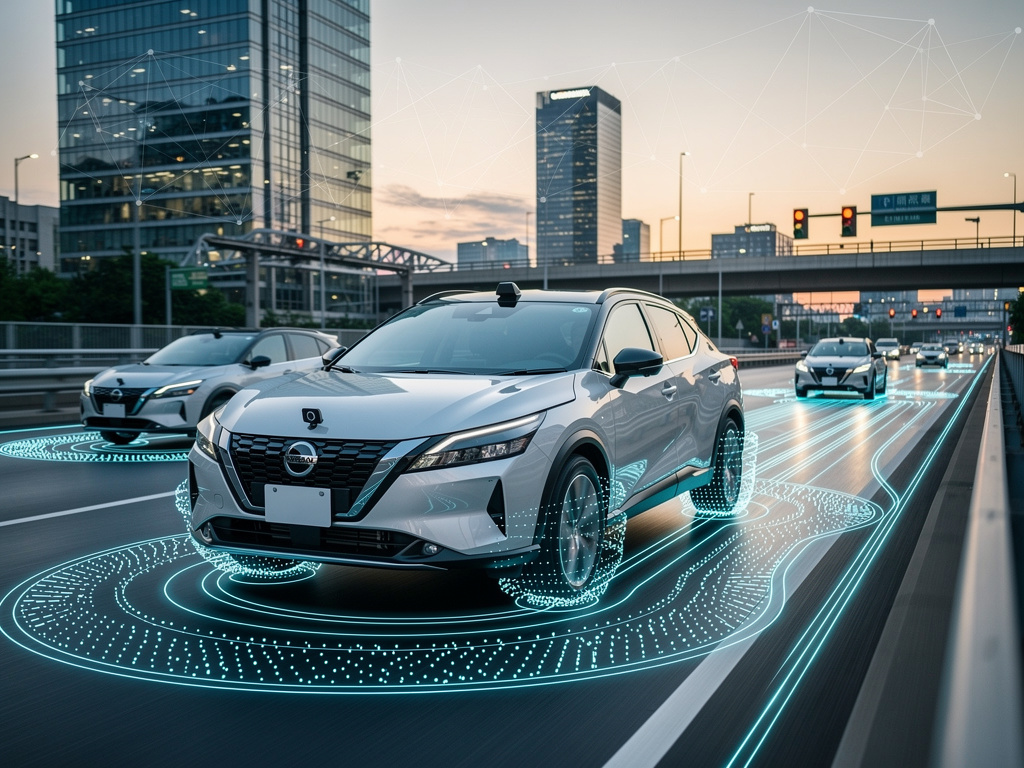
In the fast-evolving world of automotive technology, a significant partnership has emerged that could reshape how drivers interact with their vehicles. Nissan Motor Co., the Japanese automotive giant, has inked definitive agreements with Wayve, a UK-based artificial intelligence startup, to integrate advanced AI into its next-generation ProPILOT driver-assistance systems. This collaboration, announced in December 2025, aims to blend Wayve’s embodied AI software with Nissan’s established hardware, promising enhanced capabilities for both everyday advanced driver-assistance systems (ADAS) and more ambitious point-to-point autonomous driving features. Drawing from recent announcements, this deal positions Nissan to compete more aggressively in a market dominated by players like Tesla and Waymo, focusing on AI-driven innovations that learn from real-world data rather than relying solely on predefined maps or sensors.
The partnership’s roots trace back to earlier collaborations and demonstrations. As early as September 2025, Wayve showcased its AI Driver technology navigating the bustling streets of Tokyo in a Nissan vehicle, highlighting the system’s ability to handle complex urban environments without traditional lidar or high-definition maps. This demonstration, part of Nissan’s preparations for a 2027 launch, underscored the potential for AI to make driving safer and more intuitive. According to details from Nissan Global News, the agreements formalize a joint effort to deploy this technology across a wide array of Nissan models, from sedans to SUVs, potentially reaching global markets.
Wayve’s approach to AI is particularly noteworthy for industry observers. Unlike conventional autonomous systems that depend on extensive sensor arrays and pre-mapped routes, Wayve’s embodied AI learns dynamically from driving data, adapting to new scenarios much like a human driver. This method, often described as end-to-end learning, processes inputs from cameras and basic sensors to make decisions in real time. Nissan’s ProPILOT, already a staple in models like the Rogue and Leaf, will evolve under this partnership to include features that extend beyond highway cruising to urban navigation and parking, addressing pain points in current ADAS offerings.
The Technological Synergy Driving Innovation
Insiders point out that this alliance comes at a pivotal time for Nissan, which has faced challenges in keeping pace with electrification and autonomy trends. By partnering with Wayve, Nissan gains access to cutting-edge AI without the need to build it entirely in-house, a strategy that mirrors moves by other automakers like Toyota’s tie-up with Waymo. Posts on X from September 2025, including those from Wayve’s official account, revealed early integrations, such as AI-driven demos in Yokohama, where Wayve established a testing center earlier that year. These social media insights reflect growing excitement, with view counts in the tens of thousands, signaling strong public and investor interest.
Financially, the deal builds on Wayve’s momentum. The startup, founded in 2017, secured significant backing, including a potential $500 million investment from Nvidia discussed in X posts around the same period. This influx of capital has enabled Wayve to expand its operations, including the Japan hub, which aligns perfectly with Nissan’s home base. As reported in Wayve’s press release, the collaboration emphasizes scalable AI that can be mass-produced, a key factor for affordability in consumer vehicles.
From a technical standpoint, the integration involves Wayve’s software stack interfacing with Nissan’s sensors and computing platforms. ProPILOT’s next iteration will likely incorporate machine learning models trained on vast datasets from diverse driving conditions, improving reliability in adverse weather or unpredictable traffic. Industry experts note that this could reduce the dependency on expensive hardware, potentially lowering costs for end-users while enhancing safety metrics, such as collision avoidance rates.
Market Implications and Competitive Dynamics
The broader implications for the automotive sector are profound. Nissan’s move signals a shift toward AI-centric autonomy, where software becomes the differentiator rather than hardware alone. Competitors like General Motors with its Super Cruise or Ford’s BlueCruise may need to accelerate their AI integrations to match. According to coverage in CleanTechnica, this partnership supports Nissan’s sustainability goals by optimizing energy use in electric vehicles through smarter driving algorithms.
On X, discussions around the deal highlight mixed sentiments. Some users praise the innovation, with posts from influencers like Sawyer Merritt drawing parallels to Tesla’s Full Self-Driving beta, noting Wayve’s camera-only approach. Others express skepticism about deployment timelines, given regulatory hurdles in markets like the U.S. and Europe. These platform conversations, often garnering high engagement, underscore the public’s fascination with AI’s role in mobility, though they also reveal concerns about data privacy and ethical AI use.
Regulatory landscapes add another layer of complexity. In Japan, where Nissan plans initial rollouts, authorities have been supportive of autonomous tech trials, as evidenced by Wayve’s Yokohama center. However, global expansion will require navigating frameworks like the EU’s AI Act or U.S. Department of Transportation guidelines, which emphasize transparency in AI decision-making. Nissan’s experience with prior ProPILOT versions, which have undergone rigorous safety testing, positions it well to address these challenges.
Challenges and Future Prospects
Despite the optimism, hurdles remain. Integrating third-party AI into legacy automotive systems isn’t seamless; compatibility issues could delay launches. Wayve’s relative youth as a company—compared to established players like Mobileye—means it must prove its tech at scale. Insights from Electric Cars Report suggest that initial deployments will focus on Level 2+ ADAS, where the driver remains responsible, before progressing to higher autonomy levels.
Economically, the partnership could boost Nissan’s stock, which has fluctuated amid supply chain disruptions. Analysts anticipate that AI-enhanced features could command premium pricing, helping Nissan recapture market share in segments like crossovers. Wayve, meanwhile, benefits from Nissan’s manufacturing prowess, accelerating its path from startup to supplier for major OEMs.
Looking ahead, this deal exemplifies a trend where traditional automakers team up with agile tech firms to innovate rapidly. As seen in X posts about similar partnerships, such as Toyota and Waymo, the industry is coalescing around AI as the core of future mobility. For Nissan, success here could revitalize its brand, particularly in electric and hybrid lineups where ProPILOT integration might enhance range efficiency through predictive driving.
Inside the AI: How It Works and Why It Matters
Delving deeper into Wayve’s technology, the embodied AI model stands out for its foundation in neural networks that mimic human cognition. Trained on petabytes of driving data, it predicts and responds to scenarios like pedestrian crossings or sudden lane changes with minimal latency. Nissan’s contribution includes robust vehicle dynamics control, ensuring the AI’s outputs translate smoothly to physical actions like braking or steering.
Comparisons to peers are inevitable. While Tesla relies on its Dojo supercomputer for training, Wayve emphasizes hardware-agnostic software, making it adaptable. Coverage in Autonomous Vehicle International details how this flexibility allows Nissan to retrofit existing models, potentially extending the tech’s reach without full redesigns.
For industry insiders, the data aspect is crucial. Wayve’s system collects anonymized fleet data to refine models continuously, creating a feedback loop that improves over time. This contrasts with static systems and could lead to exponential advancements, though it raises questions about data ownership and cybersecurity, topics frequently debated on platforms like X.
Global Rollout Strategies and Consumer Impact
Plans for rollout indicate a phased approach, starting in Japan by 2027, followed by Europe and North America. Nissan’s global footprint, with production in over 20 countries, facilitates this. As per GreenFleet, the tech’s emphasis on point-to-point driving suits urban commuters, potentially reducing congestion and emissions through optimized routes.
Consumer adoption will hinge on trust and usability. Early demos, shared widely on X, show the AI handling Tokyo’s dense traffic with poise, building confidence. Pricing remains speculative, but bundling with premium packages could make it accessible, similar to how adaptive cruise control became standard.
Ultimately, this partnership may catalyze broader industry shifts, encouraging more AI integrations. For insiders, it’s a case study in collaboration, blending automotive heritage with tech disruption to forge safer, smarter roads.
Economic and Ethical Considerations
Economically, the deal aligns with Nissan’s turnaround strategy under CEO Makoto Uchida, who has prioritized tech investments. Wayve’s valuation, bolstered by backers like Microsoft and Uber, suggests high growth potential, with the Nissan tie-up validating its model.
Ethically, ensuring AI fairness—avoiding biases in diverse global settings—is paramount. Discussions on X often touch on this, with users calling for transparent testing. Nissan’s commitment to safety standards, as outlined in joint statements, addresses these concerns.
In wrapping up this exploration, the Nissan-Wayve alliance represents a bold step toward AI-empowered driving, with ripple effects that could define the next decade of automotive progress. As developments unfold, it will be fascinating to watch how this synergy translates to real-world impact.


 WebProNews is an iEntry Publication