
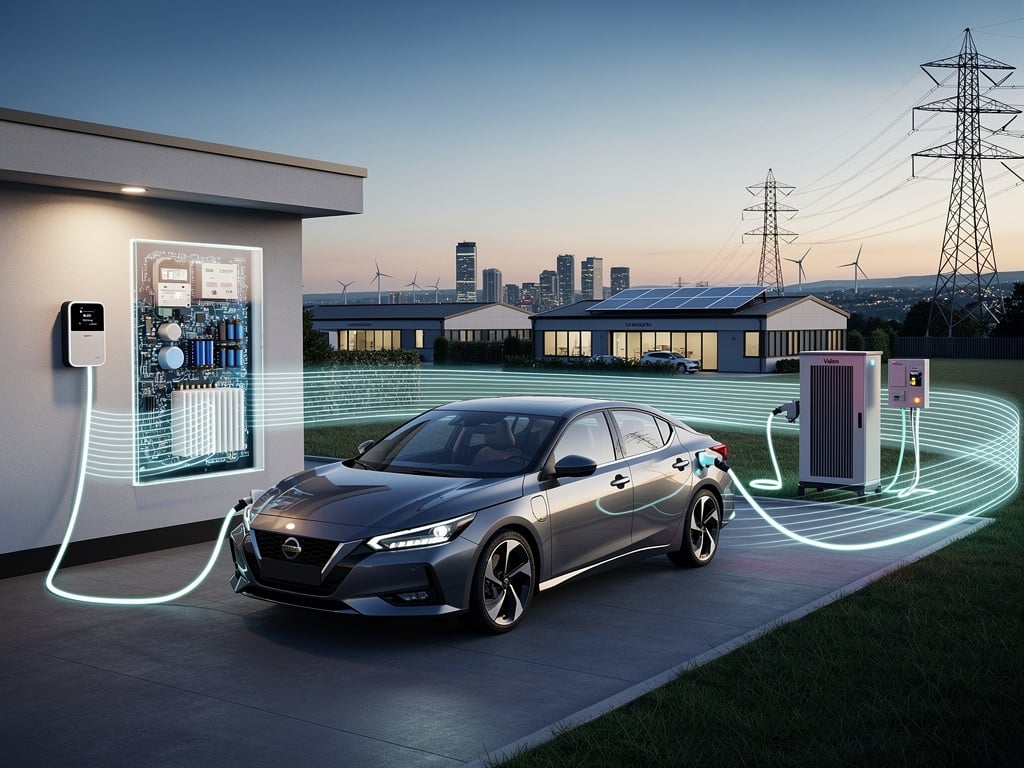
Nissan and Valeo have entered into a significant agreement that advances bidirectional charging technology for electric vehicles, allowing cars to function as mobile energy storage units capable of supplying power back to homes, buildings, or the electrical grid. The partnership, announced through a joint statement, positions both companies to develop and commercialize vehicle-to-everything systems that could transform how energy moves between transportation and power infrastructure.
Under the terms of the contract, Valeo will supply its power electronics expertise while Nissan contributes its extensive experience in battery management and electric vehicle platforms. The collaboration focuses on creating onboard chargers that support bidirectional energy flow, meaning electricity can travel from the grid to the vehicle battery during charging and reverse direction when needed. This capability opens possibilities for vehicle owners to use their cars as backup power sources during outages or to sell excess stored energy during peak demand periods.
The agreement builds on years of research both companies have conducted separately. Nissan has pioneered vehicle-to-grid concepts through demonstration projects in Europe and Japan, where fleets of Leaf models have provided grid services. Valeo, a major automotive supplier known for its thermal and electrical systems, has invested heavily in power conversion technologies that handle the complex task of converting between alternating current from the grid and direct current stored in batteries. By combining these strengths, the partners aim to accelerate the path from prototype systems to mass-market applications.
Bidirectional charging addresses one of the fundamental challenges in expanding electric vehicle adoption: the intermittent nature of renewable energy sources. Solar and wind power generate electricity at variable rates that do not always match consumption patterns. Electric vehicles parked for hours or days represent enormous potential storage capacity. Studies suggest that if a meaningful percentage of the vehicle fleet could return energy to the grid, utilities would face fewer difficulties balancing supply and demand. This approach could reduce the need for expensive stationary battery installations while creating new revenue streams for vehicle owners.
Technical specifications for the systems under development remain confidential, but industry observers expect power levels in the range of 7 to 22 kilowatts for home applications, with higher capacities possible for commercial installations. The chargers must maintain strict safety standards, manage thermal loads efficiently, and communicate effectively with both the vehicle battery management system and external energy management platforms. Valeo’s experience with high-voltage components gives the partnership an advantage in addressing these engineering requirements.
Nissan brings particular credibility to the project through its long history with electric vehicles. The company launched the Leaf in 2010 as one of the first mass-market battery electric cars, and the model has accumulated substantial real-world data on battery performance and degradation. This knowledge proves valuable when designing systems that will regularly cycle energy in both directions. Frequent charging and discharging could accelerate battery wear if not properly managed, making Nissan’s expertise in state-of-health monitoring especially relevant.
The partnership reflects broader industry trends toward energy flexibility. Several automakers have begun exploring bidirectional capabilities, though few have reached commercial scale. In Europe, regulatory frameworks increasingly support vehicle-to-grid arrangements, with countries like the Netherlands and Germany offering incentives for smart charging installations. California has implemented similar policies in the United States, recognizing the potential for electric vehicles to support grid stability as renewable penetration increases.
Valeo has positioned itself at the forefront of automotive electrification components. The French company supplies equipment to most major manufacturers and has expanded its portfolio to include inverters, onboard chargers, and thermal management systems essential for electric powertrains. Its decision to partner with Nissan rather than develop bidirectional technology independently suggests recognition that vehicle-specific integration requires close collaboration with an original equipment manufacturer.
Financial terms of the agreement were not disclosed, but the contract likely includes provisions for technology licensing, joint development milestones, and future supply agreements. Valeo would manufacture the power electronics while Nissan integrates them into its vehicles. The arrangement could eventually extend to other Nissan brands, including Infiniti luxury models and potentially commercial vans produced through the company’s alliance with Renault.
Consumer acceptance represents a key factor in determining whether bidirectional charging achieves widespread adoption. Many vehicle owners express concerns about battery longevity when using their cars as energy buffers. Education campaigns will need to explain how modern battery management systems limit depth of discharge and maintain appropriate temperature ranges to minimize degradation. Warranty provisions will also play a significant role, as manufacturers must assure customers that participating in vehicle-to-grid programs will not void coverage.
The technology carries implications beyond individual households. At the community level, fleets of electric school buses or delivery vans equipped with bidirectional chargers could provide valuable services to local utilities. During extreme weather events, these vehicles might keep critical facilities operating when the main grid fails. Municipalities and fleet operators have already begun piloting such applications, though scaling them requires standardized communication protocols and reliable economic models.
Integration with home energy systems adds another layer of complexity. Bidirectional vehicles must coordinate with solar panels, stationary batteries, heat pumps, and smart appliances to optimize energy flows throughout the day. This orchestration typically relies on cloud-based platforms that analyze weather forecasts, electricity prices, and usage patterns to determine when to charge, discharge, or remain idle. Both Nissan and Valeo have invested in software capabilities that could support these sophisticated energy management scenarios.
The partnership announcement arrives as global automakers face pressure to reduce carbon emissions across their operations and supply chains. By enabling electric vehicles to support renewable energy deployment, Nissan and Valeo position their products as part of a comprehensive climate solution rather than simply zero-emission transportation. This holistic approach may appeal to corporate customers and environmentally conscious consumers seeking maximum impact from their vehicle purchases.
Challenges remain in commercializing the technology. Standardization efforts continue through organizations like ISO and SAE to ensure different vehicle brands and utility systems can communicate effectively. Cybersecurity represents another priority, given that bidirectional systems create additional entry points into both vehicles and power grids. The partners will need to implement multiple layers of protection while maintaining user-friendly experiences.
Market timing appears favorable as many regions commit to ambitious electric vehicle targets. The European Union has set 2035 as the deadline for ending sales of new combustion-engine passenger cars, while several American states have adopted similar timelines. China continues aggressive promotion of electric mobility through both mandates and incentives. In each market, the ability to offer grid services could strengthen the economic case for electric vehicles by reducing total cost of ownership.
Nissan has indicated that bidirectional charging will appear first on specific models before expanding across its lineup. The company has not yet revealed which vehicles will receive the technology or when commercial availability will begin. Industry analysts expect initial offerings in Europe, where regulatory support and electricity pricing structures make the systems particularly attractive. Japanese and North American markets may follow once technical validation and certification processes conclude.
Valeo’s contribution extends beyond hardware to include sophisticated control algorithms that optimize power conversion efficiency. Every percentage point of efficiency gained reduces energy losses and heat generation, allowing for smaller cooling systems and improved overall vehicle range. The supplier has developed insulated gate bipolar transistor and silicon carbide technologies that promise significant advances in power density and thermal performance compared with previous generations of components.
The collaboration highlights the increasingly important role of suppliers in electric vehicle development. As vehicles become more dependent on sophisticated electronic architectures, companies like Valeo that specialize in particular subsystems gain strategic importance. Their ability to serve multiple manufacturers creates economies of scale that individual automakers would struggle to match when developing technologies internally.
Looking ahead, bidirectional charging could evolve beyond simple energy transfer to include more advanced grid services. Vehicles might participate in frequency regulation, voltage support, or demand response programs that compensate owners for providing valuable stability to the electrical system. These applications require rapid response times and precise control that modern power electronics can deliver when properly configured.
The Nissan-Valeo agreement represents a concrete step toward realizing the long-discussed vision of electric vehicles as integral components of smart energy networks. While technical and commercial hurdles remain, the partnership combines complementary capabilities that increase the likelihood of successful market introduction. As both companies work toward bringing bidirectional systems to customers, they contribute to a future where transportation and energy systems work more closely together to reduce emissions and improve resilience.
Success will ultimately depend on delivering systems that meet customer expectations for reliability, ease of use, and economic return. If the technology performs as promised and delivers tangible benefits, it could accelerate the transition to electric mobility while supporting broader efforts to decarbonize electricity generation. The coming years will reveal how quickly these bidirectional capabilities move from development laboratories into driveways and parking spaces around the world.


 WebProNews is an iEntry Publication