
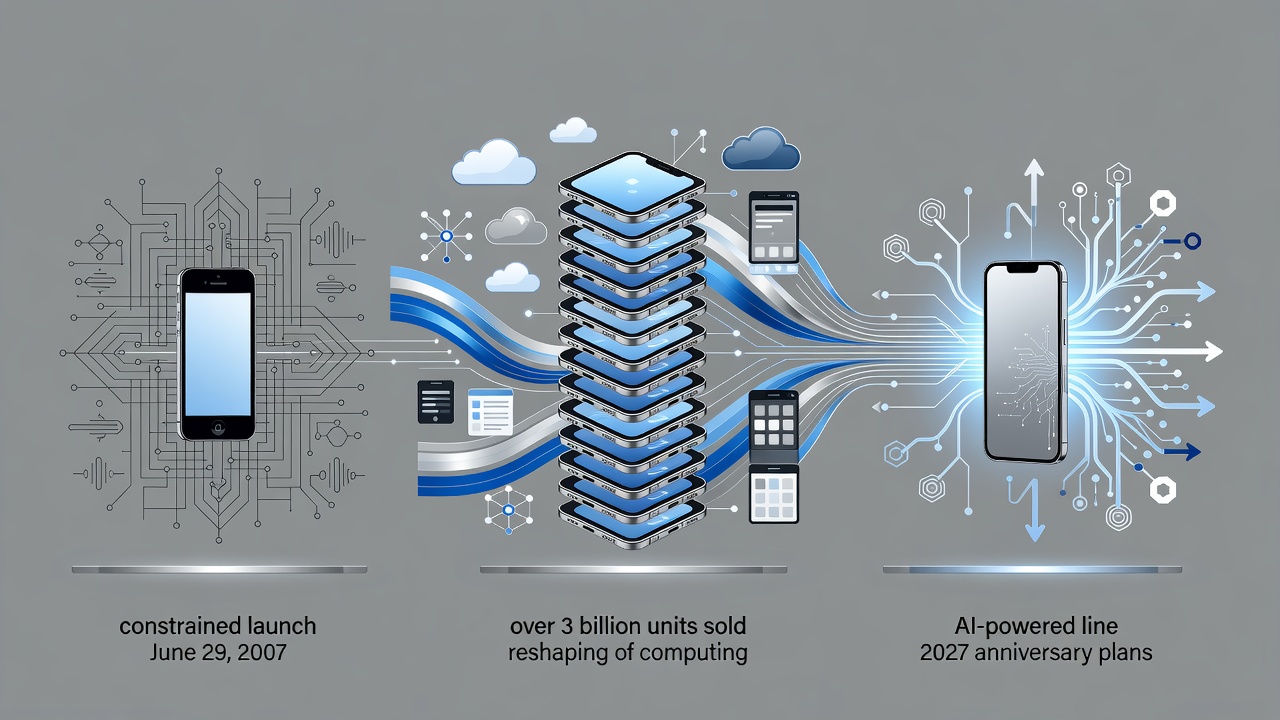
On June 29, 2007, lines snaked outside Apple Stores across the U.S. Customers waited hours. Some camped overnight. They paid $499 or $599, signed a two-year AT&T contract, and walked away with a device that looked nothing like the BlackBerrys and Nokia handsets they knew. The original iPhone had arrived. Nineteen years later, its shadow stretches across every product Apple sells.
Steve Jobs introduced it five months earlier in a now-legendary keynote. “Today, Apple is going to reinvent the phone,” he declared. The device combined a widescreen iPod, a mobile phone, and an internet communicator. It ditched the stylus. It offered multi-touch. It ran a version of OS X shrunk to fit a pocket. Critics called it overpriced. Competitors scoffed. But buyers saw something else. They saw the future.
The launch proved immediate. Apple sold 1.4 million units in the device’s first year despite availability only from late June, according to AppleInsider. The company moved 1.9 million by year’s end. Those numbers seem quaint now. Wikipedia reports more than 3 billion iPhones sold as of July 2025. Over 1.5 billion remain in active use. The product line generates the majority of Apple’s revenue and has reshaped entire industries from music to photography to payments.
Yet the first model carried real constraints. No App Store at launch. No 3G. A 2-megapixel camera. No copy and paste. No expandable storage. The battery couldn’t be swapped by users. Steve Ballmer, then Microsoft’s CEO, dismissed it outright. “There’s no chance that the iPhone is going to get any significant market share,” he said in April 2007. “No chance.” History disagreed.
Tony Fadell, who helped drive the project from its iPod roots, captured the tension. “[Going on sale] is a happy moment, but it’s also a stressful one,” he told the Wall Street Journal in a 2022 video. “What’s going to happen when it goes out into the world?” Greg Joswiak, now Apple’s senior vice president of worldwide marketing, felt the weight too. “I mean, it’s still it just kind of gives me goosebumps because it was history.”
The bet centered on control. Apple insisted on dictating the hardware and software experience. Carriers traditionally shaped handsets, preloaded apps, and dictated terms. AT&T agreed to Apple’s demands. The carrier stayed out of the design. No bloat. No compromises on the user interface. That decision set the template. Every iPhone since has followed the same principle. Integration above all.
Reviews captured the mix of awe and skepticism. David Pogue wrote in the New York Times that “The iPhone is revolutionary; it’s flawed. It’s substance; it’s style.” Walter S. Mossberg and Katherine Boehret at the Wall Street Journal offered measured praise. “Its software, especially, sets a new bar for the smart-phone industry, and its clever finger-touch interface, which dispenses with a stylus and most buttons, works well, though it sometimes adds steps to common functions.”
Price cuts followed quickly. In September 2007 Apple dropped the 8GB model to $399 and discontinued the 4GB version. Early buyers complained. Jobs responded with a $100 store credit. The episode revealed growing pains. It also showed Apple’s willingness to adjust fast. The device wasn’t perfect. But its core bet succeeded. People didn’t want another BlackBerry. They wanted a pocket computer that felt magical.
Android copied the formula aggressively. Larger screens. Touch interfaces. App stores. Google and partners flooded the market with alternatives. Joswiak didn’t mince words about the imitators. “They were annoying,” he said in that same Wall Street Journal interview. “They took the innovations that we had created and created a poor copy of it and just put a bigger screen around it.” The copies validated the direction even as they intensified competition.
Today the conversation has shifted. Apple’s 20th anniversary iPhone is slated for 2027. MacRumors, citing Bloomberg, reports the company is ramping up two models sized like the upcoming iPhone 18 Pro and Pro Max, roughly 6.3 and 6.9 inches. They will launch alongside a second-generation foldable iPhone. All three devices are expected to use variants of a 2-nanometer A21 chip. The anniversary models could echo the radical redesign of the 2017 iPhone X, which ditched the home button for Face ID and an edge-to-edge OLED display.
CNET detailed further rumors in a June 13, 2026 article. The 2027 device may feature an all-glass design with no physical buttons, relying instead on solid-state controls with haptic feedback. Displays could be brighter and thinner, sourced from Samsung with advanced OLED technology. Bloomberg’s Mark Gurman described the effort as “extraordinarily complex.” The piece notes the original iPhone’s legacy remains unmatched in its effect on society, business, and communication. Like the iPhone X for the 10th anniversary, the 2027 models are positioned as a potential landmark.
Recent sales patterns show the franchise retains strength. Reports from late 2025 indicated the iPhone 17 lineup saw robust early demand in the U.S. and China, with some models outselling predecessors by double-digit percentages in the first weeks. Those figures come amid broader questions about upgrade cycles and competition from AI-focused devices. Yet the installed base keeps growing. Services tied to the hardware expand. The original vision of a single device handling communication, entertainment, work, and more has only deepened.
Fadell reflected on the unexpected scale. “Truly, we just thought this was going to be a fun, easy to use thing when you want to do a few messages… We didn’t think it was going to become the center of your life.” Joswiak offered a broader view. “We’ve created an incredible tool to help people with how they learn, to help with how they communicate, how they’re entertained.”
The hardware has evolved beyond recognition. A 3.5-inch screen became 6.9 inches or larger. A single rear camera became triple or quad arrays with computational photography. Processors once tasked with basic web browsing now handle desktop-class workloads and on-device AI. Battery life that once drew complaints now lasts all day for most users. But the philosophy traces straight back to 2007. Software and hardware designed together. An obsessive focus on the experience. A willingness to remove features that don’t fit the vision.
But the stakes have grown. Apple faces scrutiny over its premium pricing. The entry-level iPhone now starts near the inflation-adjusted price of the original yet delivers vastly more capability. Trade-in programs, carrier subsidies, and monthly payments soften the blow. Still, some analysts question whether incremental updates can continue to drive upgrades at current prices. The 2027 anniversary models will test whether Apple can once again deliver a leap that resets expectations.
Nineteen years. Three billion devices. An economy built on apps, accessories, and services. The original iPhone didn’t just sell well. It changed what a phone could be. It moved computing from desks to pockets to wrists. It forced every competitor to adapt or fade. And on this anniversary, as rumors swirl about buttonless designs and foldables, the through line remains clear. The slab of glass and aluminum that went on sale that June day in 2007 set a standard Apple still chases.


 WebProNews is an iEntry Publication