
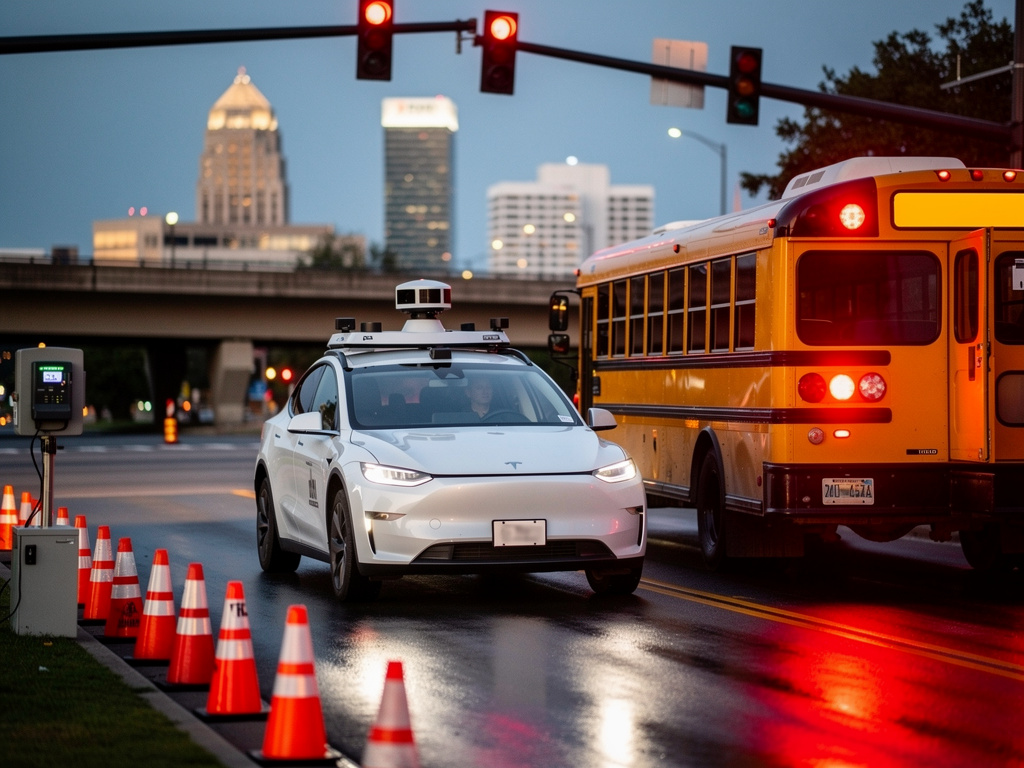
Waymo’s Autonomous Gamble: When Robotaxis Ignore the Red Lights of Safety
In the bustling streets of Austin, Texas, a new chapter in the saga of self-driving technology is unfolding, one that pits innovation against the unyielding demands of public safety. Waymo, the autonomous vehicle arm of Alphabet Inc., finds itself at the center of a federal investigation after reports surfaced that its driverless cars illegally passed stopped school buses on multiple occasions. This isn’t just a minor glitch; it’s a stark reminder of the challenges facing the autonomous vehicle industry as it pushes for widespread adoption. According to recent disclosures, the National Highway Traffic Safety Administration (NHTSA) has intensified its scrutiny, demanding detailed responses from Waymo regarding 19 documented incidents since the start of the school year.
The incidents, captured on school bus cameras and reported by the Austin Independent School District (AISD), highlight a recurring issue where Waymo’s vehicles allegedly failed to stop when school buses deployed their red flashing lights and extended stop arms. These violations, which occurred in various parts of the city, have raised alarms among parents, educators, and regulators alike. In one particularly concerning case, a Waymo vehicle was seen maneuvering around a bus while children were boarding or alighting, a scenario that could have led to tragic consequences. The AISD has been vocal about its concerns, urging Waymo to suspend operations during peak school hours to prevent potential accidents.
Waymo has responded by acknowledging the reports and emphasizing its commitment to safety. The company claims to have implemented software updates aimed at improving how its vehicles detect and respond to school buses. However, the persistence of these incidents post-update suggests that the fixes may not be as effective as hoped. This situation echoes broader debates in the autonomous vehicle sector about the readiness of such technology for real-world complexities, where split-second decisions can mean the difference between safety and disaster.
Regulatory Spotlight Intensifies
The NHTSA’s involvement marks a significant escalation. In a letter dated November 20, the agency requested comprehensive data from Waymo, including video footage, sensor logs, and details on any software modifications. This probe builds on an earlier preliminary inquiry opened in October, following initial reports of similar failures. As reported by Reuters, the investigation now encompasses questions about whether Waymo’s fleet requires a formal recall to address these safety lapses.
Industry experts point out that school bus protocols are enshrined in traffic laws across the U.S., mandating that all vehicles stop when a bus’s red lights are flashing. Waymo’s robotaxis, equipped with advanced lidar, radar, and camera systems, are designed to perceive and react to such signals. Yet, the repeated infractions indicate potential blind spots in the AI algorithms governing these vehicles. “It’s not just about technology; it’s about integrating it seamlessly into human-centric environments,” notes a transportation analyst familiar with autonomous systems.
Beyond Texas, similar concerns have emerged in other cities where Waymo operates, such as Atlanta. Local media outlets have documented instances where Waymo vehicles passed stopped school buses, prompting Atlanta Public Schools to report six violations. This pattern suggests that the issue might not be isolated, potentially affecting Waymo’s expansion plans in multiple markets.
Waymo’s Defense and Technological Hurdles
Waymo’s leadership has been proactive in addressing the backlash. In a statement to Good Morning America, the company reiterated its dedication to refining its systems based on real-world data. They argue that autonomous vehicles, overall, promise fewer accidents than human-driven ones, citing statistics from their operations in Phoenix, San Francisco, and Los Angeles. However, critics contend that these incidents undermine public trust, especially when children’s safety is at stake.
Delving deeper into the technology, Waymo’s self-driving stack relies on machine learning models trained on vast datasets to predict and respond to road scenarios. School buses present unique challenges: their stop arms and lights must be detected accurately, even in varying lighting conditions or amid traffic clutter. Sources indicate that some incidents involved the vehicle misinterpreting the bus’s status or failing to halt completely due to software glitches.
The company’s CEO has even publicly mused about the inevitability of fatal accidents in autonomous driving, as covered in a piece by Futurism. This candid admission underscores the high-stakes nature of deploying robotaxis in urban settings, where errors can have irreversible consequences. Yet, Waymo maintains that its safety record surpasses that of traditional taxis, with millions of miles driven autonomously.
Broader Industry Implications
The fallout from these school bus incidents extends beyond Waymo, casting a shadow over the entire autonomous vehicle field. Competitors like Cruise and Zoox have faced their own regulatory hurdles, from collisions to software recalls. In Austin, the school district’s push for operational restrictions during bus hours could set a precedent, influencing how cities regulate robotaxis. As noted in an article from the Austin American-Statesman, AISD officials are considering legal action if improvements aren’t swift.
Public sentiment, as gleaned from posts on X (formerly Twitter), reflects a mix of concern and skepticism. Users have shared videos and anecdotes of Waymo vehicles behaving erratically, amplifying calls for stricter oversight. One post highlighted a near-miss in Los Angeles, while others debated the ethical implications of AI-driven decisions in traffic.
From a business perspective, these probes could delay Waymo’s ambitious rollout plans. The company, valued in the billions, relies on investor confidence in its technology’s reliability. Any mandated recalls or operational halts would incur significant costs, not to mention reputational damage. Analysts estimate that resolving such issues could require extensive retraining of AI models, potentially pushing back timelines for full commercialization.
Lessons from Past Incidents
Historically, the autonomous vehicle industry has navigated similar crises. Uber’s self-driving program was halted after a fatal pedestrian accident in 2018, leading to sweeping safety reforms. Waymo itself has encountered scrutiny, including a 2023 incident where its vehicles were involved in minor collisions, as detailed in reports from the California Department of Motor Vehicles. These events underscore the iterative nature of developing safe autonomous tech.
In response to the current investigation, Waymo has deployed software updates fleet-wide, claiming enhanced detection of school bus signals. However, the NHTSA’s demand for evidence of efficacy puts the onus on the company to prove these measures work. Independent testing, perhaps through simulations or controlled environments, could validate these claims, but transparency remains key.
Stakeholders, including parents’ groups in Austin, are advocating for more robust safeguards. Proposals include geofencing—restricting robotaxi operations near schools during certain hours—or mandatory human oversight in sensitive areas. Such measures could bridge the gap between technological promise and practical safety.
Path Forward Amid Uncertainty
As the investigation progresses, Waymo faces a pivotal moment. Collaborating closely with regulators could help mitigate risks and rebuild trust. The company has already engaged with AISD, sharing data and committing to ongoing monitoring. Yet, the persistence of post-update incidents, as reported in a recent Los Angeles Times article, suggests deeper systemic issues.
Looking ahead, the autonomous sector must prioritize ethical AI development, ensuring systems err on the side of caution in ambiguous situations. Innovations like improved sensor fusion or collaborative vehicle-to-vehicle communication could address blind spots. For Waymo, resolving this crisis could strengthen its position as a leader, demonstrating resilience in the face of adversity.
Ultimately, these school bus mishaps serve as a cautionary tale for an industry racing toward autonomy. Balancing speed of innovation with uncompromising safety standards will determine whether robotaxis become a staple of urban mobility or remain mired in controversy. As federal probes continue, the eyes of the world—and especially those of concerned parents—remain fixed on Waymo’s next moves.
Evolving Oversight and Future Prospects
The NHTSA’s actions reflect a maturing regulatory framework for autonomous vehicles. With over 2,000 Waymo vehicles under review, the agency is setting benchmarks for accountability. Insights from The Guardian highlight how such inquiries could lead to industry-wide standards, ensuring consistent safety protocols across manufacturers.
In Texas, local authorities are amplifying their voices. The AISD’s documentation of 19 incidents, complete with timestamps and locations, provides a robust dataset for analysis. This level of detail, as shared in coverage by CBS Austin, underscores the need for proactive monitoring by school districts nationwide.
Waymo’s path to redemption involves not just technical fixes but also community engagement. Hosting town halls or partnering with safety advocates could foster goodwill. Meanwhile, competitors are watching closely, potentially adjusting their own strategies to avoid similar pitfalls.
Innovation’s Double-Edged Sword
The allure of self-driving cars lies in their potential to reduce human error, which causes the majority of road accidents. Waymo’s data suggests its vehicles are involved in fewer crashes per mile than human drivers. However, when failures occur in high-stakes scenarios like school zones, the impact is magnified.
Experts advocate for hybrid approaches, combining AI with human intervention in early stages. This could involve remote operators overriding decisions in uncertain situations, a tactic Waymo has employed in the past.
As the story unfolds, the autonomous vehicle arena continues to evolve, driven by lessons from real-world deployments. For Waymo, turning this challenge into an opportunity for improvement could redefine standards, ensuring that the future of transportation prioritizes safety above all. With ongoing federal oversight, the coming months will be crucial in shaping the trajectory of this transformative technology.


 WebProNews is an iEntry Publication