
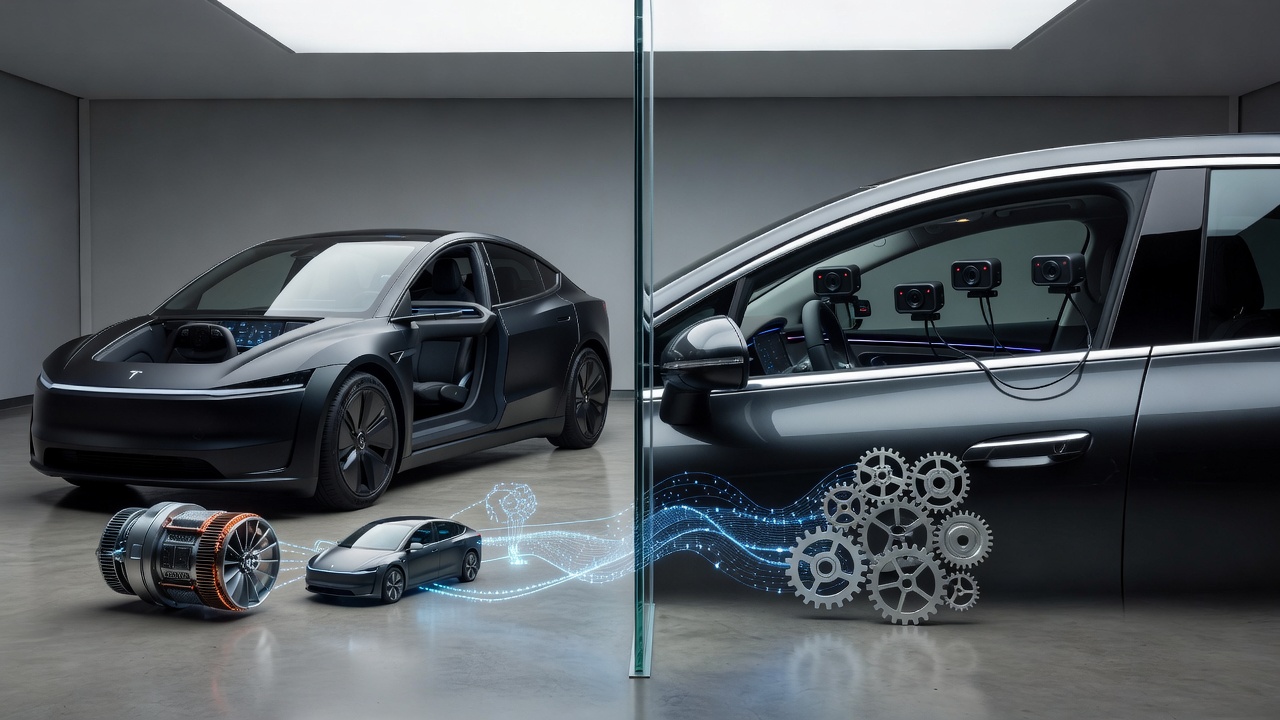
Jonathan Morrison posed a simple question last week. If a vehicle will never have a human at the controls, why force it to carry a steering wheel?
The head of the National Highway Traffic Safety Administration delivered the remark during a CNBC interview. “If you’re developing a vehicle that is designed never to be driven by a human operator, does it make any sense to require manual control for the vehicle?” he asked. “I think the answer is pretty clear there.”
His words landed the same week Europe activated its own vision for road safety. From July 7, every new passenger car and van registered in the European Union must carry a camera that watches the driver’s face. The contrast could not be sharper. One regulator prepares to remove the last traces of human control from fully autonomous machines. The other insists on constant electronic oversight of the person behind the wheel.
The timing feels deliberate. Morrison’s comments build on months of incremental moves by NHTSA to clear regulatory obstacles for companies building robotaxis and self-driving fleets. Last month the agency dropped the requirement for a physical brake pedal in certain autonomous vehicles. Earlier proposals updated standards for transmission indicators and windshield systems to exempt vehicles without manual controls. Production of such models remains capped at 2,500 units under current exemption rules, but the trajectory points toward broader acceptance.
Automakers have pressed for exactly this shift since at least 2019. General Motors’ Cruise unit once petitioned NHTSA for updates that would allow its Origin vehicle to operate without steering wheel or pedals. The agency responded in 2022 with revised occupant-protection standards that opened the door. Yet real-world deployment has lagged. Current self-driving cars on American roads still carry traditional controls, partly to satisfy federal motor vehicle safety standards written for conventional automobiles.
Morrison signaled openness to changing that. He told CNBC the agency wants autonomous technology to succeed but must address practical problems first. AVs have stalled in ways that block first responders. Remote operation sometimes leaves vehicles unresponsive. Concerns also linger about reliance on components from Chinese suppliers. Still, the administrator made clear that outdated rules should not stand in the way of progress.
His stance drew quick notice on X. Tesla enthusiasts highlighted how the move could accelerate the Cybercab, the company’s wheel-less two-seater designed purely for robotaxi service. Posts noted potential gains for Waymo, Zoox and other developers now limited by legacy requirements. One analyst called it huge for Tesla, linking the federal openness to possible faster approvals for full autonomy.
Across the Atlantic the philosophy runs in the opposite direction. The European Union’s updated General Safety Regulation, phase two, took effect this month. It mandates advanced emergency braking that detects pedestrians and cyclists, improved forward visibility, and systems that monitor driver attention. The driver distraction warning relies on an infrared camera pointed at the face. If the system detects eyes off the road for more than 3.5 seconds at highway speeds or six seconds at lower speeds, it issues alerts through lights, sounds and vibration.
The camera activates automatically above 12 miles per hour. Drivers cannot disable it permanently. It reactivates after any warning. European Commission officials project the full package of new rules will save more than 25,000 lives by 2038. Research cited in regulatory documents attributes 5 to 25 percent of crashes to distraction.
Yet the requirement has sparked sharp criticism. Privacy advocates question what happens to the data. Regulations demand a closed-loop system. Information must stay inside the vehicle. No biometric details should reach manufacturers, servers or third parties. Article 6(3) of the regulation states the system should not continuously record or retain data beyond what is necessary. Enforcement details remain vague. No independent audit mechanism exists to verify compliance. Retention periods after an alert go unspecified.
Real-world tests reveal another problem. The systems often trigger on normal behavior. Drivers report frequent false alarms while checking mirrors, adjusting the radio or simply scanning the road. One reviewer of an Xpeng model in Belgium described constant interruptions. A Ford Puma owner on Reddit complained of distracting alerts every 10 minutes. The technology, intended to improve safety, sometimes distracts instead.
All About Cookies examined the gaps. “The regulations require the ADDW system to work on a ‘closed loop’ without the use of biometric data,” the report noted. “This means that the data used to determine whether a driver is ‘distracted’ must not leave the vehicle.” But the outlet warned that without clear definitions of “necessary” data or audit requirements, the potential for misuse persists. Patterns of eye movement could reveal routes, habits or even passengers if ever exposed through a breach.
The original reporting that prompted this analysis captured the philosophical split. American regulators increasingly trust the machine. European ones continue to distrust the human. One side removes the steering wheel to enable pure autonomy. The other installs a camera to keep the driver accountable.
Recent coverage reinforces the divergence. CNET reported Morrison’s support for innovation while noting the 2022 rule changes that first eased some restrictions. InsideEVs framed the steering wheel decision as removal of a major roadblock for robotaxis, linking it directly to the brake pedal update and exemption process. Both outlets highlighted benefits for Tesla’s designs and existing players like Waymo.
Meanwhile European-focused stories emphasize enforcement. CarScoops called the mandate a shift that turns optional safety tech into legal requirement, affecting an estimated 15 million vehicles annually. The outlet also flagged that similar camera systems are under discussion in the United States, though without the same blanket rule.
Industry observers see practical consequences. Vehicles without steering wheels or pedals can use interior space differently. Seats can swivel. Controls can disappear entirely. Crash standards must still protect occupants, but the absence of a driver position changes everything from airbag placement to structural design. NHTSA has already updated some occupant protection rules to accommodate this.
Yet challenges remain on both sides of the Atlantic. American companies must prove their systems handle edge cases without human fallback. European drivers face a surveillance tool that many already find intrusive. Early data from equipped cars suggests the alerts can annoy rather than assist. And privacy questions linger despite the closed-loop promise.
Transportation Secretary Sean Duffy has echoed the push for fewer barriers. In earlier remarks he questioned whether an autonomous vehicle truly needs a steering wheel if the goal is safe commercial deployment. The new federal framework unveiled earlier this year prioritizes both safety and innovation, explicitly including purpose-built AVs without traditional controls.
So the regulatory paths diverge. The United States moves to let machines operate on their own terms. Europe demands that humans remain observable at all times. One bet rests on flawless automation. The other bets on enforced vigilance. Both claim the same goal. Fewer deaths on the road.
Whether either approach delivers remains unproven at scale. Robotaxis still operate in limited geographies. Driver monitoring systems generate complaints even as they roll out. Morrison’s question hangs in the air. The coming years will test whether removing the wheel or adding the camera better serves public safety. The answer will shape vehicle design, data practices and mobility itself for decades ahead.


 WebProNews is an iEntry Publication