
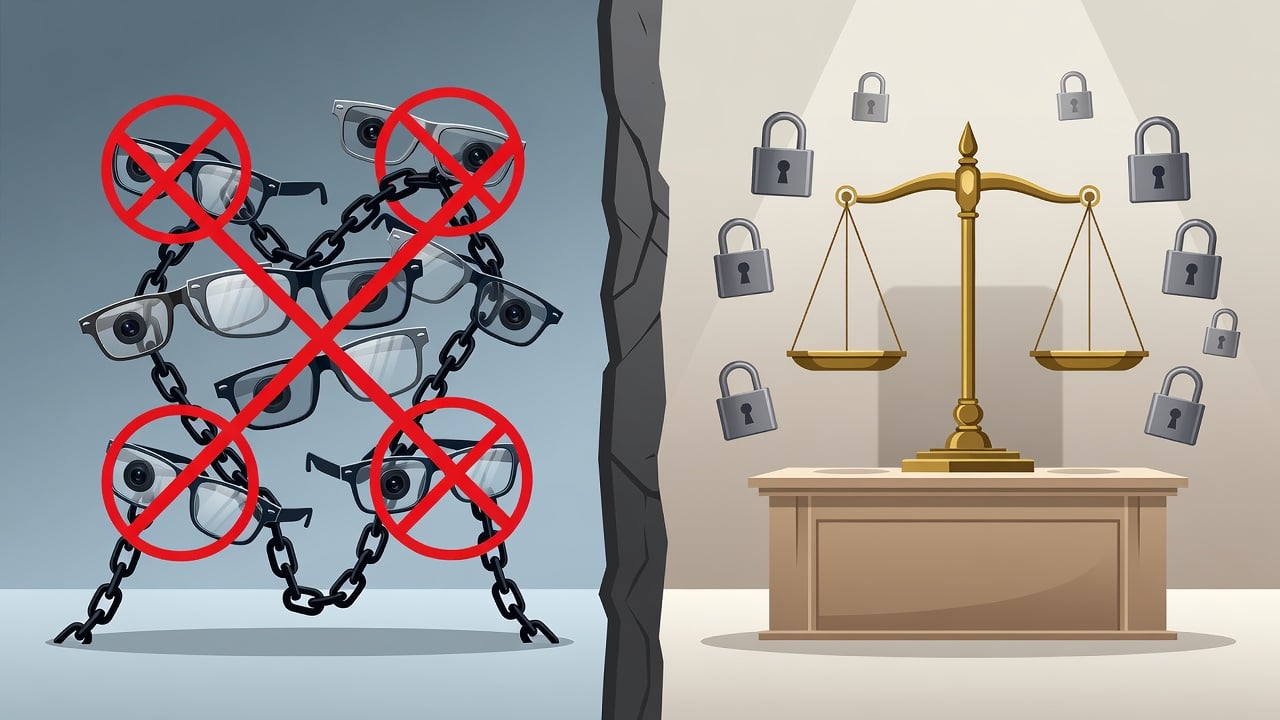
New York is about to become the first state to prohibit smart glasses across its entire court system. The rule takes effect July 20. It applies to all 1,240 state, county, city, town and village courts. Anyone entering must surrender eyewear or headwear equipped with cameras, microphones or other recording technology.
Court officers will hold the devices for safekeeping. The policy covers lawyers, staff, jurors and visitors alike. Prescription versions aren’t exempt. Users who need corrective lenses must bring ordinary glasses instead.
The ban stems from longstanding rules against unauthorized recordings.
New York already bars photography, filming, broadcasting and audio capture inside courthouses. Officials worry smart glasses make enforcement nearly impossible. Users can record discreetly. No need to raise a phone or aim a visible device. A July 1 memo from the Office of Court Administration spelled it out plainly.
“The reason for this prohibition is to ensure that individuals cannot surreptitiously record court proceedings in violation of the New York State Civil Rights Law and applicable court rules,” the memo said, Bloomberg Law reported.
Built-in safeguards haven’t convinced administrators. Many devices feature a recording indicator light. Meta added protections that disable the camera if the light is covered. Yet lights can be overlooked in busy hallways. Security staff lack reliable ways to verify whether a pair is actively streaming or capturing images.
The issue gained traction earlier this year. In February a California judge cautioned people with Meta CEO Mark Zuckerberg not to record during a social media addiction trial. Jurors could be identified. The incident highlighted risks that extend far beyond courtrooms.
But New York’s move stands out. It represents the first blanket prohibition at the state level. Individual courthouses in Wisconsin, Pennsylvania and Hawaii had imposed limits before. This policy covers every facility in the Unified Court System.
And the implications reach further. Law firms, media outlets and government contractors send employees into these buildings regularly. They now face new compliance headaches. Company policies on wearables may need immediate updates. Simply disabling a camera might not satisfy the rule. The ban targets the hardware itself.
Prescription users encounter added complications. They must carry backup frames. Accessibility concerns could arise for those reliant on integrated corrective lenses. The memo offers no carve-outs.
Tech companies pushing these products face a clear signal. Discreet designs help drive consumer interest. The same features create enforcement nightmares where privacy and confidentiality matter most. Engadget noted that New York’s decision could influence other states and public institutions as adoption grows.
Meta’s Ray-Ban smart glasses, which integrate cameras and AI, sit at the center of the debate. The company has marketed them for everyday use. Yet courtroom settings demand different standards. Similar concerns have surfaced around other brands offering prescription options or advanced audio features.
Recent coverage shows the story is still developing. Syracuse.com detailed how the prohibition extends to every level of court. PCMag emphasized the focus on preventing secret recordings. Even international outlets picked it up. WION described the policy as a protection measure for courtroom privacy.
Officials aren’t waiting for incidents to multiply. The February California episode served as a warning. A small recording light proves insufficient when stakes involve juror safety, witness testimony or sensitive legal strategy. Once footage exists, it can spread quickly. Social media and online platforms amplify the damage.
So what happens next? Courts elsewhere may study New York’s approach. Employers will adjust training. Visitors will prepare differently. The ban forces a conversation about where wearable technology belongs. Not every space welcomes hands-free cameras.
Critics might argue the rule feels overly broad. Yet supporters point to existing statutes. New York Civil Rights Law already restricts recordings. Smart glasses simply expose gaps in how those laws were enforced. Technology advanced faster than policy.
The July 20 start date gives little time for adjustment. Court staff must train on identification and storage procedures. What counts as “recording technology” requires clear guidelines. Headwear with hidden mics falls under the same umbrella.
Meanwhile device makers continue iterating. Newer models promise better privacy controls. Some offer on-device processing to limit cloud uploads. Others emphasize consent prompts. Whether those features sway administrators remains uncertain. A visible light or software toggle doesn’t solve the fundamental trust problem.
Businesses involved in litigation should act now. Update employee handbooks. Consider alternatives like basic eyewear for court days. The cost of noncompliance could include denied entry or worse.
This isn’t just about glasses. It’s about balancing innovation with fundamental protections. Courtrooms preserve due process. They demand environments free from hidden surveillance. New York drew a line. Other institutions will watch closely.
The policy arrives as wearable cameras grow more common. From fitness trackers to augmented reality headsets, recording capabilities proliferate. Privacy expectations shift in response. Public spaces, medical facilities and schools could face similar questions ahead.
But for now the focus stays on New York courts. Starting next week the surrender process begins. Security officers will collect devices at entrances. Storage protocols must prevent damage or loss. Retrieval upon exit should run smoothly.
One thing is clear. The era of unrestricted wearable tech just met its first significant legal barrier at scale. How manufacturers, users and other jurisdictions respond will shape the next chapter.


 WebProNews is an iEntry Publication