
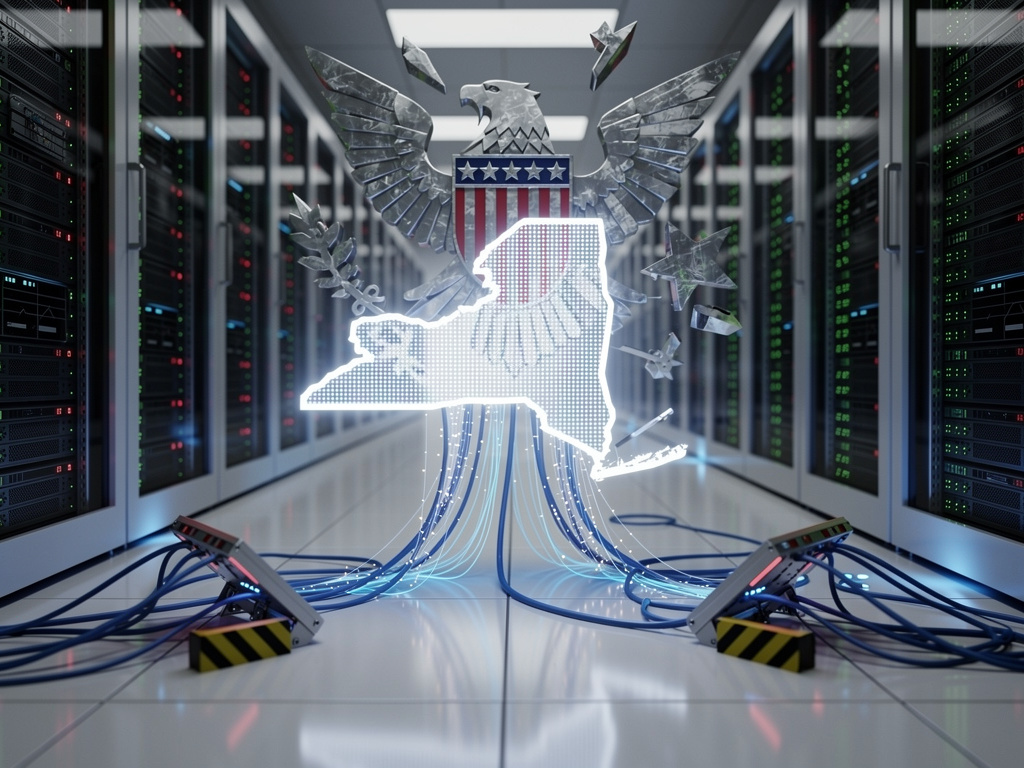
New York Gov. Kathy Hochul signed the RAISE Act into law on Friday, thrusting the state into the vanguard of AI oversight just as President Trump’s executive order seeks to streamline federal control and preempt state-level meddling. The legislation, originally passed by the state legislature in June, underwent significant revisions to align more closely with California’s SB 53, softening some mandates amid fierce lobbying from tech giants. Critics warn this move not only bucks White House directives but could spawn a regulatory morass stifling U.S. innovation at a pivotal moment for global AI dominance.
The RAISE Act targets developers of frontier AI models—those with compute power exceeding 10^26 FLOPs—requiring them to implement safety and cybersecurity protocols, conduct risk assessments, and report serious incidents to state authorities. Companies must also disclose safety frameworks publicly, a provision that echoes California’s law but stops short of the original New York bill’s more stringent reporting thresholds. Axios reported the signing, noting New York’s entry as the second state after California to impose such broad rules on cutting-edge AI.
Negotiations leading to the bill’s final form were heated, with Hochul proposing amendments that diluted the original text after pushback from industry players. Tech lobbyists argued the initial version threatened to drive AI development out of New York, potentially costing jobs and investment in a sector vital to the state’s economy. The American Prospect lambasted the changes as Hochul ‘caving’ to Big Tech, while supporters hailed it as a balanced approach.
Trump’s Federal Push Collides with State Ambitions
President Trump’s recent executive order explicitly aims to curb state AI regulations that could fragment the market and undermine U.S. leadership against competitors like China. The order directs federal agencies to review and challenge state laws posing barriers to innovation, putting New York’s RAISE Act squarely in the crosshairs. Industry groups, including the American Innovators Network, decried the bill as ‘misguided,’ warning it imposes unnecessary burdens on developers already navigating complex safety challenges.
The American Innovators Network issued a statement post-signing, asserting, ‘The RAISE Act will create legal uncertainty and compliance costs that deter investment in New York, the very state positioning itself as an AI hub.’ They highlighted how such rules contradict Trump’s pro-innovation agenda, potentially handing advantages to less-regulated foreign rivals. American Innovators Network emphasized that voluntary industry-led safety measures outperform top-down mandates.
Hochul, undeterred, touted the law on X as setting a ‘national standard for strong, sensible AI regulation,’ framing it as a counter to federal inaction. Yet, with Trump’s order fresh, legal challenges loom, as federal preemption could render state efforts moot. Politico detailed the tensions, reporting Hochul’s sign-off followed ‘heated negotiations’ mirroring California’s framework to appease critics.
California’s SB 53: A Template with Cracks
New York’s revised RAISE Act draws heavily from California’s SB 53, signed earlier this year, which mandates similar disclosures for AI models surpassing compute thresholds. Both laws require annual safety reports and incident notifications for events posing ‘catastrophic risks’ like critical infrastructure failures or mass harm. Proponents argue these transparency measures foster accountability without halting progress; detractors see them as bureaucratic hurdles diverting resources from core R&D.
California’s law faced its own backlash, with tech firms warning of talent flight to states like Texas and Florida boasting lighter touches. New York’s adoption amplifies these concerns, especially as the state courts Micron and other chipmakers under the CHIPS Act. The New York Times noted the modifications make the bill ‘more closely match’ California’s, at Big Tech’s urging, potentially easing some compliance pains but not eliminating them.
Industry insiders point to empirical evidence: OpenAI and Anthropic have pioneered voluntary safety protocols, publishing frameworks that exceed proposed state mandates. Forcing disclosures, they argue, risks revealing proprietary methods to adversaries, eroding America’s edge. A CNBC analysis highlighted opposition from Trump allies and super PACs, underscoring fears of innovation chokeholds.
Innovation Costs Mount in Regulatory Splintering
Multiple state regimes promise a compliance nightmare for national firms. A model trained in California or New York must adhere to varying disclosure rules, compute audits, and reporting chains, inflating legal and engineering overhead. Estimates from tech coalitions peg annual costs at hundreds of millions for frontier developers, funds better spent scaling models to outpace China’s state-backed efforts.
New York Democrats decried Hochul’s revisions as Big Tech capitulation, per Fox News, with lawmakers like Assemblymember Amy Paulin lamenting lost ‘guardrails.’ Yet even softened, the law mandates Attorney General oversight, inviting investigations that could paralyze deployments. Posts on X from industry voices echo this, decrying state overreach amid Trump’s unification bid.
The bill exempts smaller developers under the compute threshold, ostensibly protecting startups, but frontier players like xAI or Meta face the brunt. With Trump’s order empowering federal lawsuits against conflicting states, New York’s gamble could backfire, repelling the very investments Hochul courts. Gothamist reported lobbyists’ claims that unchecked rules ‘could stifle innovation,’ a sentiment now validated by the signing.
Global Stakes and U.S. Leadership Peril
China advances unchecked, deploying AI in military and surveillance without disclosure fetters, while Europe’s AI Act burdens with red tape. U.S. states diverging from Trump’s vision risk ceding ground, fragmenting a unified front. The RAISE Act’s incident reporting—covering risks to ‘life, health, or critical infrastructure’—sounds prudent but invites overbroad enforcement, chilling experimentation.
Hochul’s X post declared, ‘The federal government doesn’t care about protecting you from the harms of AI. I do.’ This populism clashes with evidence: Frontier firms invest billions in alignment research, outstripping government capabilities. Bloomberg Government News framed it as ‘AI curbs opposed by tech industry,’ signaling brewing federal-state warfare.
As 2026 unfolds, expect court battles testing preemption limits. New York’s defiance may rally blue states but at the expense of national cohesion, potentially dimming America’s AI ascendancy. Industry leaders urge repeal or alignment with federal guidelines to safeguard the edge that powers economic primacy.


 WebProNews is an iEntry Publication