
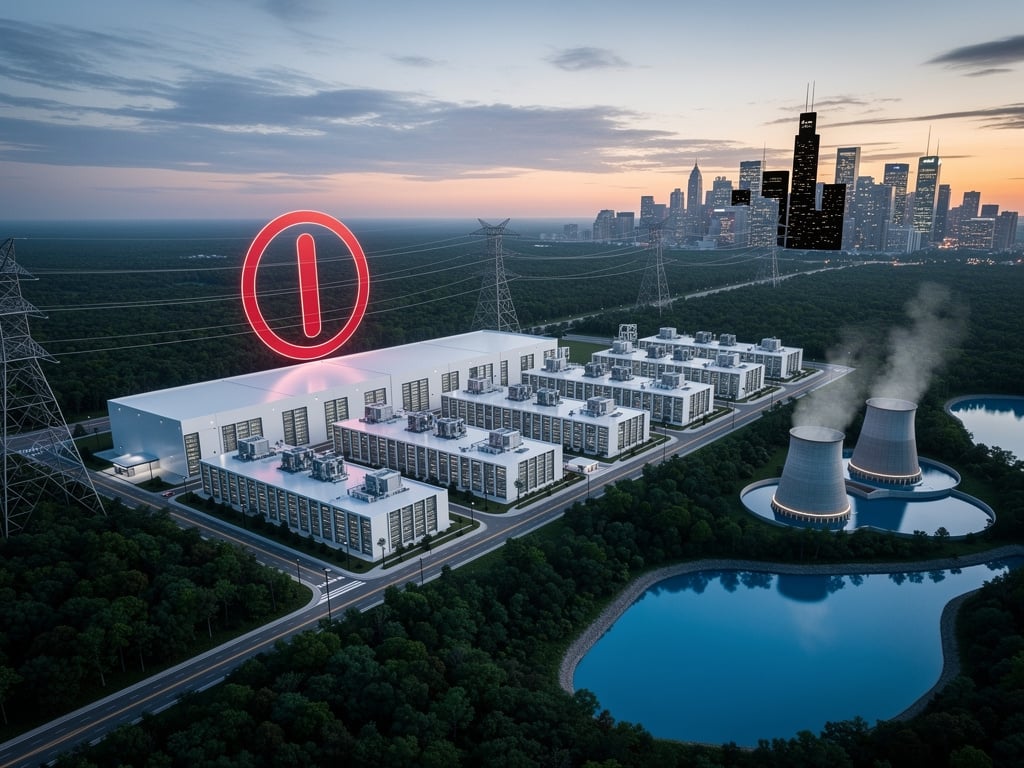
New York just took a stand against unchecked data center growth. Lawmakers approved a one-year moratorium on new large-scale facilities. The measure, if signed by Gov. Kathy Hochul, would mark the first such statewide restriction in the nation. It buys time to study soaring electricity demands, water use and grid strain from AI-driven projects.
The legislation evolved from an earlier three-year proposal. Senate Bill S.9144A originally called for a lengthy pause until the Department of Environmental Conservation completed a generic environmental impact statement and the Public Service Commission issued orders on rate impacts. That bill text defined data centers as any facility capable of using 20 megawatts or more. It covered buildings, servers and infrastructure dedicated to data processing, storage or web hosting.
But urgency in the final days of the legislative session produced a compromise. The version passed this week shortens the initial halt to one year. It still requires a comprehensive environmental review covering electricity consumption, water usage, land impacts, pollution and effects on disadvantaged communities. Facilities must eventually source more power from renewables and contribute to local benefits. “It is reasonable to have a pause, a moratorium on the building of new data centers, so that we can plan for our energy future. So that we can protect our environment,” said Sen. Kristen Gonzalez, a sponsor.
Hochul has signaled skepticism toward the status quo. “I think that much more should be done to ensure that communities are benefiting enormously from this and there’s not a drain on the power sources in that area,” she told reporters. “So I will look at this one-year moratorium in the context of also knowing that the status quo can’t continue.” Her office will review the bill before a December deadline.
Why the sudden alarm? Demand forecasts paint a stark picture. The New York Independent System Operator is reviewing 24 data center proposals that together exceed 9,000 megawatts. One project alone near Albany eyes 180 megawatts. Nationally, data centers already consume more than 4 percent of U.S. electricity. Projections show that share could reach 8 to 12 percent by 2030, driven largely by AI training and inference. A single hyperscale AI facility can draw as much power annually as 100,000 homes. Larger ones under construction may use 20 times that amount.
But power is only part of the equation. These centers also consume vast quantities of water for cooling. They generate electronic waste. And they often locate in rural or semi-rural areas where grids already face constraints. Environmental groups warn that without intervention, ratepayers will foot the bill for new generation and transmission while climate targets slip. “The more Americans learn about AI data centers, the more they are opposed to these monstrous, energy-intensive, water-sucking facilities,” said Emily Wurth, managing director of organizing at Food & Water Watch. “Wherever these hyperscale data centers are built, electricity rates skyrocket for families and small businesses, water stability is threatened, and communities are turned upside down.” Her organization urged Hochul to sign immediately, calling the vote the only responsible path.
Advocates see the moratorium as a chance to align development with New York’s Climate Leadership and Community Protection Act, which targets net-zero emissions by 2040. They point to polls showing majority opposition to data centers in local communities. Similar pushes have emerged in Maine, Virginia, Georgia and other states. A federal AI Data Center Moratorium Act proposed by Sen. Bernie Sanders and Rep. Alexandria Ocasio-Cortez reflects growing bipartisan unease.
Industry representatives counter that the blanket approach sends the wrong signal. “The moratorium would overall be damaging to the state’s economy, because having a blanket moratorium instead of looking at it at a case by case basis would not allow the state to move forward on a data center project that would actually be helpful to our economy,” Stacey Sikes, acting president and CEO of the Long Island Association, told Gothamist. Tech and business groups warn it could drive investment to states with fewer restrictions. Virginia and Texas have welcomed hyperscalers with open arms and tax incentives.
The original bill’s detailed requirements offer clues to what regulators might demand. The Public Service Commission would have to study rate impacts on residential, commercial and industrial customers and issue orders ensuring data centers bear the full cost of new infrastructure, generation and transmission. No subsidies. No cost shifts. A new customer classification for these massive loads was on the table. The Department of Environmental Conservation would examine everything from e-waste to effects on overburdened neighborhoods. Regulations could mandate minimum renewable energy percentages and energy storage. And the moratorium would have applied even to additional permits for projects already under construction but not yet operational.
That level of scrutiny reflects real anxiety. Goldman Sachs analysts have estimated the U.S. will need 47 gigawatts of new power capacity to meet data center growth. That’s roughly three New York Cities’ worth. Transmission queues are backlogged. Interconnection delays stretch years. In places with concentrated data center clusters, wholesale prices have spiked dramatically. New York’s grid operator already frets over resource adequacy as AI workloads surge.
Yet the industry argues data centers bring jobs, tax revenue and economic activity. They power the very AI tools transforming finance, health care and manufacturing. Halting them risks ceding leadership to other regions or countries. Some developers already design facilities with on-site generation or direct renewable contracts to reduce grid burden. Others explore advanced cooling that cuts water use. The question is whether voluntary measures suffice or if mandatory rules are required.
Assembly Speaker Carl Heastie described the final one-year version as a compromise hammered out after talks with advocates and stakeholders. It emerged in an omnibus package amid end-of-session frenzy that also tackled redistricting and algorithmic pricing. Passage came quickly. The bill now sits with Hochul. Her administration has floated its own ratepayer protection ideas, including requiring data centers to pay their fair share and streamlining interconnections for other job-creating businesses.
So what happens next? If signed, the moratorium gives agencies 12 months to produce studies and begin rulemaking. Public hearings would become mandatory for projects above the threshold. Developers might accelerate already-permitted projects or shift plans out of state. Environmental groups will push for strong final rules that prioritize renewables, protect ratepayers and avoid fossil fuel lock-in. Industry will lobby for exemptions, faster reviews and recognition of efficiency gains.
The debate extends far beyond Albany. Data center proliferation has sparked local battles nationwide. Heated town meetings. Zoning fights. Moratoriums at the county level. New York’s move elevates the conversation to statewide policy. It forces a reckoning with the physical realities of the digital economy. Servers may live in the cloud. But they run on very real electrons, water and land.
Critics of the pause call it economic self-sabotage. New York already struggles with high energy costs and business flight. Adding regulatory hurdles could compound that. Supporters counter that blind growth carries bigger risks: higher bills for families, missed climate targets, strained infrastructure that ultimately deters other investment. The studies mandated by the bill should clarify which path holds more peril.
Either way, the genie is out. AI adoption accelerates. Model sizes grow. Inference scales. Electricity demand will keep climbing. The only variable is how society chooses to manage it. New York has chosen a timeout. Whether that pause produces smarter policy or simply delays the inevitable remains to be seen. Hochul’s decision will set the tone not just for her state but for a national conversation that can no longer be ignored.


 WebProNews is an iEntry Publication