
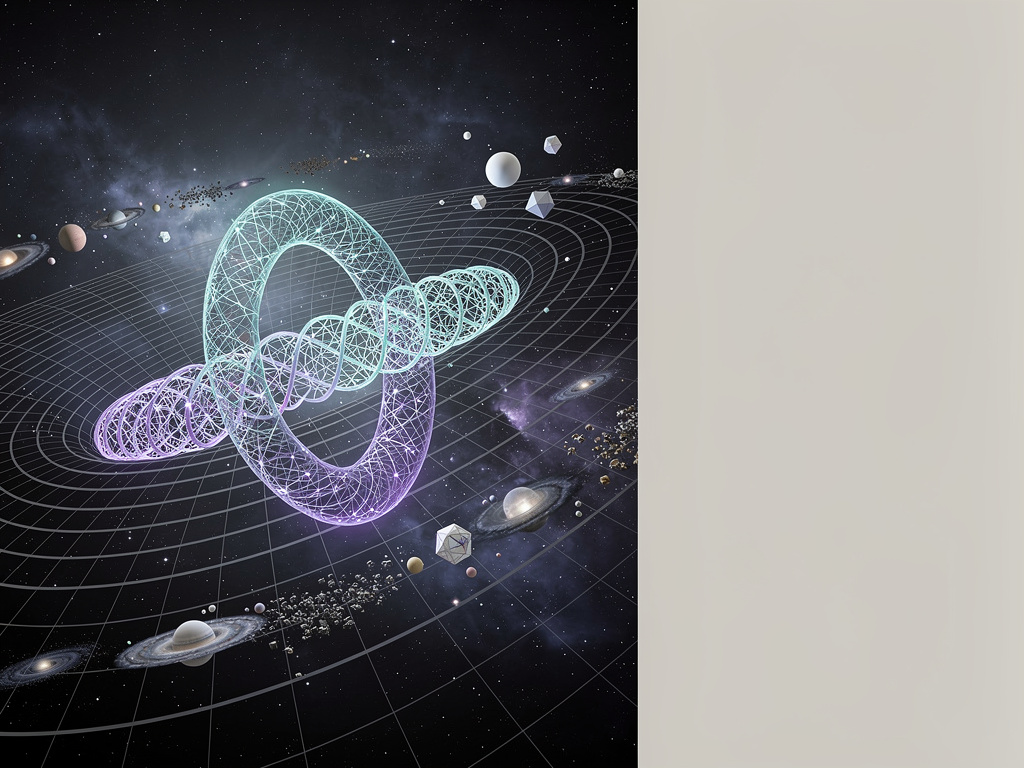
Strings Unraveling the Cosmos: A Breakthrough in Modeling Dark Energy
In the ever-evolving quest to understand the universe’s deepest secrets, physicists have long grappled with string theory’s inability to account for dark energy, the mysterious force driving the cosmos’s accelerating expansion. But a groundbreaking development, detailed in a recent article from Quanta Magazine, reveals that researchers have finally constructed a string theory model compatible with positive vacuum energy, mirroring our own universe. This achievement, led by theorists Bruno Bento and Miguel Montero, marks a pivotal moment, potentially bridging the gap between quantum mechanics and general relativity in ways previously thought impossible.
The core challenge stemmed from string theory’s traditional frameworks, which favored universes with zero or negative vacuum energy, clashing with observations of our expanding cosmos. Dark energy, comprising about 68% of the universe’s energy density, propels galaxies apart at an increasing rate, a phenomenon first detected in 1998 through supernova observations. For decades, string theorists struggled to reconcile this with their models, often resorting to abstract constructs that didn’t align with reality. Bento and Montero’s work, however, introduces a de Sitter universe model within string theory, incorporating positive dark energy density and offering a stable, expanding framework.
This isn’t just theoretical tinkering; it addresses a fundamental flaw that has plagued string theory since its inception in the 1970s. By embedding quantum strings—tiny, vibrating entities that purportedly make up all matter and forces—into a spacetime geometry that allows for acceleration, the researchers have opened doors to testable predictions. Their model suggests that dark energy arises naturally from the interactions of these strings in higher dimensions, providing a quantum explanation for cosmic expansion without invoking additional, ad hoc elements.
Overcoming Historical Hurdles in Theoretical Physics
Critics of string theory have often pointed to its lack of empirical evidence and its proliferation of unobservable dimensions—typically 10 or 11 in total, with most compactified into minuscule shapes. Yet, as reported in a ScienceDaily piece on alternative gravity theories, some scientists propose extending Einstein’s general relativity to explain acceleration without dark energy. Bento and Montero’s approach diverges by staying true to string theory’s roots while adapting it to observational data, such as that from the Dark Energy Spectroscopic Instrument (DESI), which has hinted at evolving dark energy behaviors.
The duo’s innovation lies in constructing explicit models of de Sitter space, a positively curved spacetime that expands exponentially. Previous attempts faltered because string theory’s mathematics resisted positive vacuum energy, leading to instabilities. By incorporating specific fluxes and branes—higher-dimensional objects within the theory—they stabilized the model, ensuring it doesn’t collapse or decay unnaturally. This stability is crucial, as it allows the universe to persist long enough for structures like galaxies and life to form, aligning with our observed reality.
Moreover, this breakthrough resonates with ongoing debates in cosmology. A BBC article highlights how dark energy might be changing, potentially altering the universe’s fate from eternal expansion to a possible “Big Crunch.” Bento and Montero’s string theory variant offers a framework to explore such dynamics, suggesting that dark energy’s density could vary due to quantum string vibrations, providing a mechanism for these shifts.
Implications for Unifying Forces and Quantum Gravity
Delving deeper, the model’s compatibility with dark energy paves the way for unifying all fundamental forces under one umbrella. String theory has always aimed to merge gravity with quantum field theory, but dark energy posed a stubborn obstacle. Now, with this de Sitter construction, physicists can simulate universes that look like ours, complete with accelerated expansion and stable matter configurations. This could lead to predictions about particle masses, force strengths, and even the behavior of black holes in an expanding cosmos.
Insights from social media platforms like X underscore the excitement surrounding this development. Posts from users, including physicists and science enthusiasts, buzz with discussions on how this resolves string theory’s “swampland” conjectures—ideas that certain low-energy theories are inconsistent with quantum gravity. One thread notes the alignment with DESI data, suggesting that string theory might finally yield observable signatures, such as specific patterns in cosmic microwave background radiation or gravitational waves.
Furthermore, a Popular Mechanics report from last year anticipated such evidence, linking string theory to weakening dark matter effects. Bento and Montero’s work builds on this by providing a concrete mathematical scaffold, potentially influencing upcoming observations from telescopes like the Nancy Grace Roman Space Telescope, set to launch later this decade.
Challenges and Criticisms from the Scientific Community
Not everyone is convinced. Skeptics argue that while this model is a step forward, string theory remains untestable in practice, with its extra dimensions hidden at scales too small for current experiments. Eric Weinstein, a vocal critic, has posted on X about how string theory has “blocked” progress in physics for decades, advocating for alternative paths like geometric unity. This sentiment echoes in a Hacker News discussion, where users debate the theory’s merits amid new gravity models that sidestep dark energy altogether.
Bento and Montero acknowledge these hurdles, emphasizing that their model is a starting point, not a final answer. It requires further refinement to incorporate realistic particle physics, such as the Standard Model’s quarks and leptons. Yet, the explicit construction of a de Sitter vacuum in string theory counters the notion that such universes are impossible, challenging the swampland program’s assertions and invigorating research into quantum gravity.
In parallel, other theories gain traction. A ScienceDaily update on dark matter detectors highlights efforts to probe invisible components directly, which could either validate or refute string theory’s predictions. If experiments detect string-like resonances in high-energy collisions, it would bolster this new model; otherwise, it might reinforce calls for paradigms beyond strings.
Future Directions and Experimental Horizons
Looking ahead, this breakthrough could influence fields beyond cosmology, including quantum computing and materials science, where string-inspired mathematics model complex systems. For instance, the AdS/CFT correspondence—a string theory tool linking gravity to quantum fields—might now extend to de Sitter spaces, offering insights into holographic principles in our universe.
Recent news from WebProNews proposes viewing space as a viscous fluid, challenging dark energy models. Bento and Montero’s work intersects here by suggesting string vibrations could mimic such viscosity at quantum scales, providing a unified explanation for cosmic phenomena.
On X, a post from Quanta Magazine itself teases that this formulation partially resolves string theory’s flaws, sparking threads about potential “theory of everything” implications. Users speculate on how it might explain entropy-driven gravity, as in a theory discussed by Dr. Singularity, where quantum entropy sources gravitational effects.
Broader Impacts on Cosmological Understanding
The ripple effects extend to our comprehension of the universe’s origins and destiny. If dark energy is string-derived, it could imply multiple universes in a multiverse scenario, each with different string configurations yielding varied physical laws. This ties into anthropic principles, where our universe’s parameters are fine-tuned for life, now explicable through string theory’s vast array of possible vacua.
A Daily Mail article warns of a potential Big Crunch if dark energy wanes, a scenario Bento and Montero’s model can simulate by adjusting string parameters. This predictive power is invaluable, allowing theorists to forecast cosmic evolution based on quantum fundamentals.
Educationally, this development invigorates university programs, as noted in a University of Birmingham piece, where new verification methods for string theory are explored. Professors like Marika Taylor advocate for innovative tests, from collider experiments to astrophysical observations, to ground the theory in data.
Integrating Diverse Perspectives in Ongoing Research
Interdisciplinary collaboration is key. Combining string theory with modified gravity approaches, as in the ScienceDaily gravity extension, could yield hybrid models that better fit observations. Bento and Montero’s framework invites such synthesis, potentially resolving tensions like the Hubble constant discrepancy, where expansion rate measurements vary.
Social media sentiment on X reflects cautious optimism, with users like Erika highlighting string theory’s historical challenges and newfound testability. Posts emphasize its role in uniting quantum mechanics with gravity, echoing Quanta Magazine’s coverage of curled dimensions determining physical laws.
Ultimately, this milestone underscores physics’ dynamic nature, where longstanding barriers yield to persistent innovation. As researchers refine these models, the quest for a complete cosmic picture continues, promising revelations that could redefine our place in the universe. With tools like advanced telescopes and particle accelerators on the horizon, the coming years may confirm whether strings truly orchestrate the cosmos’s symphony.


 WebProNews is an iEntry Publication