
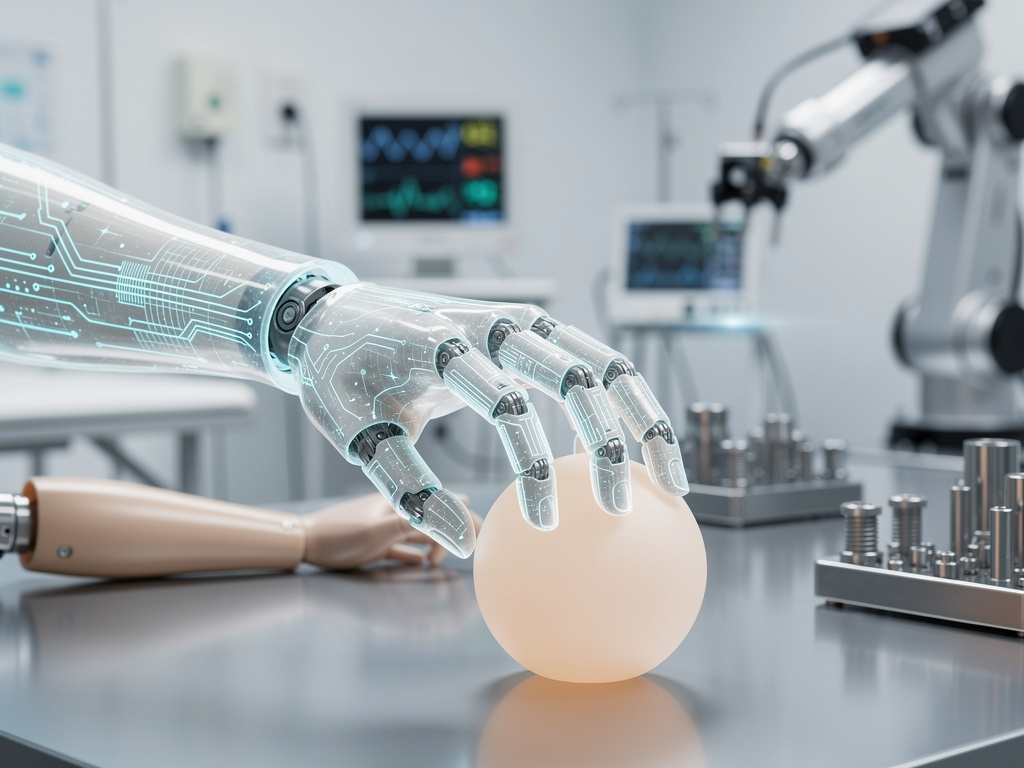
The Dawn of Feeling Machines: Neuromorphic Skin Ushers in a New Era for Robotics
In the rapidly evolving field of robotics, a breakthrough has emerged that could fundamentally alter how machines interact with the world. Researchers have developed a “neuromorphic” artificial skin that mimics the human nervous system, transmitting sensory information through neural-style activity spikes. This innovation, detailed in a recent article from Ars Technica, promises to make robots more intuitive and efficient by processing data in a way that echoes biological processes. Unlike traditional sensors that rely on constant data streams, this skin uses sporadic spikes, much like neurons firing in the brain, to convey touch, pressure, and other sensations.
The development stems from efforts to overcome the limitations of current robotic skins, which often consume excessive power and struggle with real-time responsiveness. By adopting a neuromorphic approach—inspired by the brain’s efficiency—these researchers have created a system where sensors embedded in flexible materials send signals only when changes occur, reducing energy use dramatically. This isn’t just theoretical; prototypes have shown the skin can detect subtle textures and forces, enabling robots to handle delicate objects without crushing them.
Industry experts see this as a pivotal step toward humanoid robots that can operate in dynamic environments, from healthcare to manufacturing. The skin’s design integrates with existing robotic frameworks, potentially accelerating adoption in sectors where precision touch is crucial.
Mimicking Biology: How Neuromorphic Systems Work
At the core of this technology is neuromorphic computing, which draws from neuroscience to build hardware that processes information like the human brain. According to insights from Science Robotics, combining electronic skins with machine learning allows for advanced tactile sensing and proprioception in soft robots. These systems don’t just sense; they learn and adapt, interpreting complex data patterns to make decisions autonomously.
In practical terms, the artificial skin comprises layers of flexible polymers embedded with sensors that generate electrical spikes in response to stimuli. This spike-based communication is far more efficient than traditional analog signals, as it minimizes noise and focuses on relevant changes. For instance, when a robot grasps an egg, the skin spikes to signal pressure levels, preventing breakage through immediate feedback loops.
Recent experiments, as reported in various studies, have demonstrated this skin’s ability to integrate with robotic arms, providing feedback that rivals human touch sensitivity. The implications extend beyond simple grasping; robots could navigate crowded spaces or assist in surgery with heightened awareness.
Advancements in Sensor Integration and Applications
Building on these foundations, researchers have explored multimodal capabilities, where the skin detects not only pressure but also temperature, vibration, and even chemical changes. A publication in OAEPublish highlights how human skin-inspired neuromorphic sensors emulate the body’s adaptability, using stretchable materials to sense a broad range of stimuli. When paired with neuromorphic computing, these sensors enable real-time, context-aware responses, crucial for intelligent systems.
In robotics, this means creating machines that can “feel” their environment in ways previously impossible. For example, in prosthetics, such skins could restore a sense of touch to amputees, integrating with neural interfaces for seamless control. The technology’s flexibility allows it to conform to irregular shapes, making it ideal for soft robotics that mimic organic movements.
Moreover, developments in artificial neural networks, as discussed in Materials Horizons, show how these skins facilitate real-time data interpretation through deep and convolutional neural networks. This enables features like multimodal sensory feedback, enhancing human-machine interfaces in wearable bioelectronics and health monitoring.
From Labs to Real-World Deployment
The journey from concept to application has accelerated in 2025, with several prototypes moving toward commercialization. Inspired by vertebrate biology, designs like those in Nature Communications feature electronic skins paired with artificial muscles for biocompatible robots. These include robotic cuffs for blood pressure detection, grippers for bladder volume tracking, and even ingestible devices for internal sensing and drug delivery.
One notable advancement is the integration with wireless modules for untethered operation, allowing robots to function in remote or hazardous areas. In the context of humanoid robots, publications such as ScienceDirect describe electronic skins that emulate biological sensor networks, enabling accurate biosensing and discrimination of stimuli. This could revolutionize fields like elderly care, where robots need to handle fragile humans gently.
Posts on X (formerly Twitter) reflect growing excitement, with users discussing gelatin-based e-skins from UCL and Cambridge that sense damage like cuts, training machine learning on millions of data points. Such sentiment underscores the technology’s potential to humanize robots, making them more relatable and functional.
Challenges in Scalability and Ethics
Despite the promise, scaling neuromorphic skins presents hurdles. Manufacturing flexible, durable materials at low cost remains a challenge, as does ensuring long-term reliability in varied conditions. Researchers are addressing this through innovations like self-healing skins, as seen in University of Tokyo developments shared on social platforms, where lab-grown skin attaches to robotic faces and repairs itself.
Ethically, the rise of feeling robots raises questions about machine sentience and rights. If a robot can “feel” pain through damage detection, as explored in recent discussions, how does that affect programming for self-preservation? Industry insiders debate whether this could lead to robots prioritizing their own “safety” over tasks, complicating deployment in high-risk scenarios.
Furthermore, integrating these systems with broader AI frameworks requires robust data security to prevent vulnerabilities. As AI evolves, with breakthroughs like those noted in The Economic Times, neuromorphic skins could enhance agentic AI, where robots act independently based on sensory inputs.
Pushing Boundaries in Human-Robot Interaction
Looking ahead, the fusion of neuromorphic skins with advanced robotics is set to transform industries. In healthcare, robots with sensitive skins could perform delicate procedures, detecting tissue variations in real-time. Manufacturing might see robots assembling intricate components with human-like dexterity, reducing errors and waste.
Recent news from Euronews highlights quirky applications, like humanoid robots folding laundry, showcasing the technology’s versatility. Meanwhile, ScienceDaily reports on ongoing research pushing robotic behavior manipulation through sensory enhancements.
Google’s 2025 research breakthroughs, as outlined in their blog, include AI models that could integrate with these skins for transformative products in science and robotics. At events like CES 2026, previews from COINTURK FINANCE emphasize AI-driven robotics, underscoring commercial interest.
Innovative Materials and Future Prospects
Materials science plays a crucial role, with advancements like capacitive arrays for tactile modulus detection in npj Flexible Electronics. These allow robots to gauge material softness, essential for tasks requiring nuanced touch.
X posts also buzz about Neuralink integrations, suggesting synergies with brain-computer interfaces for enhanced control. For instance, combining neuromorphic skins with implants could enable thought-controlled robots that feel feedback directly in the user’s mind.
As 2025 closes, the field is poised for exponential growth. Collaborations between academia and industry are accelerating, with prototypes evolving into market-ready solutions. This technology not only bridges the gap between machines and humans but also opens doors to empathetic AI companions.
Overcoming Technical Hurdles for Widespread Adoption
Key challenges include power efficiency and signal processing. Neuromorphic designs address this by spiking only on changes, but optimizing for diverse environments demands further refinement. Researchers are experimenting with hybrid systems, blending traditional and neuromorphic elements for robustness.
In terms of applications, soft robotics for implants shows promise, as bio-inspired designs enable stress-free tissue interaction. This could lead to revolutionary medical devices, from smart prosthetics to monitoring patches that deliver therapies.
Public discourse on X reveals enthusiasm mixed with caution, with threads discussing self-healing skins and their uncanny realism. Such innovations, while fascinating, prompt reflections on the blurring lines between artificial and natural life.
Strategic Implications for Industry Leaders
For companies like Tesla and Boston Dynamics, adopting neuromorphic skins could differentiate their products. Imagine Optimus robots with skins that detect wear and tear, self-repairing to maintain performance.
Economically, this could spur new markets in sensory tech, with investments flowing into startups specializing in flexible electronics. Governments might fund research for defense applications, like robots in disaster zones that navigate debris with tactile precision.
Ultimately, as these technologies mature, they will redefine human-machine symbiosis, making robots integral to daily life with a touch of humanity. The path forward involves balancing innovation with ethical considerations, ensuring benefits outweigh risks in this tactile revolution.


 WebProNews is an iEntry Publication