
Rodent Revolution: How Neuroengineers Are Teaching Rats to Master Doom
In the dimly lit labs of neuroengineering, a peculiar experiment has captured the imagination of scientists and gamers alike. For over four years, a dedicated team led by Hungarian neuroengineer Viktor Tóth has been pushing the boundaries of animal cognition by training rats to navigate and engage with the classic video game Doom II. What began as a whimsical idea has evolved into a sophisticated virtual reality setup, complete with custom hardware and automated training protocols, offering insights into brain-machine interfaces and behavioral neuroscience.
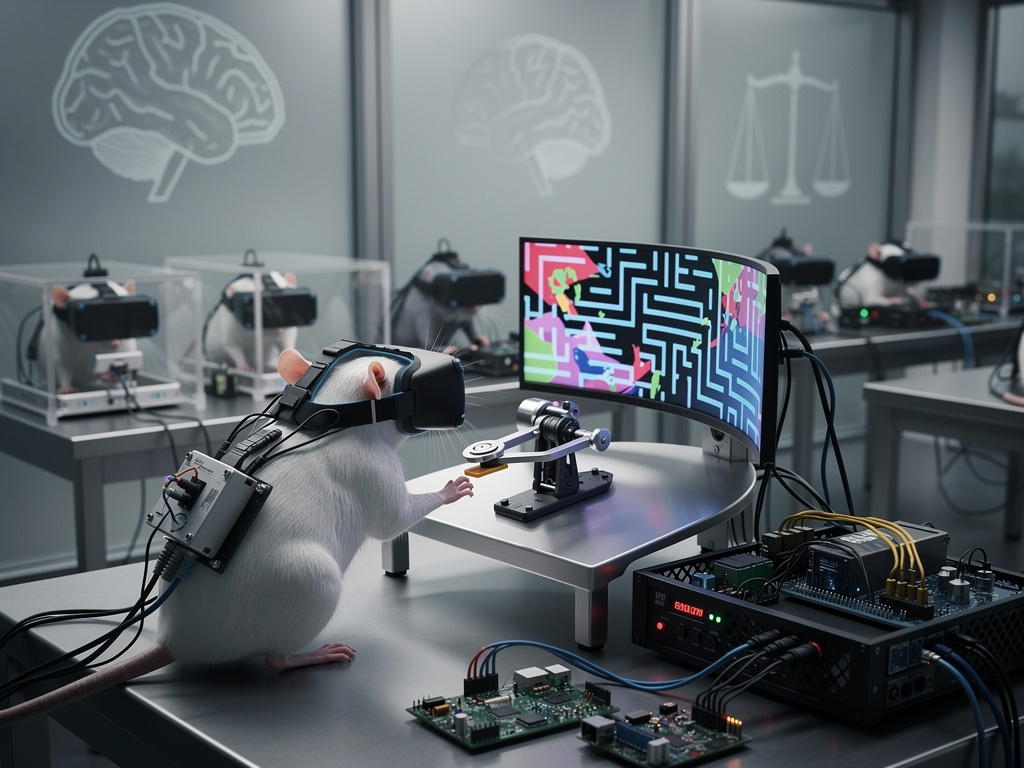
Tóth’s project, detailed on his dedicated website Rats Play Doom, started in 2021 when he first conceived of teaching rodents to play the iconic first-person shooter. Drawing inspiration from advancements in animal training and VR technology, Tóth assembled a low-cost rig using off-the-shelf components. The setup includes a polystyrene ball for locomotion, pneumatic tubes for rewards, and initially, a simple monitor. Rats, named after Doom creators like John Romero and John Carmack, were conditioned to move through virtual corridors, receiving sugar water as incentives for progress.
The experiment’s core innovation lies in its automation. Tóth developed software that integrates with a modified version of Doom II, allowing real-time tracking of the rat’s movements and automated dispensing of rewards. This system not only trains the animals to traverse levels but also introduces combat elements, such as shooting at in-game enemies. Early videos showed rats like Romero startling at virtual imps, a testament to their immersion in the digital world.
The Evolution of Rat VR Technology
Over time, the hardware has seen significant upgrades. By 2025, as reported in a recent article from Tom’s Hardware, the setup incorporated a wraparound AMOLED screen for a more immersive panoramic view. This curved display, sourced from flexible smartphone panels, envelops the rat, enhancing the virtual environment’s realism. A new trigger mechanism allows the rodents to “shoot” by pressing a lever, marking a leap from mere navigation to active gameplay.
Tóth’s approach emphasizes cost-effectiveness. His entire rig costs under $2,000, a fraction of commercial neuroscience VR systems that can exceed $70,000. This accessibility, as he explains in his Medium post via Mindsoft, could democratize preclinical research, enabling more labs to study complex behaviors in rodents. The open-source nature of the project further invites collaboration, with code and blueprints available for enthusiasts to replicate or improve upon.
Training protocols draw from operant conditioning principles, gradually shaping behaviors through positive reinforcement. Rats learn to associate forward movement on the ball with progress in the game, and successful enemy engagements with rewards. Challenges abound, including the animals’ independent streaks, which Tóth notes often lead to unexpected deviations from scripted paths.
From Pigs to Primates: Contextualizing Animal Gaming
This isn’t the first foray into animal gaming. In 2021, researchers trained pigs to manipulate joysticks with their snouts, as covered in Vice, demonstrating cognitive flexibility in livestock. Neuralink’s experiments with monkeys playing Pong via brain implants pushed the envelope further, highlighting direct neural interfaces. Tóth chose rats for their agility in confined spaces and ease of handling, making them ideal for compact VR setups.
Public fascination peaked with viral videos and media coverage. An Hackaday piece from December 2025 detailed recent advancements, noting how rats now proficiently eliminate foes, building on years of iterative improvements. On social platforms like X, posts from users such as IGN in 2021 marveled at the initial experiments, with one tweet describing a rat’s surprise encounter with an in-game monster, amassing thousands of likes.
The project’s longevity is impressive. What started as a six-month trial has persisted, with multiple generations of rats participating. Tóth’s updates reveal ongoing refinements, such as integrating machine learning to adapt training difficulty based on individual performance, ensuring each rat progresses at its own pace.
Neuroscience Implications and Ethical Considerations
At its heart, this endeavor probes deeper questions in neuroscience. By recording neural activity during gameplay, researchers gain windows into decision-making processes, spatial navigation, and threat response in a controlled yet dynamic setting. Tóth’s earlier Medium article on Mindsoft outlines the potential for such setups in studying disorders like ADHD or anxiety, where behavioral richness in VR could reveal subtle cognitive patterns not observable in traditional mazes.
Ethical dimensions are paramount. Tóth ensures humane treatment, with rats housed comfortably and training sessions limited to prevent stress. Unlike invasive methods in some primate studies, this setup is non-invasive, relying on external sensors and voluntary participation driven by rewards. Critics, however, question the anthropomorphic framing—do rats truly “play” or merely respond to stimuli? Tóth counters that the behaviors exhibited, like targeted shooting, suggest a level of engagement beyond rote conditioning.
Comparisons to other bio-computing experiments add intrigue. A 2023 project detailed in Rock Paper Shotgun involved growing rat neurons in vitro to control Doom, blurring lines between biology and computation. Tóth’s in vivo approach complements this, offering insights into embodied cognition where the animal’s physical actions directly influence the digital realm.
Monetization and Public Engagement
Public engagement has been a clever byproduct. In 2021, Tóth floated the idea of livestreaming rat gameplay on Twitch, as reported by Game Rant, to fund further research. While not fully realized, the concept sparked discussions on X, with posts from VGC highlighting the novelty of rodents as streamers. Recent X chatter, including a December 2025 post from Pirat_Nation with over 100,000 views, celebrates the shooting mechanism, fueling online buzz.
Funding remains a challenge for independent projects like this. Tóth relies on personal resources and donations via his website, but the visibility from media outlets has attracted interest from academic institutions. Collaborations could expand the scope, perhaps integrating EEG monitoring to correlate brain waves with in-game decisions.
The project’s open-source ethos fosters innovation. Enthusiasts on platforms like X have shared modifications, such as enhanced reward systems or multiplayer modes pitting rats against humans. This community-driven evolution mirrors the collaborative spirit of the original Doom modding scene.
Broader Technological Horizons
Looking ahead, the implications extend to human applications. Skills honed in rat VR could inform prosthetic designs or rehabilitation therapies, where patients relearn movements in immersive environments. Tóth envisions scaling the technology for larger animals or even therapeutic games for humans with motor impairments.
Challenges persist, including variability in rat performance. Not all subjects excel equally; some master shooting quickly, while others prioritize exploration. Tóth’s data, shared in updates, reveals learning curves that parallel human gamers, with plateaus and breakthroughs.
International interest is growing. Posts on X from global users, like a French tweet from Valentin Cebo in 2021, praise the project’s documentation, inspiring similar experiments worldwide. In Asia, as noted in a recent X post from KHeresy, there’s curiosity about potential applications in behavioral research.
Pushing Boundaries in Animal Cognition
The experiment also touches on philosophical questions. If rats can learn to navigate and combat in a virtual world, what does this say about consciousness and intelligence across species? Tóth’s work challenges traditional views, suggesting that complex problem-solving isn’t uniquely human.
Technological hurdles, such as syncing the rat’s physical speed with game physics, have been overcome through clever engineering. The wraparound screen, for instance, minimizes disorientation, allowing rats to maintain consistent in-game momentum.
As the project enters its fifth year, Tóth plans expansions like multiplayer scenarios or varied game environments. These could test social behaviors or adaptability, enriching the dataset for neuroscientists.
The Future of Bio-Digital Interfaces
In academia, the setup is gaining traction. References in publications highlight its utility for studying neural plasticity, where repeated gameplay might induce measurable brain changes.
Public sentiment, gauged from X trends, remains overwhelmingly positive, with users expressing awe at the ingenuity. A recent post from return of the research era humorously notes the simulation-like absurdity, yet underscores the serious scientific underpinnings.
Ultimately, Tóth’s rats aren’t just playing a game—they’re pioneering a new frontier in understanding the mind. By bridging biology and technology, this experiment illuminates paths for future innovations, from advanced AI training to enhanced human-computer interactions. As rats continue to frag demons in virtual hellscapes, they remind us of the endless possibilities when curiosity meets creativity.


 WebProNews is an iEntry Publication