
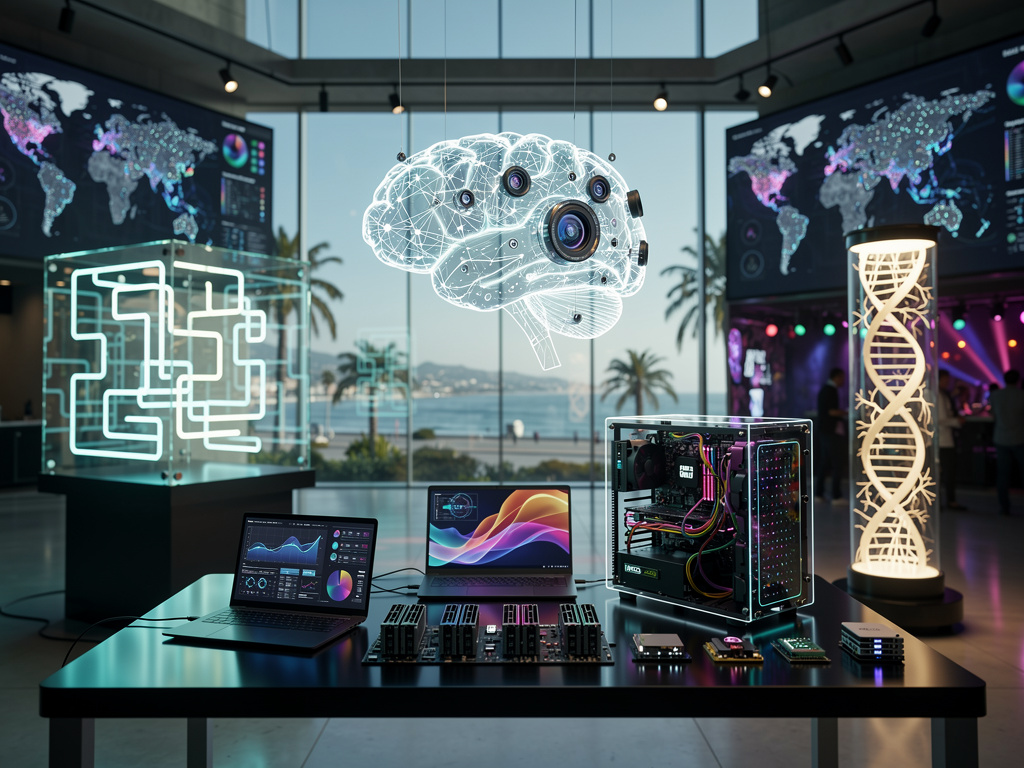
As the annual Conference on Neural Information Processing Systems, known as NeurIPS, kicked off in San Diego this December, the artificial intelligence community converged in a whirlwind of breakthroughs, debates, and unexpected extravagance. With over 175 accepted papers from Google alone and a sold-out registration that spanned San Diego and satellite events in Mexico City, the event underscored AI’s rapid evolution. Attendees buzzed about reinforcement learning’s ascendancy, Google’s dominant presence, and a party scene that veered into the absurd, including a yacht bash that symbolized the field’s growing excesses.
This year’s gathering, held from December 2 to 7, drew academics, startup founders, and tech giants, all grappling with AI’s unexplained inner workings even as progress surges forward. Reports from the conference highlighted a mix of optimism and caution, with researchers decrying a flood of low-quality submissions amid the hype. Yet, amid the chaos, key trends emerged: a shift toward more efficient models, biology-inspired AI, and a renewed focus on real-world applications.
One standout narrative was Google’s resurgence in the AI arena. The company, sponsoring at the diamond level, showcased advancements in multimodal models like Gemini, which now handle vast contexts for tasks such as video analysis and code generation. Jeff Dean and the Gemini team led sessions that drew crowds, emphasizing how these models are pushing boundaries in reasoning and memory.
Reinforcement Learning Takes Center Stage
Reinforcement learning, or RL, dominated conversations, with attendees proclaiming it the next big frontier. Papers and workshops explored RL’s potential to train agents that learn through trial and error, moving beyond static data to dynamic interactions. This enthusiasm stems from RL’s promise in creating AI systems that adapt in real time, a step toward more autonomous agents.
Notably, a best paper award went to work on 1000-layer networks for self-supervised RL, illustrating how deeper architectures could enhance learning without constant human oversight. Discussions on X echoed this sentiment, with posts highlighting RL’s role in scaling test-time interactions, allowing agents to “think” through actions rather than just tokens.
Google’s contributions amplified this trend, with over 70 involvements in competitions and tutorials. Their booth became a hub for exploring RL applications in everything from robotics to natural language processing, signaling a broader industry pivot away from sheer model size toward smarter training methods.
Google’s Surge Amid Industry Shifts
Beyond RL, Google’s presence loomed large, with executives like Oriol Vinyals tweeting about Gemini’s innovations, including massive context windows that rival competitors like OpenAI’s GPT series. This comes as Google integrates AI more deeply into its ecosystem, from research to consumer products, positioning it as a leader in the post-scaling era.
Meanwhile, other players like Qualcomm and Arm showcased edge AI advancements, focusing on low-power models for devices. Qualcomm’s presentations on efficient generative AI and neural networks, as detailed in their blog post, emphasized running sophisticated models on smartphones, reducing reliance on cloud computing.
NTT Research contributed 15 papers, tackling model efficiency and security, including watermarking to protect AI outputs. Their work, covered in Quantum Zeitgeist, demonstrated reductions in compute needs by orders of magnitude, addressing operational bottlenecks in enterprise settings.
The Slop Crisis and Calls for Reform
A darker undercurrent at NeurIPS was the so-called “slop” problem—a deluge of subpar research papers fueled by AI hype. Academics voiced frustrations over low-quality submissions, with one expert labeling it a “disaster” in a piece from The Guardian. This influx, driven by rapid field growth, has overwhelmed reviewers and diluted the conference’s prestige.
Calls for reform echoed through panels and social media. Researchers advocated stricter standards, better reproducibility, and a move toward agentic models that prioritize efficiency over brute-force scaling. WebProNews reported on these demands in their article detailing the crisis, noting how the sheer volume of papers—thousands submitted—has strained the peer-review process.
X posts amplified these concerns, with users sharing summaries of high-scoring papers like those on gated attention for large language models and diffusion models’ resistance to memorization. These discussions underscored a community pushing for quality amid quantity, with one viral thread recapping best paper awards that favored innovative, rigorous work.
Biology Meets AI in Transformative Ways
NeurIPS also spotlighted AI’s intersection with biology, dubbed by some as “biology’s transformer moment.” Sessions explored foundation models for virtual cells, predicting responses to chemical perturbations, as highlighted in Genetic Engineering & Biotechnology News’ coverage of the event. This fusion promises accelerations in drug discovery, where AI simulates complex biological systems.
Papers from entities like IBM Research and academic groups delved into these models, building on prior work like Amazon’s NeurIPS contributions in vision-language processing. The Neural Information Processing Systems Foundation’s own site, NeurIPS.cc, listed calls for bridging grants that support such interdisciplinary efforts, fostering collaborations between AI and life sciences.
Attendees noted a shift from text-based AI to multimodal approaches that incorporate physics and real-world data. Microsoft outlined similar trends in their forward-looking piece on 2026 AI directions, predicting AI as a true partner in research, enhancing teamwork and infrastructure efficiency.
The Party Scene’s Over-the-Top Spectacle
No NeurIPS recap would be complete without addressing the social frenzy. The Verge captured this vividly in their column on the industry’s biggest week, describing a party boat extravaganza that epitomized the field’s excesses. Yacht bashes hosted by startups and tech firms turned networking into spectacle, with attendees joking about the scene getting “completely out of hand.”
This hedonism contrasts with the conference’s serious undertones, where warnings about unofficial events proliferated. The official app urged caution against unauthorized gatherings, as noted on NeurIPS.cc, amid concerns over scams and distractions from core research.
Yet, these events facilitated informal exchanges that sparked ideas. X threads buzzed with anecdotes of late-night discussions on nested learning paradigms, as shared by Google VP Yossi Matias, blending revelry with intellectual rigor.
Pushing Boundaries in Model Understanding
Deeper dives into AI’s mysteries persisted, with NBC News reporting on researchers’ struggles to explain rapid advancements. Papers on why diffusion models avoid memorization and optimal mistake bounds in learning algorithms offered glimpses into black-box behaviors.
Arm’s blog on their NeurIPS involvement highlighted exchanges on intelligent computing’s future, emphasizing hardware-software synergies for edge AI. This aligns with Qualcomm’s focus on low-power vision networks, creating a ecosystem where AI runs seamlessly on everyday devices.
Spotlight presentations, like one on brain control mechanisms using deep learning and differential geometry, showcased niche innovations. Such work, accepted as NeurIPS spotlights, points to AI’s expanding role in neuroscience and beyond.
Enterprise Innovations and Future Directions
On the enterprise front, NTT’s papers addressed watermarking and model behavior, providing tools for secure AI deployment. Their emphasis on foundational theory resonates with Google’s nested learning approach, which treats models as nested optimization problems to combat forgetting.
Sponsorships from firms like IBM and NTT DATA underscored commercial stakes, with career sites buzzing for talent. The conference’s call for papers, emphasizing funding disclosures and code submissions, reinforces transparency in an era of proprietary models.
Looking ahead, trends like physical AI—simulating real-world physics for better agents—gained traction. GenAI Summit’s X post distilled insights from experts like Anima Anandkumar, advocating for AI that bypasses traditional data limitations through physics-informed methods.
Navigating Hype and Ethical Realities
Amid the excitement, ethical discussions simmered. Workshops on women in machine learning and LatinX in AI, sponsored by Google, promoted diversity in a field often criticized for homogeneity.
Critiques of “slop” extended to broader quality issues, with The Guardian’s piece quoting academics on over 100 dubious papers from a single author. This prompts questions about gatekeeping in AI research.
Ultimately, NeurIPS 2025 revealed a field at an inflection point: bursting with potential yet wrestling with sustainability. As RL mania builds and Google’s star rises, the community must balance innovation with integrity to harness AI’s full promise.


 WebProNews is an iEntry Publication