
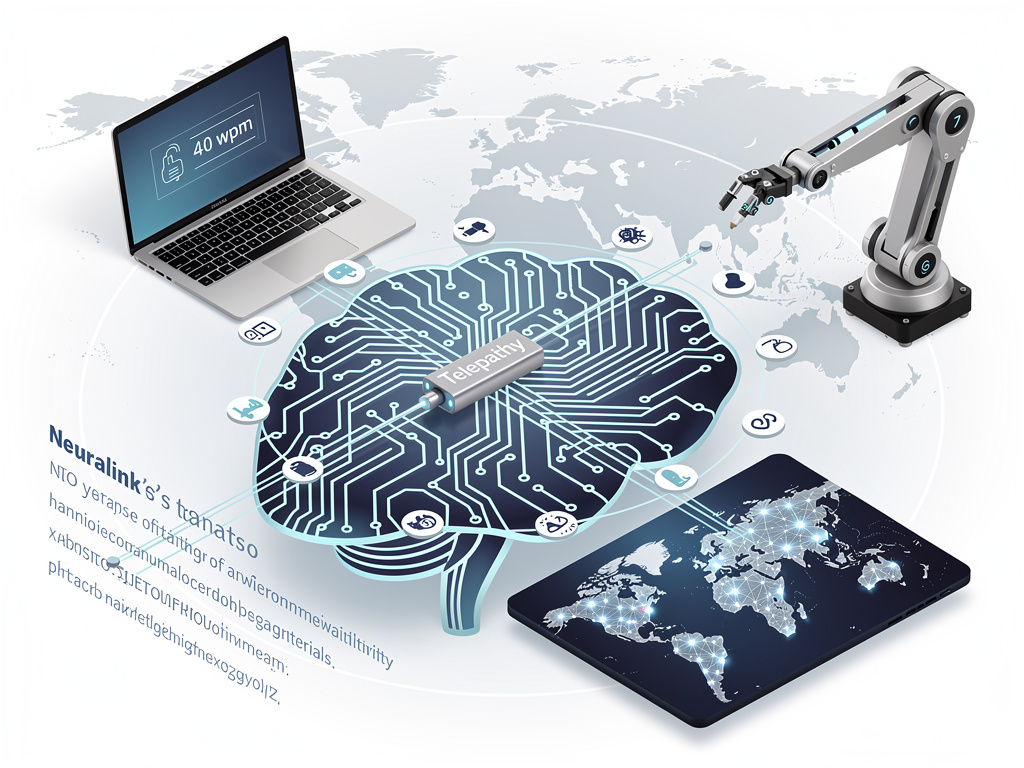
Two years after implanting its first human brain chip, Elon Musk’s Neuralink has enrolled 21 participants in clinical trials worldwide, marking a pivotal acceleration in brain-computer interface technology. The company’s Telepathy implant now enables paralyzed individuals to control cursors, robotic arms, and digital keyboards solely through neural signals, with some achieving typing speeds of 40 words per minute and information transfer rates exceeding 10 bits per second in their first week. This milestone, detailed in Neuralink’s latest update, underscores a shift from experimental proofs to practical restoration of autonomy for those with spinal cord injuries and ALS.
The journey began in January 2024 at Barrow Neurological Institute in Phoenix, Arizona, with Noland Arbaugh, the first recipient, who suffered a paralyzing spinal cord injury a decade earlier. Today, Neuralink reports zero serious device-related adverse events across participants, while signal quality has improved in 18 of the 20 most recent cases. As trials expand globally—including sites in Canada, the UK, and beyond—the focus remains on decoding brain variations to refine hardware and surgery.
Pioneering Implants Restore Daily Independence
Noland Arbaugh, now pursuing a neuroscience degree, uses Telepathy to study math, read, and learn languages. ‘I can’t even begin to describe how happy I am to be back in school. Not just passing my classes, but doing it in style. This is literally the best semester of college (grades-wise) I’ve ever had,’ he said, crediting the implant for anticipating his intentions faster than conscious thought (Neuralink). His experience revealed early thread retraction issues, prompting surgical enhancements that boosted performance in subsequent users.
Nick, paralyzed for four years, hit over 10 bits per second—surpassing able-bodied mouse users—while telepathically operating robotic arms to feed himself and gesture naturally. ‘The thoughts at that point were not forward, up, down, back. The thoughts were I’m holding a cup and I’m gesturing,’ he described. Sebastian, a 23-year-old medical student injured two years ago, logs up to 17 hours daily on lectures and annotations, ditching voice commands for seamless multitasking.
Audrey, the first female Neuralnaut with a 20-year-old spinal injury, crafts intricate abstract art despite prior limited computer skills. ‘My mind feels a little free. A little less in a box or shoved in a room all the time. It’s very freeing actually,’ she shared. Her online-recognized works signal Telepathy’s creative potential (Neuralink).
ALS Patients Redefine Communication Boundaries
For ALS sufferers like Jake and Brad, Telepathy maps imagined finger movements to keyboards, enabling 40 words-per-minute typing from unilateral implants capturing bilateral signals. Jake supports Neuralink’s mind-based keyboard development, while Brad swivels a 360-degree wheelchair camera to watch his son’s robotics competitions. ‘I want the world to see ALS not merely as a tragic endpoint, but as an opportunity for profound growth and innovation that highlights human resilience,’ Brad stated (Neuralink).
Neuralink’s PRIME study, approved by the FDA in May 2023, targets quadriplegia from cervical spinal cord injuries or ALS. By September 2025, 12 participants logged over 15,000 hours of use, per Elon Musk’s reports (Wikipedia). Reuters confirmed the jump to 21 enrollees as of January 28, 2026, two years post-first implant, with expansion to Canada via Health Canada approval in November 2024 (Reuters).
The company now eyes the VOICE trial for 140 words-per-minute speech restoration by targeting brain regions for vocalization, building on current feats. TeslaNorth.com highlighted Nick’s robotic feats and Audrey’s art ambitions amid this scale-up (TeslaNorth.com).
Hardware Evolution Tackles Brain Variability
Telepathy’s N1 implant deploys up to 1,000 electrodes on flexible threads, surgically placed by a precise robot to minimize cortical damage—threads are 4-6 microns wide, akin to a red blood cell. Early challenges like thread retraction, linked to anatomy and ALS progression, spurred mitigations: real-time surgical adjustments for brain variations and plans to triple electrodes to 3,000 while boosting retention mechanically.
Future surgeries may pierce the dura mater directly for less invasiveness. Neuralink’s timeline shows three participants in 2024 ramping to multiple monthly in 2025, with 21 now active. Safety remains pristine, aiding regulatory nods for international growth, including UK partnerships with University College London Hospitals.
All Health Tech noted 2025 expansions to Canada, UK, Germany, and UAE, targeting 20-30 more by year-end, alongside robotic limb integrations via Tesla’s Optimus (All Health Tech). Wikipedia details the PRIME study’s evolution, from Noland’s implant to Alex’s in August 2024 (Wikipedia).
Global Trials Signal Broader Ambitions
Beyond Telepathy, Neuralink prepares Blindsight for vision restoration—FDA Breakthrough Device in June 2025—and trademarks like Telekinesis hint at device control expansions. Musk envisions symbiosis with AI, starting with medical needs. X posts from Neuralink celebrate the 21 Neuralnauts driving BCI forward, with users like @iam_smx amplifying the milestone.
Challenges persist: ethical scrutiny over animal testing and trial transparency, as Physicians Committee for Responsible Medicine raised in 2022, though USDA cleared Neuralink. FDA weighs benefits against risks for pivotal trials needing 20-40 patients, per MIT Technology Review (MIT Technology Review).
Competitors like Synchron advance stent-based BCIs, but Neuralink’s high-channel count promises superior bandwidth. With $650 million raised at $9 billion valuation, per All Health Tech, Neuralink accelerates toward commercial viability.
Participant Voices Fuel Momentum
Neuralnauts’ real-world impacts—from Noland’s academics to Brad’s family moments—validate progress. As trials scale, data refines universal applicability, promising not just restoration but enhancement. Neuralink’s two-year mark positions it at neurotech’s forefront, transforming paralysis into possibility.


 WebProNews is an iEntry Publication