
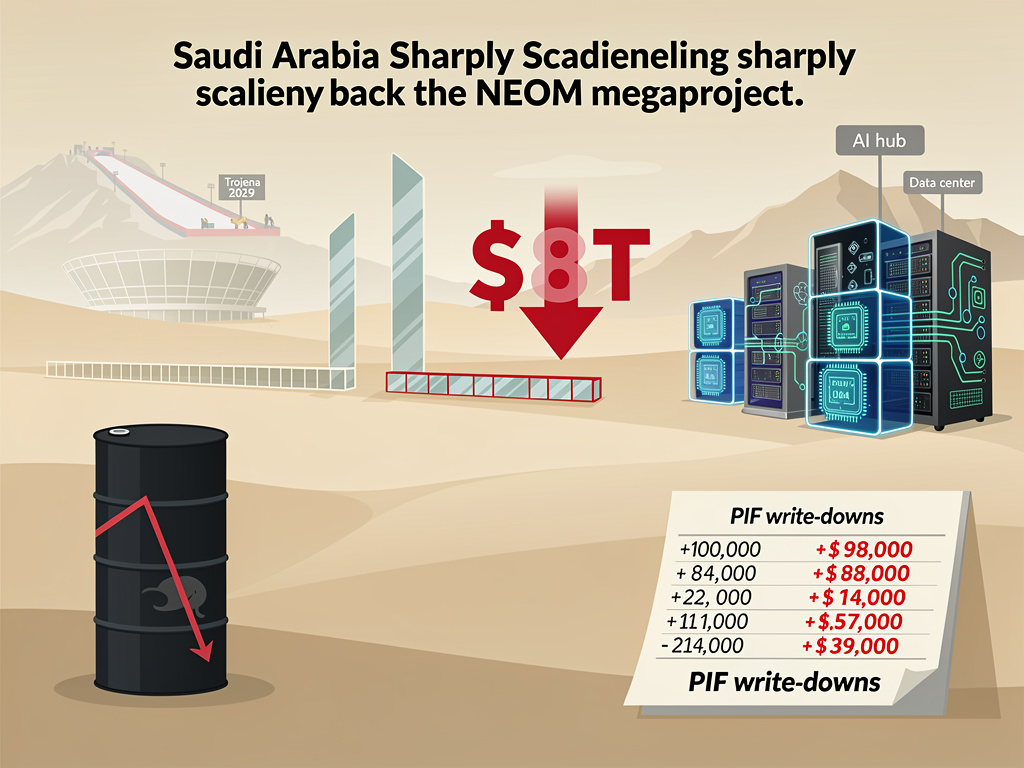
Saudi Arabia’s audacious NEOM megaproject, once heralded as a $500 billion beacon of futuristic urbanism, faces a stark recalibration. A year-long internal review nearing completion has prompted Riyadh to slash ambitions for the Red Sea coastal development, transforming Crown Prince Mohammed bin Salman’s vision into a more modest endeavor amid mounting delays, ballooning costs, and fiscal pressures. The Financial Times first detailed the pivot, citing insiders who described a shift toward practicality over grandeur.
Launched in 2017 as the crown jewel of Vision 2030, NEOM spans 26,500 square kilometers—larger than Belgium—and promised everything from a 170-kilometer linear city called The Line to ski resorts and industrial hubs. Owned by the kingdom’s Public Investment Fund (PIF), which manages nearly $1 trillion in assets also chaired by the crown prince, the project aimed to diversify Saudi Arabia’s oil-dependent economy. Yet, subdued oil prices hovering around $60 a barrel, coupled with commitments for Expo 2030 and the 2034 World Cup, have squeezed liquidity, forcing a reassessment.
People briefed on the review told the FT that changes reflect ‘a growing willingness within the Saudi system to adapt plans to economic realities, rather than persist with projects that are no longer viable at their original scale.’ NEOM’s new CEO Aiman al-Mudaifer initiated the probe after predecessor Nadhmi al-Nasr’s exit in November 2024, with conclusions expected by early 2026.
The Line’s Dramatic Shrinkage
The Line, NEOM’s signature 170-kilometer mirrored megacity designed for nine million car-free residents, exemplifies the retreat. Originally slated for phased completion with residents by 2025 and 1.5 million by 2030, plans have withered. By late 2025, only a 2.4-kilometer section stood partially built, with no inhabitants, per RP Realty Plus. Bloomberg reported in 2024 that officials now target fewer than 300,000 residents by decade’s end, down from millions.
Financial Times investigations revealed deeper woes: costs escalated from $1.6 trillion to $8.8 trillion, defying physics and finance. Construction stalled after $50 billion spent, leaving desert trenches and pilings. A senior construction manager deemed it ‘uninvestible,’ while foreign investments failed to materialize despite overtures to wealthy Saudi families. Satellite imagery showed work halting on key sites like the airport and spine.
NEOM insists The Line remains a ‘strategic priority,’ reimagined as a modest project leveraging existing infrastructure, potentially as an AI data center hub. ‘We are always looking at how to phase and prioritise our initiatives to align with national objectives and long-term value creation,’ the company told the FT.
Trojena and Other Components Falter
Trojena, the planned year-round ski resort in NEOM’s mountains, suffered a blow when Saudi Arabia indefinitely postponed the 2029 Asian Winter Games it was to host, as announced by the Olympic Committee and Olympic Council of Asia. ABC News linked the decision to fiscal strains, noting it reflects pressure on Vision 2030’s sports portfolio funded by PIF. Trojena will now stage standalone events, per ABC News.
Oxagon, the octagonal logistics and industrial port, faces delays too, with construction barely underway by mid-2025. Sindalah, a luxury island resort, held a 2024 opening party but remained closed to the public months later, triple its budget and years behind schedule, according to The Independent. PIF wrote down $8 billion on NEOM-linked projects in 2025, signaling distress.
Workforce cuts loom large: NEOM aims to slash headcount to one-third, relocating over 1,000 staff to Riyadh for oversight, as Semafor reported and Newsweek echoed. New contracts dried up by 2025, absent from the pre-budget statement, per Wikipedia’s compilation of reports including the Wall Street Journal’s audit revealing ‘evidence of deliberate manipulation’ by managers.
Fiscal Pressures Reshape Vision 2030
PIF, under scrutiny to deliver returns, redirects toward AI, data centers, logistics, minerals, and tourism, deprioritizing giga-projects amid gigaproject delays, Reuters noted. Investment Minister Khalid Al Falih urged scaling back state spending to invite private capital wary of risks. NEOM advisory board member Ali Shihabi affirmed adjustments before projects become ‘structural liabilities.’
Historical context underscores the shift: Early denials came from Economic Minister Faisal F. Alibrahim in 2024, insisting no scale change. Yet phased builds—from 20 modules to three by 2023—betrayed slippage. Crown Prince Mohammed bin Salman, in a 2023 Discovery documentary, dismissed skeptics: ‘They say in a lot of projects that happen in Saudi Arabia, it can’t be done, this is very ambitious.’ Now, a multi-generational timeline emerges, with full Line possibly by 2045 or later.
Human costs compound scrutiny: Human Rights Watch documented migrant worker abuses, with over 21,000 deaths or disappearances under Vision 2030 per ITV. A Pakistani engineer’s death went uninvestigated, Middle East Eye reported. Forced displacements razed villages, drawing BBC ire over security forces allegedly ordered to kill resisters.
Pivot to Pragmatism
NEOM eyes hydrogen production and green energy as enduring pillars, with solar-wind farms powering ambitions despite Oxagon lags. At Davos 2025, Deputy CEO Rayan Fayez emphasized risk appetite for tech tests, per New Civil Engineer. Concrete factories commissioned for 20,000 cubic meters daily signal selective progress.
Critics like Imperial College’s Mike Cook called it a ‘crackpot idea,’ while FT’s interactive probe detailed unraveling. The Nation decried it as ‘bullshit’ propped by Western firms like AECOM chasing fees. Still, CEO Jerry Inzerillo of related Diriyah framed The Line as a ‘laboratory for 2040 quality of life.’
For industry insiders, NEOM’s retreat tests megaproject viability in a post-oil era. Riyadh’s adaptability—canceling or altering as MBS once pledged for public interest—may salvage value, positioning Saudi Arabia in AI and renewables. Yet the desert mirage fades, leaving questions on Vision 2030’s trillion-dollar bets.


 WebProNews is an iEntry Publication