
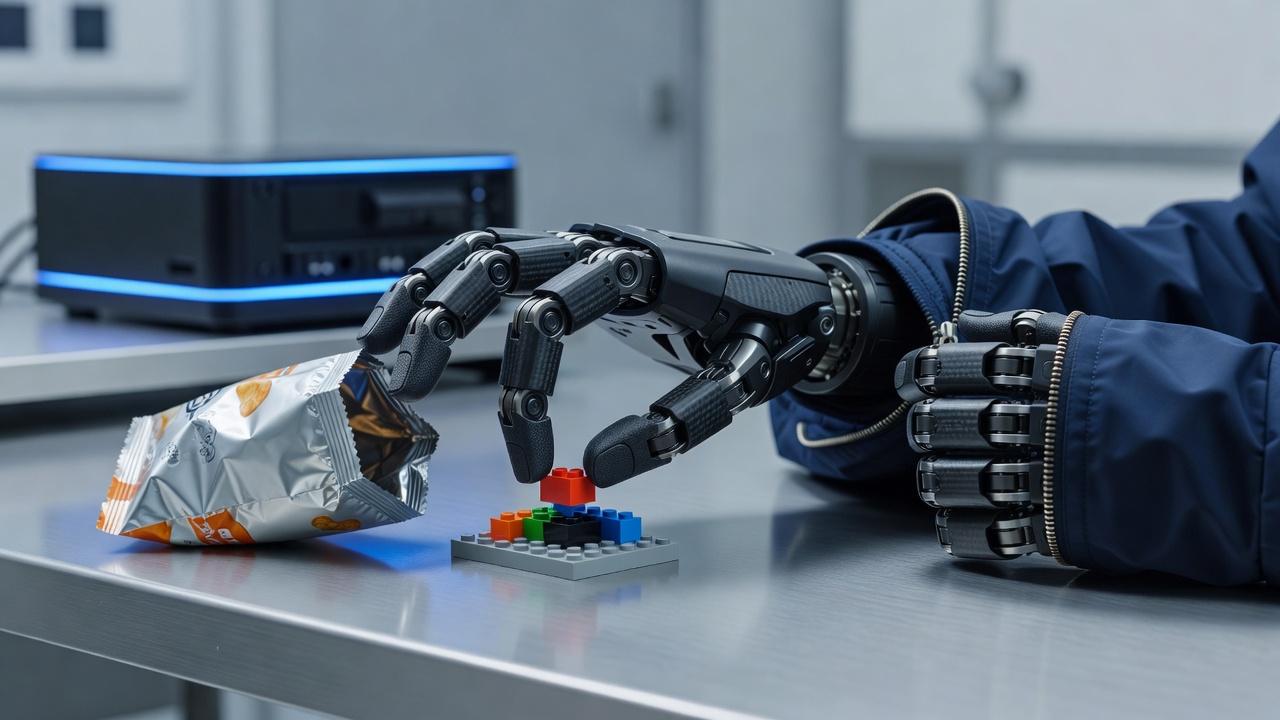
Researchers at a California-based robotics lab have achieved a significant advance in robotic dexterity by developing a pair of hands capable of performing everyday manual tasks with surprising competence. The system, known as Neo, can snap together Lego bricks, unzip a jacket, open a bag of Funyuns, and handle a range of other objects that once seemed far beyond the reach of machines. Details of the project appear in a recent TechRadar article that captures both the technical accomplishment and the uneasy feelings many people experience when watching these machines at work.
The Neo hands rely on a combination of improved mechanical design and sophisticated learning methods. Each hand features 20 degrees of freedom, allowing individual finger joints to move with precision that approaches human capability. Tactile sensors embedded across the palms and fingertips provide continuous feedback about pressure, texture, and slip. This sensory information feeds directly into a neural network trained through thousands of hours of simulation followed by real-world refinement. The training process involved both imitation learning, where the system copied human demonstrations, and reinforcement learning that rewarded successful completion of progressively harder tasks.
One of the most striking demonstrations shows the robot assembling a small Lego set. The fingers locate individual pieces, align them with the correct orientation, and press them together with exactly the right amount of force. Previous robotic systems often crushed plastic bricks or failed to connect them because they could not sense when contact had been made. Neo avoids that problem by adjusting its grip moment by moment based on the tactile data streaming from its sensors. The same sensitivity lets the hands grasp a flexible chip bag, locate the sealed edge, and tear it open without scattering the contents across the table.
Unzipping a jacket presents different challenges. The robot must first pinch the tiny zipper pull between thumb and forefinger, then coordinate a steady pull while the other hand holds the fabric taut. Any sudden movement or incorrect angle causes the zipper to jam. The Neo system manages this sequence by breaking the motion into dozens of micro-adjustments, each informed by the resistance felt through its fingertips. Observers note that the motion looks almost thoughtful, as though the machine is carefully considering each step rather than executing a pre-programmed routine.
Engineers behind the project emphasize that success came from focusing on contact-rich manipulation rather than trying to copy every nuance of human anatomy. Instead of building hands with dozens of tiny bones and muscles, they concentrated on reliable actuators and high-resolution sensing. The result is a pair of hands that look somewhat alien, with exposed wiring and metallic joints, yet perform actions that feel remarkably lifelike. This practical approach contrasts with earlier efforts that prioritized appearance over function and often produced machines too fragile for real use.
The software side of Neo relies on a transformer-based architecture similar to those powering modern language models. In this case, the model processes streams of visual and tactile information to predict the next best action. Training required careful curation of data to avoid the robot learning harmful shortcuts, such as using excessive force that might damage objects or itself. Researchers introduced variations in lighting, object placement, and surface friction to ensure the system could generalize beyond the laboratory environment. The final model demonstrates an ability to recover from mistakes, such as when a Lego brick slips, by immediately adjusting its grip and trying again.
Public reaction to these videos has been mixed. Some viewers express excitement at the prospect of robots helping with household chores or assisting people with limited mobility. Others feel a sense of unease watching mechanical fingers manipulate objects once thought to require uniquely human touch. The TechRadar piece captures this tension, describing the difficulty of deciding whether to feel thrilled by the technical achievement or unsettled by how quickly machines are acquiring skills once considered safe from automation.
This discomfort has deep roots. Throughout history, people have worried about machines replacing human labor, from the Luddites fearing textile mills to modern concerns about self-driving cars. What distinguishes the current moment is the rapid progress in areas once considered too subtle for machines: folding laundry, tying shoelaces, or gently handling fragile items. Neo’s ability to open a bag of snacks may seem trivial, but it represents mastery of the unpredictable physical world where every object behaves slightly differently.
The research team plans to integrate the hands with larger robotic platforms, including mobile bases that can navigate homes and offices. Early tests show promise, though challenges remain in coordinating whole-body movement with fine finger control. Power consumption presents another hurdle; the current hands require significant energy to maintain precise control over many motors simultaneously. Future versions will need more efficient actuators and better battery technology before they can operate for extended periods without tethering.
Beyond the laboratory, companies in logistics and manufacturing have already expressed interest. Tasks that involve sorting irregular packages or assembling products with varied components have long resisted full automation. Neo’s technology could reduce the need for human workers to perform repetitive, physically demanding work while improving consistency and reducing injury rates. At the same time, questions arise about the impact on employment in sectors that depend on manual dexterity.
Educational applications also appear promising. Robots that can demonstrate physical skills might help teach children or adults with learning differences by providing patient, repeatable examples of tasks like buttoning shirts or using utensils. Medical settings could benefit from robotic assistants capable of delicate procedures or helping patients regain motor function through guided practice.
Ethical considerations accompany every advance in this field. The ability to manipulate objects with human-like competence raises issues of safety and accountability. What happens if a robot misjudges force and injures someone? How do we ensure these systems remain under meaningful human control? Researchers stress the importance of transparency in how these models make decisions, though the complexity of neural networks makes complete explainability difficult.
The sensory capabilities of Neo also open possibilities for remote operation in dangerous environments. Emergency responders could direct similar hands to search collapsed buildings or handle hazardous materials while staying at a safe distance. The same technology might assist in space exploration, where delicate repairs on satellites or scientific instruments require precision beyond current robotic arms.
Despite the impressive demonstrations, significant limitations remain. Neo still struggles with tasks that require long-term planning or adaptation to completely novel situations. The system performs best when working with objects it has encountered during training. Completely unfamiliar items or unexpected changes in the environment can cause confusion. Human hands also possess an extraordinary ability to improvise, using the back of a finger or even an elbow when necessary. Replicating that flexibility will require additional advances in both hardware and control systems.
The pace of progress suggests these challenges may not persist for long. Similar leaps have occurred in computer vision and natural language processing, where systems that once failed at simple tasks now exceed human performance in specific domains. Robotics appears to be following a comparable trajectory, driven by better sensors, faster computing, and more sophisticated learning algorithms.
As these machines grow more capable, society will need to consider how to integrate them responsibly. The sight of robotic fingers unzipping a jacket or carefully stacking Lego bricks triggers reactions that go beyond technical assessment. These responses reflect deeper questions about what it means to be human and what kinds of work we want to reserve for ourselves. The TechRadar coverage effectively highlights this emotional dimension, reminding readers that technical breakthroughs carry cultural weight as well.
Engineers continue refining the system, adding new tasks to its repertoire while improving reliability. Each successful demonstration expands the boundary of what machines can do with their hands. The gap between robotic and human dexterity narrows steadily, bringing both opportunities for assistance and difficult choices about the future of work and human identity. Whether one feels thrilled or terrified may depend on how these powerful new capabilities are directed in the years ahead. The hands themselves remain neutral instruments, ready to build, open, or assist according to the instructions they receive and the values embedded in their design.


 WebProNews is an iEntry Publication