
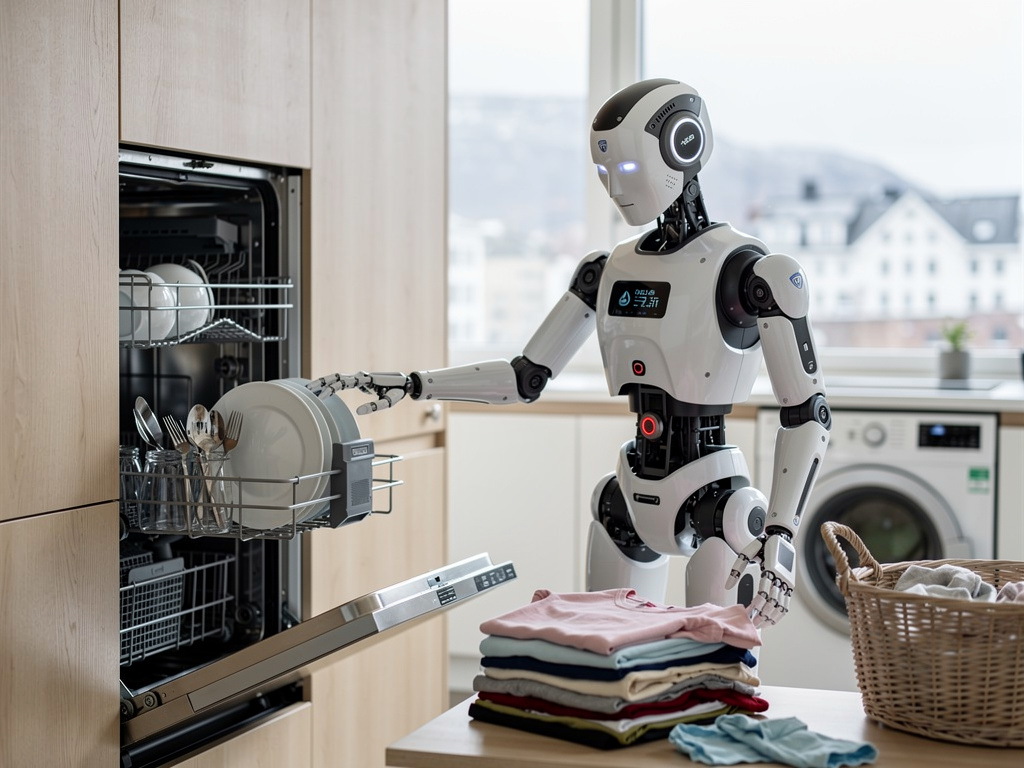
A humanoid robot just folded a shirt, loaded a dishwasher, and sorted groceries — all without human intervention. That’s the pitch from 1X Technologies, the Norwegian robotics company backed by OpenAI, which recently unveiled a new demo of its NEO Gamma robot performing household chores with striking fluidity.
The video, first covered by Digital Trends, shows NEO Gamma operating autonomously in what appears to be a real home environment. No teleoperation. No scripted movements. The robot picks up clothes from a hamper, folds them on a table, places dishes into a dishwasher, and even handles delicate items like eggs without crushing them.
Why NEO Gamma Matters Right Now
The humanoid robotics race has intensified dramatically over the past 18 months. Tesla’s Optimus, Figure’s 02, Agility Robotics’ Digit, and Boston Dynamics’ Atlas have all grabbed headlines. But most demonstrations have focused on warehouse logistics or industrial tasks. 1X is making a different bet — that the first mass-market application for humanoid robots is inside your home.
And the timing is deliberate. 1X Technologies closed a $100 million Series B round in January 2024, led by EQT Ventures with participation from OpenAI’s startup fund, Samsung NEXT, and others. The company has been clear about its intent: build affordable, safe robots designed for domestic spaces, not factory floors.
NEO Gamma stands about 5 feet 5 inches tall and weighs roughly 66 pounds. That’s intentionally lightweight. The company designed it to be physically comparable to a human so it can operate in spaces built for people — kitchens, living rooms, hallways — without requiring environmental modifications. Its body is soft and compliant rather than rigid, a safety-first design philosophy that reduces risk of injury during close human interaction.
Here’s what separates this demo from the usual robotics sizzle reel: 1X claims NEO Gamma is powered entirely by learned neural networks, not pre-programmed routines. The robot supposedly learns tasks through a combination of simulated training and real-world data, an approach that mirrors how large language models are trained but applied to physical manipulation.
Big if true.
The Technical Reality Check
Skepticism is warranted. Robotics demos have a long history of looking better on camera than they perform in practice. Controlled environments, favorable lighting, pre-arranged objects — all of these can inflate perceived capability. 1X hasn’t published peer-reviewed benchmarks for NEO Gamma’s success rates on household tasks, and the company hasn’t disclosed how many takes were needed for the demo footage.
But independent observers have noted real progress. IEEE Spectrum has tracked 1X’s development closely and noted that the company’s earlier robot, EVE, was already deployed in commercial security applications in Norway. That operational track record lends some credibility to the claim that NEO Gamma isn’t purely aspirational.
The broader challenge remains manipulation dexterity. Folding laundry is notoriously difficult for robots because fabric is deformable, unpredictable, and varies wildly in shape and texture. The fact that NEO Gamma appears to handle it — even imperfectly — suggests meaningful progress in tactile sensing and motor control.
So where does this actually go?
1X has stated its goal is to eventually produce NEO robots at scale for consumer pricing, though it hasn’t committed to a specific retail price or launch date. The company is currently building a new manufacturing facility and expanding its AI training infrastructure. CEO Bernt Øivind Børnich has spoken publicly about wanting to make robots as common as smartphones, a vision that’s ambitious bordering on audacious given current manufacturing costs for humanoid platforms.
Competition is fierce. Figure AI raised $675 million at a $2.6 billion valuation in early 2024, with backing from Jeff Bezos, Microsoft, and NVIDIA. Tesla continues to iterate on Optimus with the advantage of existing manufacturing scale. Chinese companies like Unitree are pushing aggressively on price, with humanoid robots already listed below $20,000.
The differentiator for 1X may come down to software, not hardware. If its neural network-driven approach to task learning proves generalizable — meaning the robot can adapt to new chores without extensive retraining — that’s a genuine competitive advantage. Hardware can be copied. Generalizable embodied intelligence is much harder to replicate.
What Industry Professionals Should Watch
Three things. First, whether 1X releases reproducible benchmarks for NEO Gamma’s task completion rates in unstructured environments. Second, manufacturing timeline and unit economics — consumer humanoid robotics won’t happen at $150,000 per unit. Third, how quickly competitors like Figure and Tesla close the gap on domestic applications, which have historically taken a backseat to industrial use cases.
The home robotics market is coming. The question isn’t if. It’s who gets there first with something that actually works reliably enough for people to trust it in their kitchen. NEO Gamma is a compelling proof of concept. But proof of concept and product-market fit remain very different things.


 WebProNews is an iEntry Publication