
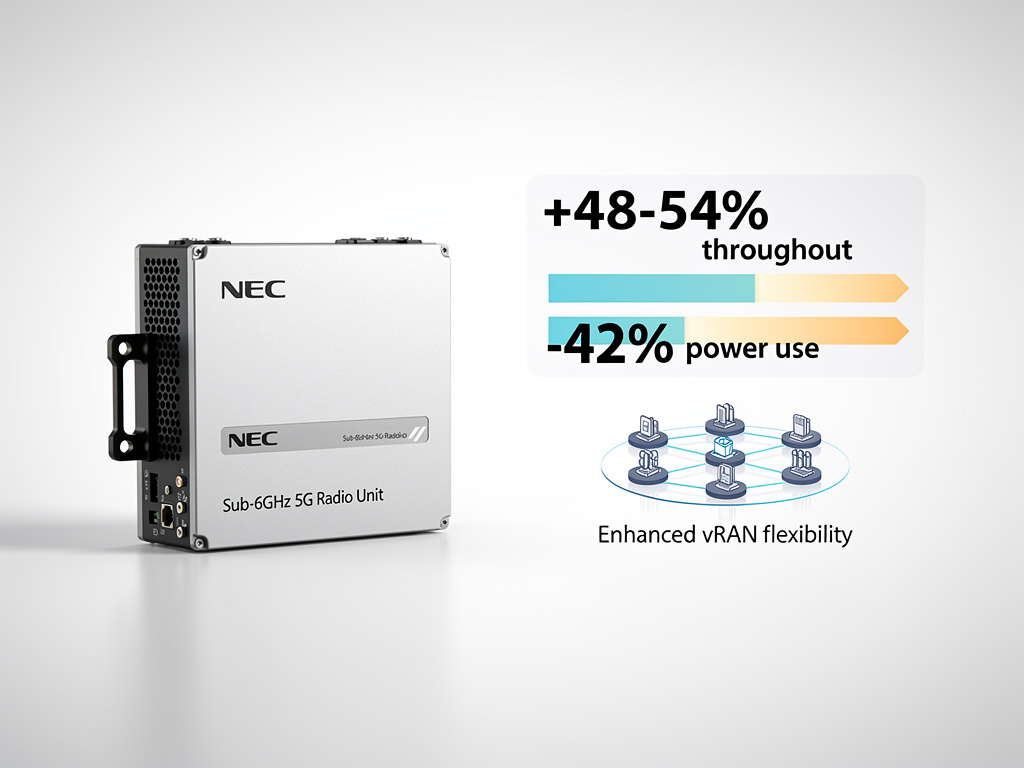
TOKYO—NEC Corporation unveiled a new Radio Unit for 5G Sub-6GHz base stations on January 23, 2026, promising substantial gains in communication speed, size reduction and power savings at a time when the Japanese vendor faces intensifying global competition in radio access networks.
The device, incorporating Massive MIMO technology, marks a successor to NEC’s existing integrated antenna RU. Simulations show it boosts average user throughput by about 48% on the uplink—potentially rising to 55% with software upgrades—and 54% on the downlink compared to the prior model, according to details from NEC’s press release. NEC plans a Japan launch in the first half of fiscal 2026 after carrier trials, with international variants following in the second half to align with diverse standards.
Technical Leaps in Efficiency and Design
Power draw drops 42% to 315 watts in normal use and 30% to under 630 watts at peak, versus the current unit. Volume shrinks 23% to 23.6 liters or less, weight falls 33% to 16 kilograms or lighter, enabling fanless operation and single-person installation. These changes address surging data traffic and demands for greener infrastructure, as NEC noted in its announcement.
The RU employs multi-user MIMO for concurrent links with numerous devices via beamforming, suiting high-density or mobile scenarios. Paired with NEC’s virtualized RAN, it stretches fronthaul reach from 30 kilometers to 40 kilometers through delay compensation software, aiding flexible deployments in data centers or urban sites and cutting capital costs.
Strategic Rollout and Showcase Plans
NEC, with over 50,000 Massive MIMO units shipped since 2020 across Japan and abroad, will demonstrate the RU at MWC Barcelona 2026 from March 2 to 5. Some underlying tech stems from a National Institute of Information and Communications Technology grant. TelecomLead highlighted its role in tackling mobile data growth and energy needs.
Telecompaper reported the Sub-6GHz focus positions it for dense coverage, contrasting millimeter-wave’s shorter range. This builds on NEC’s 5G legacy, including O-RAN compliant RUs shipped to NTT Docomo since 2019, as detailed in prior NEC releases.
Context of NEC’s 5G Challenges
While innovative, the timing comes amid NEC’s scaling back overseas 5G ambitions. Light Reading noted in January 2026 that NEC retreated from aggressive targets, slashing non-Japan 5G sales forecasts to 31 billion yen ($210 million) for fiscal 2026 from 85.4 billion yen, signaling open RAN hurdles against giants like Ericsson and Nokia.
Earlier partnerships underscore NEC’s open ecosystem push, such as interoperability tests with Docomo using O-RAN specs and Samsung gear in 2020, per NEC announcements. Rakuten Mobile has leaned on NEC for 5G radios, though its network growth lags, as Light Reading analyzed in 2025.
Implications for Operators and Rivals
For carriers, the RU’s vRAN synergy promises optimized resource use amid fluctuating loads, potentially lowering opex. ACN Newswire echoed NEC’s emphasis on Massive MIMO for spatial multiplexing beyond 4G limits. Fujitsu and NEC’s joint post-5G interoperability work with NEDO funding further signals Japan’s collaborative edge, according to Fujitsu.
NEC’s vRAN commercialization in 2025, targeting 50,000 units by fiscal 2026 with Qualcomm’s Dragonwing, integrates here; Gerardo Giaretta, VP and GM of 5G RAN Infrastructure at Qualcomm, praised the progress in a NEC statement. Yet, Dell’Oro notes open RAN may hit just 15-20% market share by 2027, pressuring specialists like NEC.
Path Forward in Competitive Arena
Verification with unnamed carriers precedes rollout, with global tweaks for standards compliance. NEC’s history—from 2019 O-RAN RU development (NEC) to 2021 higher-output units (TelecomLead)—positions this RU as a refinement. As 5G evolves toward standalone and private networks, such efficiencies could help NEC reclaim momentum despite prior setbacks.


 WebProNews is an iEntry Publication