
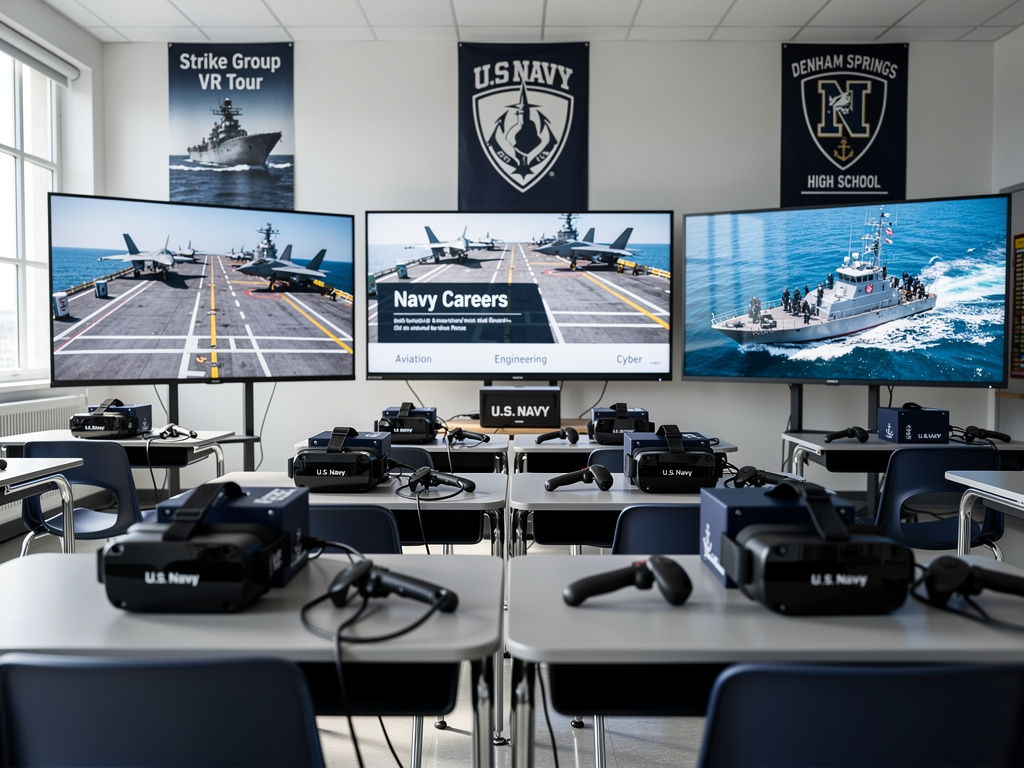
In the hallways of Denham Springs High School, ninth-graders Jairo Diaz and Riley Carson traded their textbooks for VR headsets, stepping into simulated Navy worlds that felt startlingly real. The U.S. Navy’s mobile mixed-reality setup arrived on January 27, 2026, transforming recruitment into an interactive spectacle designed to captivate Gen Z amid fierce competition for talent. Navy recruiter Tarsha Fabre, who enlisted right after high school, spearheaded the event, emphasizing hands-on exposure over pamphlets. “Showing the kids exactly what we have to offer rather than whenever I’m working in the school and just giving them the information they can have a hands-on learning experience,” Fabre told WAFB.
Diaz, previously uninterested in military service, gripped the controls of a boat simulator and marveled at the immersion. “The graphics and stuff make you feel like you’re actually there. It was fun I enjoyed that quite a lot,” he said. Carson echoed the thrill: “The boat simulator is pretty cool. It’s just a lot of technology I never really get to see that much.” The setup let students “see themselves in the Navy,” performing tasks on an aircraft carrier and exploring fields like nuclear engineering, aviation, special operations, and medicine—options Fabre touted as unmatched. “This is the one sector that actually offers a variety compared to any other military branch or private sector,” she added.
From Denham Springs to National Rollout
The Denham Springs visit formed part of the Navy’s “Strike Group” experience, a traveling exhibit hitting high schools nationwide to showcase STEM-driven careers. Similar events unfolded at Braswell High in Little Elm, Texas, where students donned Meta Quest headsets to simulate flight deck operations on carriers, as reported by Denton Record-Chronicle. Junior Alan Hernandez navigated virtual welding repairs underwater, noting the challenge: “It took a minute to find my bearings in the virtual reality scene.” Recruiter Electrician’s Mate Second Class Zalatiel Becerra oversaw the demos, blending gaming with real-world naval skills.
In Livingston Parish, the Navy previewed STEM paths through interactive challenges and personality quizzes matching students to roles, according to WBRZ. The mixed-reality rig, set for Covington, Louisiana, on Thursday after Denham Springs, underscored a mobile strategy reaching underserved areas. Fabre reflected on her own path: “I joined the Navy right after graduation and I just kind of had to find the information myself and that this was available to me.”
VR’s Proven Edge in the Recruiting Arena
The Navy’s VR push traces to 2016, when the “Nimitz” tractor-trailer—named for the famed carrier—began touring with Oculus Rift pods. Housing eight stations, it processed 60 users hourly at events like Fleet Weeks and air shows. Early results stunned: a 48% lead increase at Aspen’s Winter X Games and 126% at the Army-Navy game, per a case study from Virtual Reality Marketing. Within two months, leads doubled prior years’ totals.
By 2017, USA Today tester Edward C. Baig described piloting a SWCC boat for SEAL extractions: “I felt the 360-degree Oculus experience was very much like being part of an engaging high quality video game, with the vibrations of the sub-pac lending an extra dose of realism.” Notably, 20% of “not interested” participants flipped post-demo, as USA Today detailed. The tech targeted STEM-savvy youth, aligning with 60 career fields.
Evolution to Mixed-Reality Strike Group
Fast-forward to 2025-2026: Strike Group upgraded to mixed reality, hitting schools like Thurston High in Oregon, where students flew helicopters and welded piers virtually using Meta Quest 3, per Register-Guard. West Coast tours emphasized STEM, despite federal shutdown hiccups. In Fresno, ABC30 covered Tulare Union High demos: “By developing this mobile attraction that really kind of uses the… cutting-edge technology and gamifies many of these tasks associated with the Navy, it’s just a way to really meet young people where they like to be in terms of gaming,” said VML’s Ken Woodmansee.
Maine’s Sanford High saw submarine navigation and drone piloting, bridging education and enlistment, as WebProNews noted. Edinburg High in Texas hosted pilot simulators during Navy Week, per KRGB. These efforts countered recruitment dips, with FY2025 seeing 40,600 enlistments—exceeding goals.
Tech Backbone and Broader Impacts
Powered by Oculus Rift, Meta Quest, and haptic feedback, VR simulates high-stakes ops safely. Early Nimitz missions mimicked river patrols; now, carrier deck teamwork and boat handling dominate. ARPost highlighted the trailer’s nationwide trek, boosting leads dramatically. Recruiters like Boise’s James Condon in 2017 told Idaho News: “They are always on their phones, so why not do something that they can relate to.”
Denham Springs students missing the event were directed to local recruiters, mirroring national calls-to-action. As FY2026 recruitment surges—with 14,111 in four months per USNI News—VR cements the Navy’s tech-forward pitch. For insiders, it’s a data-driven pivot: immersive demos yield qualified leads, sustaining an all-volunteer force amid private-sector rivalry.
Student Sparks and Future Waves
Reactions fuel momentum. Nease High’s Pedro Pedreiro topped F-35 sim scores, eyeing pilothood: “I was the F-35 pilot and I got the highest score,” per First Coast News. Braswell’s participants grappled with throttles: “It’s harder than I thought it would be,” said one. WAFB and WBRZ posts on X amplified the Denham Springs buzz, drawing local eyes.
Rear Adm. James P. Waters, Navy Recruiting Command head, framed it broadly: “From the depths of the sea to the heights of the stars, America’s Navy is the most highly skilled, technologically advanced military force in the world,” as cited in WIS-TV for a South Carolina event. For Denham Springs teens, VR cracked open unforeseen paths, proving simulators don’t just entertain—they enlist.


 WebProNews is an iEntry Publication